Independent comparisons. We may earn from shop links. More info

Masonry paint buying guide

Updated: 23 October 2026

You have a rendered wall or a tired garden pier, and the tin you are about to order may be the wrong size for the surface. This masonry paint buying guide settles what the wall will take, how many litres two coats need, when a stabiliser belongs on it, and whether a colour change is allowed. The eight-tin table stays on the [facade paint comparison](/hub/paints-and-varnishes/facade-paint). Peter F. updated this page on 23 October 2026 from amazon.co.uk listings and public UK sources, not a weathering lab. A purchase through our links may earn a commission at no extra cost to you.

You have a rendered wall or a tired garden pier, and the tin you are about to order may be the wrong size for the surface.

Our top picks

On this page

What the wall will accept

Name the substrate before the brand. A sound painted render is a normal recoat, and bare common or Fletton brick often is not. Dulux’s consumer Weathershield page and Sandtex’s smooth page both exclude those bricks, and Sandtex also names engineering bricks. The Dulux 7.5 litre listing only says walls, so that limit is not on the amazon.co.uk page. Trade guidance also says not to paint free-standing walls below the damp-proof course. Hollow or blown render is a repair, not a coat of paint. If the pebbles are an asbestos cement sheet, stop: the Health and Safety Executive’s a16 note says not to sand it or to attack it with aggressive prep. Once the wall is ordinary sound masonry, the next decision is litres, because texture changes the sum more than the logo on the tin.

Litres, not the biggest number on the tin

Buy for two coats at a rate that matches the texture, and treat a huge up-to figure as a ceiling on a smooth, low-porosity face. Dulux Trade’s smooth Weathershield data sheet, a Trade product and not the same tin as the 7.5 litre tub here, says up to about 16 m² per litre on smooth render and 4–6 m² per litre on pebbledash. A practical rule of thumb is closer to 10 m² per litre. A 4 m by 5 m elevation is 20 m². At 16 m² per litre, two coats are 2.5 litres. At 10 m² per litre they are 4 litres. The same 20 m² of pebbledash at 5 m² per litre is about 8 litres for two coats. A 2.5 litre tin can finish a pier and still run out on a dash gable. Stone quantities are on painting pebbledash. Three figures in this amazon.co.uk set are unsafe to multiply. Polar WallGuard is a 2.5 litre tin whose text talks about 5 litres covering 55 m² in one place and 80 m² in another. Sandtex Microseal Smooth black prints “EO 1 m² per coat”. Sandtex fine textured Plymouth Grey prints 50–60 m² per litre, while Sandtex’s own 2026 colour guide puts fine textured at up to 6.5 m² per litre. Dulux’s 7.5 litre listing is the coherent one in the set, at up to 15.2 m² per litre, and Leyland states about 10 m² per litre. Use those for a smooth wall, and the Trade pebbledash band when the stones are the surface.

Primer only when the face is powdery

Stabilising solution is for a face that stays dusty after you have brushed it, not for a hard render you are nervous about. UK guidance, including Bostik’s sheet for chalky masonry, points the sealer at friable surfaces and says to cure damp first. A sound wall gets a thinned first coat of the masonry paint if the tin says so, then a full second coat. Dulux Trade’s smooth sheet describes thinning about 1:5 on new bare sound faces, and stabiliser only if the surface is still powdery. Sealing a sound wall can trap moisture. Brush a dry patch. A white, chalky palm wants a masonry stabiliser, then the paint. A clean palm goes straight to two coats. None of the eight listings answers the primer question, so the tin you open still wins. Green growth needs a fungicidal wash and a dry-down before either.

Colour, pack and what this set costs

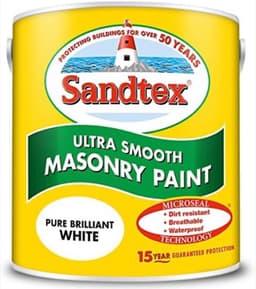
Price per litre, from the shelf prices captured for this comparison, is the honest way to compare packs that are not the same size. Dulux Weathershield smooth white, 7.5 litres at £32.52, is about £4.34 per litre. Sandtex fine textured Plymouth Grey, 5 litres at £29.90, is about £5.98. Leyland Granocryl white, 2.5 litres at £15.17, is about £6.07. Sandtex Ultra Smooth brilliant white, 2.5 litres at £15.95, is about £6.38. HQC’s racing green and light grey are both £54.95 for 5 litres, about £10.99 per litre. Sandtex black is £11.17 for 1 litre. Polar white is £36.99 for 2.5 litres, about £14.80. A whole white elevation wants the 7.5 litre tub. A pier is the 1 litre or 2.5 litre job, and Polar’s rate is hard to justify for ordinary render. Who the two white tins are for is on best exterior masonry paint. HQC’s shared reviews often find the shade only after a long stir, and Plymouth Grey has been called closer to off-white, so paint a board before a whole elevation. Leyland’s listing sets Is Waterproof to false, the level to water resistant, and a 10-year bullet beside a warranty field of No. The brand split is Sandtex vs Dulux Weathershield.

Questions before you open a tin

In England, the General Permitted Development Order 2015, Class C, allows exterior painting that is not an advertisement. Scotland is not that English order, listed-building consent is separate, and an Article 4 direction can take the right away in a conservation area. Changing a listed cottage from white to racing green is not the same act as refreshing the same white. Ask the planning authority before the first coat if you are unsure. The 2012 VOC Regulations cap water-borne coatings for exterior mineral walls at 40 g/l, and no ASIN here prints a figure you can check. A 10-year or 15-year line is a maker claim, and breathable on a bullet is not a BS EN 1062 class.

Common questions

What should I check before I buy masonry paint?
Check the substrate, the litres for two coats, the colour against a real sample, the pack, and whether the colour change needs consent. A sound painted render is a different buy from bare Fletton brick or pebbledash. Dulux and Sandtex publish a Fletton exclusion on their own pages even when the amazon.co.uk bullets stay vague. In this set, price per litre runs from about £4.34 to about £14.80.
How many litres do I need for a smooth rendered wall?
Use a smooth rate, then double it for two coats. Dulux Trade’s smooth sheet says up to about 16 m² per litre on low-porosity render, so a 20 m² wall is 2.5 litres for two coats at that ceiling and about 4 litres at 10 m² per litre. The 7.5 litre Dulux listing here says up to 15.2 m² per litre. Do not reuse a pebbledash rate for that sum.
Do I need a primer or a stabilising solution?
Only when the face is powdery or friable after you have brushed it. A sound wall takes the masonry paint itself, with a thinned first coat if the tin says so, not a sealer on every elevation. Stabilising a hard render can trap moisture. None of these eight listings answers the primer question on the page, so follow the tin you actually open and let the wall dry first.
Can I paint Fletton or common bricks?
Dulux’s Weathershield consumer page and Sandtex’s smooth page say no to common or Fletton bricks, and Sandtex also excludes engineering bricks. The amazon.co.uk tables here mostly do not repeat that sentence. Painting free-standing brick below the damp-proof course is a separate mistake, because that band is meant to dry. If your bricks are Flettons, this shelf is the wrong one.
Do I need planning permission to change the colour in England?
Exterior painting in England is generally permitted development under Class C of the 2015 Order, as long as it is not an advertisement. Listed-building consent still applies, and an Article 4 direction can remove the right in a conservation area. Scotland does not use that English class. Ask the council if the house is listed or the street is covered by an Article 4 direction before you move off the existing colour.
Is a 15-year claim a guarantee I can bank on?
No. Sandtex prints 15 years on the Ultra Smooth bullets and on its site, with conditions. Dulux’s consumer pages carry a long-life line that the 7.5 litre listing does not repeat. Leyland’s 10-year bullet sits next to a warranty field of No. We did not weather these tins, so judge the pack and the wall, not the year count.

Related pages

Sources

Public sources from the research digest, last checked on 22 October 2026. Shelf prices and star lines are the amazon.co.uk figures in the display file. The price band is this set, not a market average. No listing was lab-tested. The Dulux Trade sheet is not the same listing as the 7.5 litre tub.

  1. VOC in Paints, Varnishes and Vehicle Refinishing Products Regulations 2012, Schedule 2 (retrieved 22 October 2026)
  2. GPDO 2015, Class C, exterior painting (retrieved 22 October 2026)
  3. Richmond upon Thames conservation areas FAQ (retrieved 22 October 2026)
  4. HSE a16: painting asbestos cement (retrieved 22 October 2026)
  5. Dulux Weathershield smooth masonry paint (retrieved 22 October 2026)
  6. Dulux Weathershield FAQs (retrieved 22 October 2026)
  7. Dulux Trade Weathershield smooth masonry paint data sheet (retrieved 22 October 2026)