Independent comparisons. We may earn from shop links. More info

Osmo Decking Oil vs UV Protection Oil

Updated: October 2026

When the same project contains deck boards, cladding and a flat post cap, one attractive Douglas Fir tint can make two Osmo tins look interchangeable. They are not. In an Osmo Decking Oil vs UV Protection Oil decision, the controlling condition is surface orientation and use: choose Decking Oil 004 for walked-on decking and suitable outdoor furniture, and UV Protection Oil Extra 427 for appropriate vertical windows, doors, cladding and fencing. The [main Douglas fir oil comparison](/hub/paints-and-varnishes/douglas-fir-oil) contains the retained amazon.co.uk listings; this guide explains why a higher star average does not move 427 onto a flat deck. A qualifying purchase can earn a commission at no extra cost to you. We did not laboratory-test the tins.

When the same project contains deck boards, cladding and a flat post cap, one attractive Douglas Fir tint can make two Osmo tins look interchangeable. They are not.

Our top picks

On this page

Two product families, one decisive condition

Horizontal decking takes foot traffic, holds dirt and can retain water on its surface. A vertical board sheds water differently and is exposed to sunlight without being walked on. Osmo’s UK material reflects that difference: the Decking Oil page names decking and furniture, while the UV Protection Oil Extra page calls the product suitable for vertical exterior wood and says it is not recommended on flat surfaces such as decking. That distinction is stronger evidence than the Amazon averages. None is a durability sample, and the 427 row has no captured review text. The practical recommendation is conditional. Use 004 when the surface is a deck, step or compatible horizontal furniture component and the Douglas Fir colour is wanted. Use 427 on the specified vertical joinery when you want its lightly pigmented UV system and can apply two coats. For a complete deck treatment, see the Douglas fir decking oil guide.

What Decking Oil 004 is for

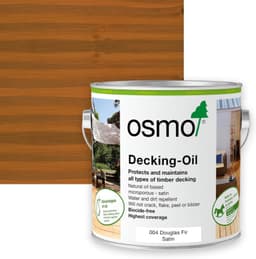
Decking Oil 004 is a transparent, satin Douglas Fir shade for exterior decking, furniture and similar joinery. Transparent here means that wood grain remains visible, not that the oil is colourless. The stated coverage is up to 24 m² per litre for one coat. A 2.5-litre tin consequently represents up to 60 m² for a single coat in stated conditions, before allowing for a second application, roughness or end grain. Two retained ASINs sit in this family. B0791DPWDH is a consistently described 2.5-litre 004 tin at £72.31. B0791DFWWN is a £23.82, 750 ml listing whose title combines “Teak” with “004 Douglas Fir”, although its colour field says Douglas Fir. The smaller pack should not be used as a proven 004 example until the seller confirms the exact label and shade. Clear Decking Oil 007 is not retained here. Osmo notes that a clear finish allows natural greying and lacks the same UV contribution as pigment.

What UV Protection Oil Extra 427 is for

UV Protection Oil Extra 427 is a satin, lightly pigmented Douglas Fir shade for vertical exterior timber. The named uses include windows, doors, cladding and fencing, with stated coverage of 18 m² per litre. The manufacturer claims UV protection factor 12 when two coats are applied. That factor should not be presented as a laboratory comparison against Decking Oil 004 or as a promise attached to one coat. Horizontal details within a vertical assembly still need drainage. Osmo’s product information calls for a fall of at least 15 degrees on relevant horizontal elements and rounded edges beyond 2 mm. A flat sill or post cap that holds water is not made suitable merely because it is attached to a fence or window. The “Extra” formulation uses biocides to protect the coating film outdoors. Under HSE terminology, a film preservative is not the same as a wood preservative intended to protect the timber itself. Product 427 therefore does not replace a structural timber-treatment specification, and it should not be moved indoors simply because the Douglas Fir tint is appealing. Choose it for its stated vertical use, coverage and tint, not because 4.6 is the largest number in the table.

What neither tin can claim

Neither product is a substitute for sound timber, suitable preservative treatment or construction that drains properly. Decking Oil does not repair soft boards, and UV Protection Oil does not correct a flat ledge that continuously holds water. Where decay, persistent moisture or structural movement is present, a competent timber or joinery professional should diagnose the substrate before it is coated. Neither listing provides a UK head-to-head longevity test. The 24 m²/L and 18 m²/L coverage figures describe different products on different surfaces, not a league table. Confirm the family and numerical shade on the physical tin, then make a trial patch. The Douglas fir oil buying guide explains the unresolved 750 ml title and pack economics, while the application guide covers weathering and moisture.

Common questions

Can I use UV Protection Oil Extra on decking?
Osmo’s UK product page says UV Protection Oil Extra is not recommended for flat surfaces such as decking. Use the appropriate Decking Oil system for walked-on horizontal boards. The 427 product’s higher Amazon average is based on three ratings and does not override its stated vertical use.
Can Decking Oil go on cladding, windows or doors?
Decking Oil is named for decking, furniture and similar exterior joinery, but that does not make it the specified UV system for every vertical component. For windows, doors, cladding and fencing, compare the current 427 instructions with the substrate and desired appearance. Complex or previously coated joinery may need professional assessment.
What does UV factor 12 mean here?
It is Osmo’s stated protection factor for UV Protection Oil Extra when two coats are used. Do not transfer the number to one coat, to Decking Oil 004 or to an unrelated test standard. Exposure, maintenance, detailing and the condition of the timber still affect performance.
Do the biocides make 427 a wood preservative?
No. The relevant biocides protect the coating film outdoors; HSE distinguishes that use from products intended to preserve the wood itself. Timber durability and structural treatment remain separate questions. Follow the safety label and do not use an outdoor biocidal coating indoors without an express instruction.
What should I do with a flat sill or post cap?
Treat it as a horizontal water-shedding detail, not automatically as vertical joinery. Osmo calls for at least a 15-degree fall on relevant elements in the UV system. If the piece is flat, traps water or cannot be detailed correctly, ask the manufacturer or a competent joiner which system and repair are appropriate.

Related pages

Sources

Public UK sources for the product pages, durability class, VOC limits, biocides and the description rule. Prices, stars and review counts are the amazon.co.uk figures in the research digest, not a live re-check.

  1. Osmo UK — Decking-Oil (retrieved 17 October 2026)
  2. Osmo UK — UV-Protection Oil Extra (retrieved 17 October 2026)
  3. Treatex — Douglas Fir Protection (retrieved 17 October 2026)
  4. TDCA — The Timber Cladding Handbook 2022 (retrieved 17 October 2026)
  5. Wood Protection Association — GN 10/12 (retrieved 17 October 2026)
  6. The Volatile Organic Compounds in Paints, Varnishes and Vehicle Refinishing Products Regulations 2012 (retrieved 17 October 2026)
  7. HSE — Biocides product types (retrieved 17 October 2026)
  8. Consumer Rights Act 2015, section 9 (retrieved 17 October 2026)