Independent comparisons. We may earn from shop links. More info

Douglas Fir Decking Oil for Boards and Furniture

Updated: October 2026

Horizontal deck boards face standing water, foot traffic and furniture movement in a way that vertical cladding does not. A Douglas fir decking oil therefore needs to be selected for a walked-on surface before you compare colour or Amazon ratings. The [main Douglas fir oil comparison](/hub/paints-and-varnishes/douglas-fir-oil) contains two Decking Oil listings and one UV Protection Oil listing. For a deck, the pigmented 004 family is the relevant choice; the 427 UV oil belongs on suitable vertical joinery and should not be promoted to deck finish because its small-sample star average is higher. A qualifying purchase can earn a commission at no extra cost to you. We did not laboratory-test the tins.

Horizontal deck boards face standing water, foot traffic and furniture movement in a way that vertical cladding does not.

Our top picks

On this page

What belongs on the deck boards

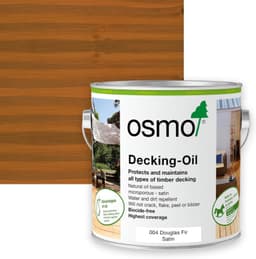
Osmo Decking Oil 004 is described for exterior decking, outdoor furniture and similar joinery. Its Douglas Fir shade is transparent and pigmented rather than an opaque paint, but “transparent” does not mean colourless. One captured review called the result orange or terracotta, while a reviewer of the smaller listing described a natural reddy brown. Timber colour, weathering, grain and application all affect the result, so test an offcut or hidden board and let it dry before committing. UV Protection Oil Extra 427 is a different family. Osmo positions it for windows, doors, cladding and fencing and says it is not recommended for flat decking. Its 4.6 Amazon average comes from only three ratings, with no captured review text, and cannot override that restriction. If your project combines deck boards with vertical screens, use the Decking Oil versus UV Protection Oil comparison to divide the surfaces correctly. Decking oil is not a structural preservative specification. A brush-on finish cannot repair decay, improve an unsafe substructure or compensate for trapped water.

Coverage, two coats and anti-slip

The 2.5-litre 004 listing states up to 24 m² per litre for one coat. Multiplying gives up to 60 m² from the tin for one coat under stated conditions, not 60 m² for a complete two-coat project. Rough boards, end grain, gaps and weathered fibres absorb more, while an existing compatible finish may change demand. Measure the actual board area, steps and exposed edges rather than relying only on the deck’s plan dimensions. Osmo’s sequence is a thin first coat, about 12 hours of drying with good ventilation, then a thin second coat. Do not use a heavy coat to save time: pooled oil can remain tacky, collect dirt and produce an uneven sheen. Where additional grip is wanted, Anti-Slip Decking Oil 430 is positioned as the second coat over coloured Decking Oil or a compatible woodstain. It is not the sole colour coat, because its own UV contribution is limited, and it is not the same product as 004. The detailed application guide covers preparation, moisture and trial patches.

Inspect the deck at least once a year

Osmo advises checking mechanically loaded areas at least annually and applying one maintenance coat when wear becomes visible on a sound surface. That is a minimum inspection rhythm, not a promise that every deck lasts exactly one year or needs recoating on a fixed anniversary. South-facing exposure, heavy foot traffic, planters, furniture feet and repeated wetting can create local wear long before a sheltered edge changes. If the old finish is peeling, the wood is soft or moisture remains trapped, another coat may hide rather than solve the underlying failure. Garden furniture can use the same Decking Oil family, although edges and joints add area.

Which retained tin should you open?

B0791DPWDH is the better-documented deck listing. It costs £72.31 for 2.5 litres and states coverage, intended use and the two-coat sequence. It makes most sense for a substantial deck or several furniture pieces. B0791DFWWN costs £23.82 for 750 ml. The smaller pack can reduce leftovers on a modest repair or furniture project. However, its title says both Teak and 004 Douglas Fir, while the colour field says Douglas Fir. Ask the seller to confirm the physical label and shade code before ordering or opening it. B079J3SHWF, the £31.41 UV Protection Oil Extra 427, should stay out of the deck decision. Use the conditional best Douglas fir oil picks if you need to compare all three listings, but keep surface suitability ahead of star rating.

Common questions

Can I put UV Protection Oil Extra 427 on my deck?
Osmo’s UK guidance does not recommend UV Protection Oil Extra for flat decking. The product is aimed at vertical exterior wood such as windows, doors, cladding and fencing. Its higher displayed star average does not change the intended surface, particularly when that average represents only three ratings.
How much area can the 2.5 L tin cover?
At the stated maximum of 24 m² per litre, 2.5 litres equates to up to 60 m² for one coat. A two-coat deck needs the quantity assessed across both applications, and real consumption varies with roughness, end grain and existing finish. Do not present 60 m² as guaranteed completed coverage.
How do I add an anti-slip finish?
Use the compatible Anti-Slip Decking Oil 430 as the top coat over the coloured base where the current system instructions permit it. Do not use 430 alone as a substitute for the pigmented first coat. Keep each product’s drying time separate, and remember that maintenance and cleaning still affect grip.
How often should I inspect or recoat the deck?
Inspect mechanically loaded areas at least once a year and recoat when visible wear appears on an otherwise sound finish. Exposure and use determine the interval; an annual check is not an automatic annual coat. Jet washing, heavy traffic and standing planters can increase maintenance needs.
What if the 750 ml title still says Teak and 004?
Treat the description as unresolved. The shade code and physical label matter because 004 Douglas Fir and clear 007 teak oil are not the same finish. Ask the seller to confirm exactly what will be supplied, retain the reply and do not rely on a single review to settle current stock.

Related pages

Sources

Public UK sources for the product pages, durability class, VOC limits, biocides and the description rule. Prices, stars and review counts are the amazon.co.uk figures in the research digest, not a live re-check.

  1. Osmo UK — Decking-Oil (retrieved 17 October 2026)
  2. Osmo UK — UV-Protection Oil Extra (retrieved 17 October 2026)
  3. Treatex — Douglas Fir Protection (retrieved 17 October 2026)
  4. TDCA — The Timber Cladding Handbook 2022 (retrieved 17 October 2026)
  5. Wood Protection Association — GN 10/12 (retrieved 17 October 2026)
  6. The Volatile Organic Compounds in Paints, Varnishes and Vehicle Refinishing Products Regulations 2012 (retrieved 17 October 2026)
  7. HSE — Biocides product types (retrieved 17 October 2026)
  8. Consumer Rights Act 2015, section 9 (retrieved 17 October 2026)