Independent comparisons. We may earn from shop links. More info

How to Apply Douglas Fir Oil

Updated: October 2026

A first coat can fail before the brush touches the wood: the tin may be intended for the wrong orientation, new Douglas fir may still be too resinous, or damp boards may trap moisture beneath the finish. Learning how to apply Douglas fir oil therefore starts with identification and preparation, not pouring. Compare the retained tins on our [Douglas fir oil page](/hub/paints-and-varnishes/douglas-fir-oil), then follow the current label for the product you actually bought. The method below separates Osmo Decking Oil 004 for horizontal boards from UV Protection Oil Extra 427 for vertical exterior joinery. A qualifying purchase can earn a commission at no extra cost to you. We did not laboratory-test the tins.

A first coat can fail before the brush touches the wood: the tin may be intended for the wrong orientation, new Douglas fir may still be too resinous, or damp boards may trap moisture beneath the finish.

Our top picks

On this page

Confirm the tin before you open it

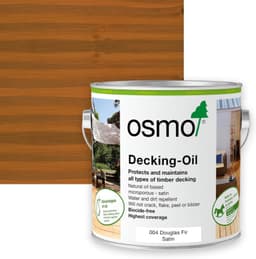
Read the family name, shade code, pack size and intended surface on the physical label. Decking Oil 004 is the retained pigmented product for decking, outdoor furniture and similar exterior joinery. UV Protection Oil Extra 427 is a separate Douglas Fir-tinted finish for vertical windows, doors, cladding and fencing; Osmo does not recommend it for flat decking. This check is particularly important for the 750 ml decking listing. Its Amazon title contains both “Teak” and “004 Douglas Fir”, although the colour cell says Douglas Fir and the part number is 004C. Ask the seller to resolve that description before use. Once a coloured coating has been applied, returning the product or reversing the appearance is much harder than checking the code on an unopened tin. Estimate quantity by family. Decking Oil states about 24 m² per litre for one coat, while 427 states 18 m² per litre. Rough, absorbent wood and end grain use more. The buying guide explains pack and price trade-offs.

Let resinous Douglas fir weather and dry

Osmo UK says resinous woods such as Douglas fir should weather for at least six weeks before Decking Oil is applied. Follow the current UK instructions on your exact tin and confirm uncertain treatment with the timber supplier. Moisture guidance also differs between manufacturer pages. Osmouk.com prints a maximum of 20% for Decking Oil, while osmo.com prints 18%. Use the limit specified by the product documentation in your hand, measure in several representative places with a suitable moisture meter and delay coating after rain. Make a trial patch after preparation because one captured reviewer found 004 much more orange or terracotta than expected.

Apply two thin coats, not one heavy coat

Work in dry conditions within the printed temperature band; Osmo UK gives approximately +10°C to 35°C for Decking Oil. Avoid rain, intense sun and insect-heavy conditions. Stir the product thoroughly so pigment is distributed evenly. Apply a thin coat along the grain with the recommended exterior brush or tool, working it out rather than leaving pools, lap marks or oil in grooves. Do not thin the oil unless the manufacturer explicitly tells you to do so. For Decking Oil 004, allow about 12 hours of drying under the stated conditions, with good ventilation, then apply the second coat thinly. If you want an anti-slip finish, Osmo positions Anti-Slip Decking Oil 430 as the top coat over a coloured decking oil, not as the sole colour and UV coat. Its own page gives about 8–10 hours of drying, which must not be confused with the 12-hour Decking Oil interval. Do not walk on, replace furniture or expose the surface to moisture until the system has dried as directed. For deck maintenance, use the decking oil guide.

Where the UV oil method differs

UV Protection Oil Extra 427 is for suitable vertical exterior timber. Osmo’s claimed UV protection factor of 12 depends on applying two coats; one thin coat is not the stated system. The product contains film-protection biocides and is for outdoor use, so it should not be moved indoors merely because the colour suits an interior room. Horizontal elements within vertical joinery need drainage. Manufacturer guidance calls for at least a 15-degree fall and rounded edges of more than 2 mm on relevant components, helping water leave rather than sit on a sharp ledge. A flat sill, post cap or deck board does not become suitable simply because most of the structure is vertical. See the Decking Oil 004 versus UV Oil 427 guide when a project has mixed orientations. Stop and call a competent professional where boards are soft, fungal decay is suspected, structural deck members may be compromised or a failed window coating continues to bleed resin.

Common questions

How long should new Douglas fir weather before Decking Oil?
Osmo UK states at least six weeks for resinous Douglas fir before its Decking Oil. Pressure-treated timber has a longer wait, and manufacturer pages differ between at least three and six months. Follow the current product label and confirm the treatment with your supplier; a fresh sanding that exposes new wood may restart the preparation period.
What moisture content is too high?
The Osmo UK Decking Oil page gives a maximum of 20%, while another Osmo page gives 18%. Do not average the two. Use the figure printed for the exact product and market, measure several locations and postpone the work after rain or where shaded joints remain wetter than the visible surface.
How many coats are needed?
Decking Oil normally uses two thin coats, or one coloured Decking Oil coat followed by the compatible Anti-Slip 430 top coat where grip is required. UV Protection Oil Extra needs two coats for its stated UV factor. Drying time belongs to each product: about 12 hours for Decking Oil and 8–10 hours on the Anti-Slip page.
How fine should I sand?
The product-specific Decking Oil page says no finer than P120, while a general Osmo UK preparation answer mentions P150 for softwood before brushing. Prefer the current instruction for the finish you bought. Sand evenly, wear a suitable dust mask and remove dust thoroughly before making a trial patch.
When is another deck coat due?
Inspect mechanically loaded deck areas at least once a year and recoat when wear becomes visible on an otherwise sound finish. That is an inspection schedule, not a guaranteed annual recoat. Exposure, foot traffic, cleaning and jet washing can shorten the interval, while sheltered areas may remain sound for longer.

Related pages

Sources

Public UK sources for the product pages, durability class, VOC limits, biocides and the description rule. Prices, stars and review counts are the amazon.co.uk figures in the research digest, not a live re-check.

  1. Osmo UK — Decking-Oil (retrieved 17 October 2026)
  2. Osmo UK — UV-Protection Oil Extra (retrieved 17 October 2026)
  3. Treatex — Douglas Fir Protection (retrieved 17 October 2026)
  4. TDCA — The Timber Cladding Handbook 2022 (retrieved 17 October 2026)
  5. Wood Protection Association — GN 10/12 (retrieved 17 October 2026)
  6. The Volatile Organic Compounds in Paints, Varnishes and Vehicle Refinishing Products Regulations 2012 (retrieved 17 October 2026)
  7. HSE — Biocides product types (retrieved 17 October 2026)
  8. Consumer Rights Act 2015, section 9 (retrieved 17 October 2026)