Independent comparisons. We may earn from shop links. More info

Gloss vs matte varnish acrylic: choose the sheen for the wall

Updated: 22 October 2026

The canvas is dry, the bottle is still unopened, and the picture will hang opposite a window in a UK room that gets low winter sun. Gloss will deepen the colour and also throw that window back at you. Matte will cut the glare and can make the darkest passages look lighter. Satin sits between them. This page is that choice for gloss vs matte varnish acrylic. It does not name a winning brand, and it does not walk through every brush stroke. Prices and stars live on the [acrylic varnish comparison](/hub/paints-and-varnishes/acrylic-varnish). Brush strokes live on [how to varnish acrylic paintings](/hub/paints-and-varnishes/acrylic-varnish/sub/acrylic-varnish-how-to-apply). Links to Amazon from the main table are affiliate links. Nothing here is an ageing test. Prices are the 19 October 2026 amazon.co.uk snapshot. Peter F. edits DIY & tools.

The canvas is dry, the bottle is still unopened, and the picture will hang opposite a window in a UK room that gets low winter sun. Gloss will deepen the colour and also throw that window back at you.

Our top picks

On this page

What the wall does to gloss

Gloss varnish deepens colour because the smooth film lets more light come back from the paint, and it also mirrors the room. Daler-Rowney describes that deeper colour as the gloss effect, and Jackson's Art adds that a gloss surface looks wet and shows every ridge in the paint. In a bright room, or opposite a window, that reflection can hide the picture for part of the day. A UK review of an EIGTWEN gloss says the shine swallowed the canvas. That is the wall problem, not a fault in the pigment. Gloss is the sheen to choose when the room is dim, the colours are already pale, and you want them to read richer, and when you can hang the picture where a lamp does not sit in the reflection. It is the sheen to leave when the painting is very dark and the wall faces a window you cannot move.

What matte does to dark paint

Matte cuts glare. The surface scatters light instead of mirroring the window, which is why a dark painting opposite glass often becomes readable again. The same scattering can lighten blacks. Daler-Rowney says matte softens intensity because matting agents scatter light. Jackson's Art says the matting agent is a pale powder, so the bottle needs stirring, and a heavy matte coat can pale the darks. A UK Galeria buyer found that gloss made the blackest black look less black and moved to a matt coat for that reason. Makers spell it matt. This page says matte. Use matte when glare is the problem you actually have, and when you can accept that the darkest colour may look a step lighter. Stir the bottle so the powder is not sitting at the bottom, or the first strokes will be glossier than the last. A US review of Shuttle Art matte, the only matte-only bottle in this set, saw a semi-gloss rather than a dead matte.

Satin, and mixing inside one range

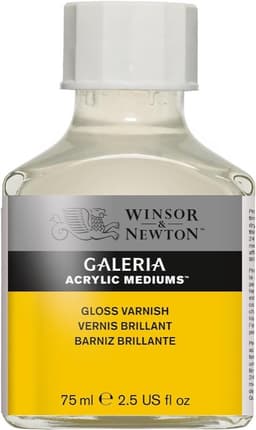
Satin is the middle sheen. It deepens colour less than gloss and reflects the room less than gloss, and it lightens blacks less than a heavy matte. In this set, Liquitex Professional satin is the only satin listing: 237 ml at £14.93. UK reviews call the sheen gentle rather than full gloss. That is one person's wall, not a rule that satin equals matte. You can mix sheens inside one range when the maker says so. The Galeria gloss bullet says the gloss can be mixed with Galeria matt to vary the finish. Liquitex also describes mixing sheens, and it warns that careless mixing can leave bubbles, which is why you stir and do not shake hard. Mixing two brands on one canvas is a test on scrap, not a method this page recommends. Removable versus permanent is a separate decision, on varnish for acrylic paintings.

How many coats before it clouds

Liquitex limits matte and satin to one or two thin coats. If you need more build, put gloss underneath and the matte or satin on top. Extra matte coats pile up the pale matting agent, which is how blacks go grey and how a film can look cloudy. Winsor & Newton still talks about one to three thin coats in its general guide, with no reworking once the film grabs. On a dark painting, stop at the coat that kills the glare. A third coat that you hope will look more matte often looks chalky instead. The labels in this set are examples, not a ranking. Several bottles are gloss. GRANOTONE is titled high gloss. The EIGTWEN pair is gloss and matte in two 100 ml bottles, and reviews split: some prefer the matte, some say the matte is barely visible, some say the gloss is too glossy.

Common questions

Will gloss make a dark painting look richer or just shiny?
Gloss can do both. It deepens colour, which helps pale passages, and it reflects the room, which hides a dark painting opposite a window. Choose gloss when the room is dim and you want richer colour. Leave it when the wall already has a glare problem you cannot move.
Does matte make black look grey?
It can. Matting agents scatter light, and a heavy matte coat is the usual way blacks go lighter. One or two thin coats, which is Liquitex's limit unless gloss is underneath, keeps more of the dark colour. If the black must stay black and the room is bright, try satin before a heavy matte.
When is satin the safer sheen?
Satin is the safer single choice when the room is bright and the painting is dark, because it reflects less than gloss and lightens blacks less than a heavy matte. Liquitex Professional satin is the satin bottle in this set, and UK reviews describe a gentle sheen rather than a full gloss. It is still a sheen with a coat limit of one or two thin layers unless gloss is underneath.
Can I mix gloss and matte in the same brand?
Yes, when that brand says so. Galeria's gloss bullet says you can mix it with Galeria matt to change the finish. Liquitex describes mixing sheens and warns about bubbles, so stir rather than shake. Mix on a scrap of the same paint before you commit the canvas. Mixing two different brands on one picture is a separate experiment, and this page does not treat it as a method.
Why do makers limit matte to one or two coats?
The matting agent that kills glare also clouds the colour if you pile it up. Liquitex limits matte and satin to one or two thin coats, and says to put gloss underneath if you need more thickness, then the matte on top. A third matte coat is how blacks go grey and how the film can look chalky.

Related pages

Sources

Public UK sources from the research digest, last checked on 19 October 2026. Shelf prices and star lines are the amazon.co.uk figures in the display file. The price band is this set, not a market average. No listing was cured in a lab.

  1. SI 2012/1715, VOC in paints and varnishes (retrieved 19 October 2026)
  2. SI 2012/1715 Schedule 2, trim varnish limits (retrieved 19 October 2026)
  3. HSE: solvents (retrieved 19 October 2026)
  4. Winsor & Newton UK: how to varnish acrylic paintings (retrieved 19 October 2026)
  5. Liquitex UK: varnishing acrylics (retrieved 19 October 2026)
  6. Liquitex UK: professional satin varnish (retrieved 19 October 2026)
  7. ARTdiscount: varnishing acrylic paintings (retrieved 19 October 2026)
  8. Daler-Rowney: how to varnish paintings (retrieved 19 October 2026)