Independent comparisons. We may earn from shop links. More info

Flat brush or angled sash

Updated: 21 October 2026

You are about to cut in emulsion along a ceiling or a skirting board, and the brush in the basket is a square artist flat. You cannot see the line once the face is on the wall. A flat brush or an angled sash is one decision: use an angled synthetic sash to cut in, and keep the square flat for a band on a panel. The sets on the [flat brush comparison](/hub/painting-supplies/flat-brush) are short-handled artist tools, not that sash. Peter F. used UK decorating guides for this fork on 21 October 2026. There was no lab. If you buy through our links, we may earn a commission at no extra cost to you.

You are about to cut in emulsion along a ceiling or a skirting board, and the brush in the basket is a square artist flat. You cannot see the line once the face is on the wall.

Our top picks

On this page

What the tip can see

A square flat lays a band. The whole edge meets the surface at once, which is what you want on a panel or a continuous wash. An angled sash puts a thin point of filament against the line, so you can see where paint meets the ceiling or the top of the skirting. Screwfix separates those jobs: a flat for most purposes, an angled sash above skirting, and a cutting-in brush for the ceiling line. Purdy UK's FAQ points the same way: the angled brushes are the ones they name for cutting in. Harris still allows a flat if you are already very experienced. Load the angled brush, bring the thin edge to the line, work about a metre, and leave about 5 to 10 cm for the roller. That exception is not the advice for a first ceiling.

Widths those guides actually name

UK decorating guides speak in inches, not artist size numbers. Screwfix puts about 1 inch around glass and about 2 inches for skirting, architraves, and door frames. Angled sash sizes in that guide run about 1.5 to 2 inches, synthetic. Cutting-in brushes run about 1 to 3 inches. None of that translates a size-2 shader. Width language for the artist sets is on the flat brush buying guide. A size-2 taklon flat will not cut in a ceiling. A 60 mm square tip is a panel width. COGVOHY is the only kept set whose bullets name walls, at 20 to 60 mm, with 5.0 from eight ratings. That is thin evidence, not a cutting-in test. Dulux wants synthetic filament for water-based finishes, because natural bristle swells in water. These square flats can carry emulsion. They still have the wrong tip for the line.
Nicpro Nicpro 10-piece flats

Testsieger

Nicpro Nicpro 10-piece flats
8.4/10about £9.16

Why the sets in this comparison are not that sash

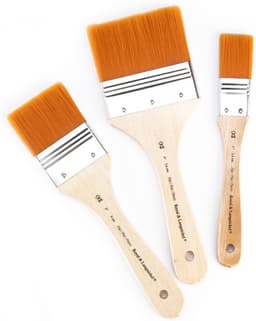
The kept sets are short-handled. Transon states about 5.2 to 5.5 inches on the inch-wide trio and about 6.7 to 8.1 inches on the numbered seven-piece. That suits a table, not a view of a ceiling line. Nicpro's ten-piece is flats only, sizes 1 to 10. There is no angle in the pack, and a details field that says 0.5 inches is not a cutting-in width for every size. Himmlfel is the set people mistake for a sash: six flats plus six angled brushes, sizes 2 to 12, at about £9.98 with 4.2 from 36 reviews. Those angles are for lines, flowers, and leaves, not a 2 inch decorator sash. Several saved texts are not in English. Do not treat a brush outside this folder as a recommended buy.

When the square flat still earns its place

Use the square tip for a band on a panel and for a broad wash. Anza's straight flat for doors is that job, and it is a decorator flat of a stated inch width, not a size-2 shader. The wide packs here, half an inch to 3 inches or 20 to 60 mm, are closer to a panel brush than the numbered ladders. They remain square, and they are still the wrong first tool for a ceiling line. An experienced painter can sometimes cut in with a flat, as Harris allows, then blend a short band into the roller. If you are choosing among the eight sets for a panel, the best flat brush set page says who should skip the thin listings. The recommendation is an angled synthetic sash for cutting in emulsion, and the square flat when the work is a panel or a wash.

Common questions

Can I cut in a ceiling with a square flat?
You can if you are already very experienced, which is the exception Harris allows. For a first ceiling, use an angled sash so you can see the thin edge on the line. A square artist flat hides that line. Leave a brushed band of about 5 to 10 cm so the roller can blend, and do not expect a size-2 shader to do the job.
When is a flat the right shape?
A square flat is the right shape for a band on a panel, a door, or a continuous wash, where you want the whole edge down at once. Screwfix treats the flat as the general-purpose decorating brush. It is the wrong first shape for the ceiling line, above skirting, and tight door frames, where an angled sash lets you see the filament.
What width of angled sash do UK guides name for skirting and glass?
Screwfix names about 1 inch around glass and window frames, and about 2 inches for skirting, architraves, and door frames. Angled sash sizes in that guide run about 1.5 to 2 inches. Cutting-in brushes run about 1 to 3 inches. Those are decorating widths, not artist size numbers.
Are the angled brushes in a craft set the same as a sash?
No. Himmlfel's six angled brushes sit beside six flats in sizes 2 to 12, at about £9.98. The listing describes them for lines, flowers, and leaves. They are not a 2 inch synthetic sash, and the short artist handle is a table length. Skip that pack for cutting in emulsion.
Does a short artist handle help above a skirting board?
No. Transon states about 5.2 to 8.1 inches depending on the set. That is a table handle. Cutting in above skirting needs you to see the line at arm's length on a decorating brush, not to pinch a size-4 shader against the wood.
Is a 60 mm nylon flat a wall brush because the listing says walls?
Only COGVOHY's bullets name walls, on flats from 20 to 60 mm, and the rating is 5.0 from eight reviews. That is a square panel width with thin evidence, not a test that the brush cuts in. A 60 mm square tip still does not show you the ceiling line the way an angled sash does.

Related pages

Sources

Public UK sources used for this comparison. Listing prices, stars and review counts are the amazon.co.uk figures saved for this set.

  1. Jackson's Art, A guide to brushes (retrieved 21 October 2026)
  2. Screwfix, Paint brushes and rollers buying guide (retrieved 21 October 2026)
  3. Dulux, Paint brush 101 (retrieved 21 October 2026)
  4. HSE, Paint FAQ (retrieved 21 October 2026)
  5. HSE, Ventilation when brushing (oce2) (retrieved 21 October 2026)
  6. The Paint Shed, How to clean your paint brushes (retrieved 21 October 2026)
  7. Community RePaint, Emulsion paint (retrieved 21 October 2026)
  8. amazon.co.uk listings for this set (retrieved 21 October 2026)