Independent comparisons. We may earn from shop links. More info

How to use plastering stilts

Updated: October 2026

You have a pair in the hall, or you are about to strap in, and the first minute feels unsafe. This is how to use plastering stilts for that first session: check the hardware, sit to put them on, walk forwards in short steps on a clear dry floor, and get off if a spring, sole, strap, or latch is wrong. It is not a ranking of brands. Which pair to buy stays on [Drywall stilts](/hub/painting-supplies/drywall-stilts). The steps follow HSE floor rules, CITB’s checks, and Wonkee Donkee’s UK notes, plus what reviewers in this set struggled with. Products Compared did not run a course. A qualifying purchase can earn us a commission at no extra cost to you.

You have a pair in the hall, or you are about to strap in, and the first minute feels unsafe.

Our top picks

On this page

Check the pair before it is on you

Inspect the stilts on the floor, not while you are standing in them. CITB’s standard expects you to check nuts, bolts, straps, the sole, and the springs, then walk 20 metres unaided as a training outcome. A weekend in the hall is practice, not that ticket. Change the wing-nut height before you strap in, unless someone is holding you, and use the lowest position that still reaches. If you are still choosing how much lift the room needs, use plastering stilts ceiling height. If a spring is apart or a latch opens on the ground, stop. UK comments on Skywalker size L include a spring that came apart after three days. That is a reason to stay off, not a home repair.

Sit, strap, then stand

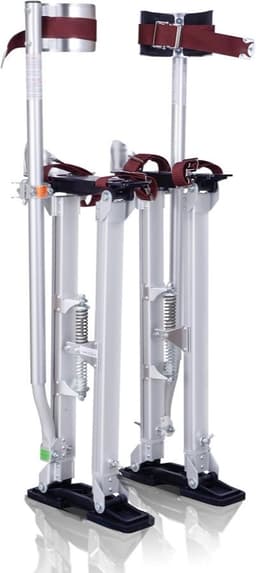
Mount from a seat. Wonkee Donkee’s UK notes tell you to use a bench, set the heel into the cup, bring the calf brace in, and fasten the straps so the spring can still move. Jumping up off the floor is the wrong start. On the silver iElyiEsy file, more than one United Kingdom reviewer wanted a second person to get them standing. Take that help on day one. The budget listings describe a leg strap and a heel plate, so follow the hardware you have. Tighten until the foot cannot slip, then flex once before you leave the bench.

Short steps, forwards only

Start on the lowest setting, on a dry, level floor with nothing you can catch. The Health and Safety Executive’s construction FAQ allows stilts for plastering or painting when you are trained and competent, the surface is not uneven or wet, and there are no trailing cables or other trip hazards. Dust sheets, offcuts, and a lead fail that test even when the stilts are fine. Walk forwards in short steps. Do not walk backwards. Put the tub at hand height before you strap in. Ulka says not to pick objects up from below foot level, and not to use stairs. Aluminium conducts electricity, so a lead is a trip and a contact risk.

When to get off

Get off when the floor stops matching the HSE conditions, when the edge is open, or when any part you checked at the start is no longer right. Stairs, a wet patch, a rucked sheet, and a lead across the door are reasons to sit down and switch method. When a platform is the better method, use plastering stilts vs hop up. A spring that has come off, a sole that is peeling, or a latch that opens while you are working is a stop. Do not re-seat a spring while you are wearing the stilts. Also get off if the height puts your head in the ceiling or forces the highest setting on day one. Use a tower when the room has an open stair or you would be learning on a paying ceiling.

Common questions

How do I put plastering stilts on?
Sit on a bench, set your heel into the cup or onto the heel plate, fasten the leg strap, and stand with a hand on the bench or on a helper. Adjust the wing nuts to the lowest useful height before you are strapped in, unless someone is holding you. Wonkee Donkee describes a heel cup and calf brace. Follow the hardware you have. Jumping up from the floor is the step to skip.
Do I need a second person?
For the first session, yes. United Kingdom reviews on the silver pair say getting on and off is awkward, and more than one buyer wanted someone else there to stand up. A helper steadies you while you find a short step. After you can walk a clear room without being held, you can decide if you still want a helper in the doorway.
How should I walk at first?
Use short steps, forwards only, on a dry level floor with the leads and offcuts already out of the room. Start on the lowest setting that still reaches the work. Reviewers describe the first minutes as frightening, and that eases with practice for some of them. It does not ease if a latch is opening. One UK decorator on the consumer pair reported about ten minutes of practice before cutting in. That is one person’s time, not a target.
Can I walk backwards on plastering stilts?
No. Walk forwards only. You cannot see a cable, a rucked sheet, or an offcut behind the sole, and stepping back is how a small snag becomes a fall. If you have gone too far, stop, turn with short steps while you can still see the floor, or sit and take the stilts off. Wonkee Donkee’s walking advice is the same limit: forwards, small steps, neutral stance.
Where should the plaster tub sit?
Put the tub, the hawk, and the water at hand height before you strap in, on a hop-up or a bench you will not have to bend down to reach. Ulka’s safety list says not to pick objects up from below foot level. Forum plasterers who skim on stilts still talk about a hop-up as the place to park the mix.
What if a strap hurts or a spring fails?
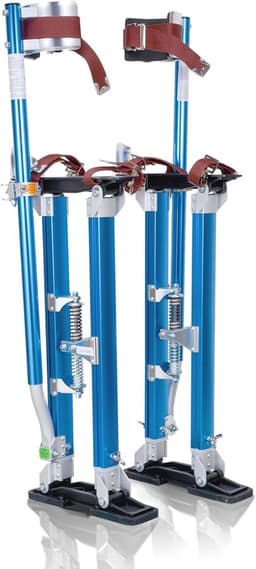
Stop. A strap that hurts is a reason to sit, take the pair off, and change the padding or the fit before you continue. One blue-pair reviewer bought padded straps because the stock ones were uncomfortable. A spring that comes apart, or a latch that opens while you are working, is a reason to stay off the pair. Do not re-seat it in mid-air. Switch to a hop-up or a tower.

Related pages

Sources

Public UK sources on work at height, equipment inspection and stilt training, plus height talk from working plasterers. Shelf prices, stars and review counts are the amazon.co.uk figures in the six listings, snapshot 16 October 2026. Prices move.

  1. HSE construction FAQ, work at height (retrieved 16 October 2026)
  2. Work at Height Regulations 2005, SI 2005/735 (retrieved 16 October 2026)
  3. HSE, inspection of work equipment (retrieved 16 October 2026)
  4. HSE, work at height step-by-step guide (retrieved 16 October 2026)
  5. CITB, stilt safety training standard (retrieved 16 October 2026)
  6. Ulka Tools, plastering stilts safety advice (retrieved 16 October 2026)
  7. Ulka Tools, stilts and the work at height regulations (retrieved 16 October 2026)
  8. The Original Plasterers Forum, stilts thread (retrieved 16 October 2026)