Independent comparisons. We may earn from shop links. More info

How to paint a room with a roller

Updated: 21 October 2026

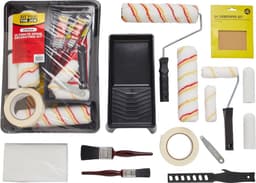
The tin is still shut and the decorating set is on the floor. You want an even wall before the first edge dries in the wrong place. How to paint a room with a roller is a short loop: cut in about a metre, load the emulsion sleeve on the tray ramp until it stops dripping, roll that patch, then move along. Work from the ceiling downwards. The [decorating set comparison](/hub/painting-supplies/decorating-set) is where the kits are ranked. This page stays with the sequence and the wash. Keep a window open, and wash your hands before you eat.

The tin is still shut and the decorating set is on the floor. You want an even wall before the first edge dries in the wrong place.

Our top picks

On this page

Start at the top, and only cut in the section you will roll

Dulux's decorating guidance is to work from the top of the room downwards, and to cut in before you fill the open wall. Dulux Trade narrows that cut-in to about a metre. You roll that section, then move on. Cutting in every ceiling line first leaves the early edge tacky, and the join shows as a darker band. Paint the ceiling before the walls if it is part of the job, so drips land on a surface you still have to cover. Where the frame does not reach, an extension pole is only a longer handle. Dulux suggests a brush of about 2 inches or 3 inches. A 1 inch brush is slower along a long ceiling junction. Bare new plaster can take a thinned first coat. Follow the ratio on the tin if it gives one.

Load the roller, then paint a W and an M

Pour a shallow pool into the deep end of the tray. Roll the emulsion sleeve down the ramp until the pile stops dripping. Dulux says not to overload the roller. A sleeve that rains onto the skirting has too much paint, and a dry cloth usually smears that run. Roll a W to spread the load, fill the gaps with an M, then lay off with light vertical strokes. If you press on the lay-off, you pull the film thin in the centre. Finish the section before you stop. On a wall about 3 metres wide, that is often three sections. The tin states the recoat interval.

Rinse first, wash after, and keep foam off the emulsion

Harris aftercare is to rinse a new sleeve before you use it. Loose fibre sits in the film on a dark colour. Squeeze the sleeve so the first load is not thinned by rinse water. Wash water-based paint in warm soapy water until the water runs clear, then stand the sleeve upright to dry. A sleeve left flat dries with a crushed ridge. If the label names white spirit, follow that label and ventilate. Foam stays off ordinary emulsion. Dulux notes a cratered, orange-peel film. The wall sleeve and the woodwork piece are split on emulsion sleeve or gloss sleeve. Short pile suits silk, and silk still does not want foam.

When this kit is the wrong tool

A boxed roller set suits sound interior walls you can ventilate. It is the wrong tool when the old coating may contain lead. The Health and Safety Executive notes that lead paint was common in Britain into the early 1980s. Key sound old paint with wet abrasive paper. Do not dry-sand it, and do not use a blow lamp. Emulsion on plaster that is still wet traps moisture. If you cannot open a window, stop. A pole does not fix lead paint or damp plaster. Lengths and failures are on the paint roller extension pole page.

Common questions

Do I cut in before I roll?
Yes, though only for the section you are about to roll. Dulux Trade puts that section at about a metre. You then roll a W and an M and lay off before the cut-in sets. Doing every edge in the room first leaves the early lines tacky, and the join shows.
How much paint goes on the roller?
Load the emulsion sleeve on the ramp until the pile is evenly wet and it stops dripping when you lift it. Dulux says not to overload the roller. A sleeve that drips onto the skirting is too wet. If the first pass still shows the old colour in stripes, the sleeve was too dry.
What is the W and M pattern?
On the metre you have just cut in, roll a W to spread the paint, then an M to fill the gaps, then lay off with light vertical strokes. Dulux Trade describes that order so the pile marks run one way. The lay-off uses less pressure than the W. The tin, not a guess, tells you when you may recoat.
Should I start with the ceiling?
Paint the ceiling first if it is part of the job, then the walls. Dulux's order is top to bottom, so drips land on a surface you have not finished. Where the frame does not reach, an extension pole is only a longer handle. Leave the ceiling alone only when you are keeping the old colour.
Do I wash a new sleeve first?
Yes. Harris tells you to rinse a new sleeve before use. Loose fibre comes off in the first pass and stays in the film, which shows on a dark colour. Use warm water, squeeze the sleeve, and shake off the excess. That rinse is separate from the wash at the end of the day.
How do I clean emulsion out of the sleeve?
Wash water-based emulsion in warm soapy water until the water runs clear, then stand the sleeve up to dry. Harris gives that aftercare for a medium-pile sleeve. A sleeve left flat in the tray dries with a crushed ridge. Solvent-borne trim paint is not the same job. The tin decides the cleaner.
Can I use the foam roller on the wall?
No, not for ordinary emulsion. Dulux warns that foam can leave a cratered, orange-peel film. In a split kit the medium-pile sleeve is for the walls, and the foam mini is the woodwork piece. A silk finish still wants a short pile rather than foam. If the box has only medium-pile sleeves, keep the cutting-in brush for the skirting.

Related pages

Sources

Public UK sources used for this comparison. Listing prices, stars and review counts are the amazon.co.uk figures saved for this set on 19 October 2026.

  1. HSE, Work at height: step-by-step guide (retrieved 19 October 2026)
  2. HSE, When and how to use ladders (retrieved 19 October 2026)
  3. VOC Regulations 2012, Schedule 2 (retrieved 19 October 2026)
  4. HSE, Lead in construction (retrieved 19 October 2026)
  5. Dulux, Painting techniques (retrieved 19 October 2026)
  6. Harris, medium-pile 9 inch sleeve (retrieved 19 October 2026)
  7. Rodo, Fit for the job 10-piece kit (retrieved 19 October 2026)
  8. Consumer Rights Act 2015, section 11 (retrieved 19 October 2026)