Independent comparisons. We may earn from shop links. More info

Vermiculite for seed sowing

Updated: October 2026

You have filled a tray with seed compost, and the packet says cover lightly without saying with what or how deep. Vermiculite for seed sowing is the usual UK cover because a thin layer stays moist. Mixing sits on the [how to use vermiculite for plants](/hub/ornamental-plants/vermiculite-for-plants/sub/vermiculite-for-plants-how-to-use) page, and the bags are ranked on the [vermiculite for plants comparison](/hub/ornamental-plants/vermiculite-for-plants). The Products Compared editorial team followed the RHS seed-scheme guide and Gardeners' World, with listings dated 15 October 2026, and did not germinate a trial. A qualifying purchase can earn a commission at no extra cost to you.

You have filled a tray with seed compost, and the packet says cover lightly without saying with what or how deep. Vermiculite for seed sowing is the usual UK cover because a thin layer stays moist.

Our top picks

On this page

When to cover, and when to leave the seed bare

The RHS germination guide for its seed scheme sets the depths, and your packet still wins if it disagrees. Seed that germinates within about 30 days can take about 2–10 mm of vermiculite, scaled to the seed, with Rudbeckia at about 2 mm. If you cover with compost instead, halve that depth. Seed that takes about 60 days or longer gets about 6 mm of coarse grit, not vermiculite. Begonia-type fine seed, and seed that needs light, stays uncovered. Kings Seeds tells you to use a fine grade and to cover to about the seed's own depth, which for dust-like seed is barely a frosting. Medium flakes around 2–5 mm sit like gravel and cannot make that 2 mm cover, so read the horticultural vermiculite buying guide before you sow the rest of the packet.

Vermiculite alone, or only as a topping

Gardeners' World says seed of all sizes can be sown in 100 per cent vermiculite, in a 50:50 mix with seed compost, or in compost with a vermiculite topping that keeps the surface moist. Pure vermiculite is for germination, not a season of feeding, because the mineral adds nothing once the seed reserves are gone. A 5 L bucket covers many trays, while a 100 L sack is more than one March sowing, so the best vermiculite for plants page says to skip that bulk buy for a single tray.
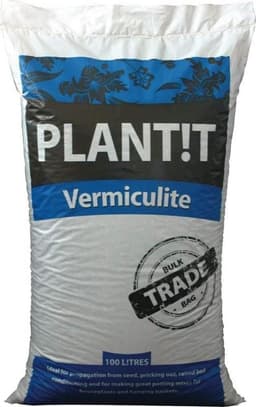
PLANT!T PLANT!T vermiculite 100 L

Testsieger

PLANT!T PLANT!T vermiculite 100 L
8.8/10about £42.95

Damping off, without promising a cure

Damping off is the collapse of seedlings when fungi get a wet, still, crowded tray. The RHS says there is no fungicide for gardeners to apply, and it tells you to use clean trays and not to reuse a tray that has already failed. Kings Seeds says a fine vermiculite cover can reduce the risk, and Gardeners' World links a topping to some help against damping off. Help is not a treatment, and a thick coarse cover that stays sodden can suit those fungi. Sow thinly, because a full packet in one half-tray loses the lot when the stems never get air. Give the tray light and moving air once you see green, and take any lid off unless the packet says to keep it on. Perlite under the seed and vermiculite on top is the Gardeners' World pairing, while slow seed still gets grit.

Flakes that are too coarse for a thin cover

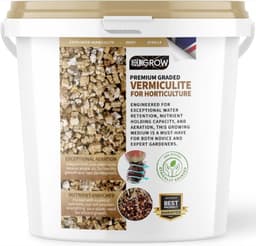
Reviewers of the PLANT!T 100 L bag describe chunky flakes, similar to perlite, and say they still buy a finer grade for sowing. Grow shops call that brand V3 medium, about 2.0–5.0 mm, and the amazon listing does not print those millimetres. Use that sack in a potting mix if you already bought it. Do not force it into a 2 mm cover over begonia and then blame the seed. UK GROW bags in the set do not state a grade. One 25 L review reported sunflower and wheat in bulb pots, which is one comment, not a rate, and a reason to look before you sow saved seed. If the pieces look like gravel, stop before you water. Fine grade belongs on the seed, and medium grade belongs underneath.

Common questions

How deep should the vermiculite cover be?
For seed that germinates within about 30 days, the RHS seed-scheme guide uses about 2–10 mm of vermiculite, matched to seed size, with Rudbeckia at 2 mm. If you cover with compost instead, halve that depth. Kings Seeds says cover to about the seed's own depth with a fine grade, and tap lumps level rather than scraping them flat.
Which seed stays uncovered?
Leave Begonia-type fine seed uncovered, and leave seed that the packet says needs light. The RHS guide is explicit, and your packet outranks a general band if the two differ. Slow seed that takes about 60 days or longer gets about 6 mm of coarse grit, not vermiculite.
Can I sow in vermiculite alone?
Yes, for germination. Gardeners' World allows 100 per cent vermiculite, half and half with seed compost, or compost plus a topping, and Westland says not to firm the surface hard. Pure flakes do not feed the seedling once the seed reserves are used, so pot on into compost when the leaves open.
Does a vermiculite cover stop damping off?
It can help, and it does not cure an infected tray. Kings Seeds links a fine cover with a lower risk, and Gardeners' World links a topping with some help against damping off. The RHS still says there is no gardener fungicide, so use a clean tray, sow thinly and give the seedlings air.
When is grit the cover instead of vermiculite?
Use about 6 mm of coarse grit when germination is expected to take about 60 days or longer, which is the RHS seed-scheme split. Vermiculite, at about 2–10 mm, is for many seeds that come up within about 30 days. An open bag from an earlier sowing is not a reason to switch that cover.

Related pages

Sources

Public sources used for this comparison. Prices are amazon.co.uk shelf prices from the listing extracts dated 15 October 2026.

  1. RHS seed germination guide (retrieved 15 October 2026)
  2. RHS peat-free advice (retrieved 15 October 2026)
  3. RHS houseplant growing media (retrieved 15 October 2026)
  4. BBC Gardeners' World: how to use vermiculite (retrieved 15 October 2026)
  5. Westland Gro-Sure vermiculite (retrieved 15 October 2026)
  6. HSE COSHH basics (retrieved 15 October 2026)
  7. HSE EH44 dust guidance (retrieved 15 October 2026)
  8. US EPA: horticultural vermiculite in potting soil (retrieved 15 October 2026)
  9. Summit Environmental (UK): vermiculite insulation versus horticultural bags (retrieved 15 October 2026)