When to prune climbers: leave young wisteria alone
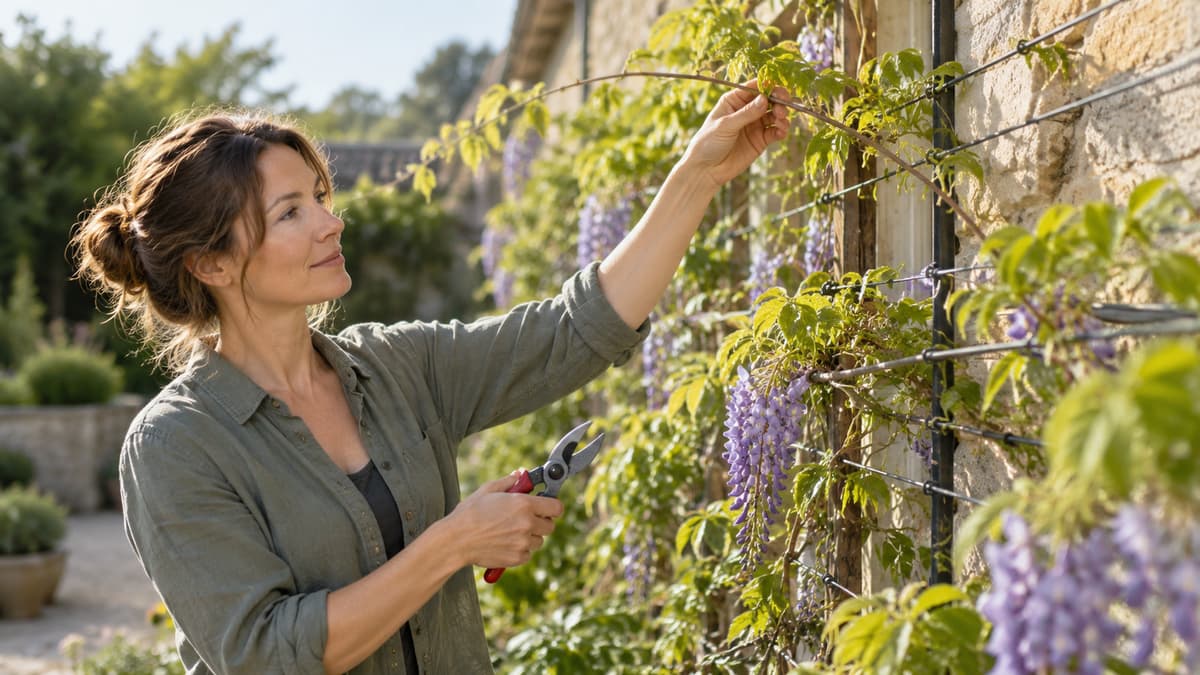
Leave a young wisteria until it covers the support. In July or August, shorten whippy shoots to five or six leaves, then to two or three buds in winter.
On this page

You have a young wisteria or a honeysuckle, and the secateurs are already in your hand. The shoots are long, the wires still show, and a tidy cut looks like the Saturday job. When to prune climbers depends on the plant. For wisteria, you wait until the framework has covered the support. Only then do you shorten whippy growth to five or six leaves in July or August, and to two or three buds in January or February.
A hard cut in early summer can take off flowers that were already forming. A seed-raised plant can take up to 20 years to flower, and extra pruning does not shorten that wait. Honeysuckle, clematis, and climbing roses do not share this calendar. We used the Royal Horticultural Society wisteria growing guide, the pruning guide, the planting page, and the wisteria FAQ. This is not a garden trial. A qualifying purchase through our links can earn a commission at no extra cost to you. Listings sit on the clematis comparison.
The top pick on the clematis plants comparison is three Growtanical plugs at about £16.99, rated 3.9 from 17 reviews. The listing prints pruning group 1. The title says Mayleen and a bullet says Rubens. A montana in that group is tidied after flowering. It is not the wisteria spur cut, so the five-leaf and two-bud numbers stay off it.
In short
Leave a young wisteria until it has covered the support. Then cut the current whippy growth to five or six leaves in July or August, and those shoots to two or three buds in January or February. Do not use that calendar on honeysuckle, clematis, or a climbing rose, and do not expect pruning to force a seed-raised plant into flower.
Why the first years are different
The first years build the framework, not a spur system. The RHS wisteria growing guide leaves young plants alone until they reach the structure. If the wires, pergola, or trellis are still showing, keep the secateurs in the shed and tie the whippy growth on. First year climber pruning, for a wisteria, is that tying-in. Cutting to a few buds in year one removes the length you were waiting for.
Some climbers do want a prune after planting. The RHS page on how to plant a climber says so for certain plants, and that note is not a licence to shorten a wisteria still on its cane. The pause ends when the framework has covered the support. After that, leaving every summer shoot at full length turns the plant into a loose curtain. A stem that stops halfway is tied on and extended, not spurred just because January has arrived. Planting sits on the how to plant a climber page.
The summer cut on wisteria
July or August is the summer window, and only after the plant has covered its support. Shorten the current season's whippy growth to five or six leaves, about 30 cm, with sharp secateurs, cutting just above a leaf. The permanent framework stays. You are reducing side shoots that grew this year, not rebuilding the plant from the base.
Early summer is the wrong month. The RHS wisteria FAQ says heavy pruning, or pruning in early summer, disrupts the flowers. A hard cut in May or June can take off wood that was going to bloom. If the shoots look untidy in late spring, tie them in. About 30 cm is a check, not a second rule. Five leaves at 20 cm is already the stop, and a vigorous shoot that reaches five leaves past 30 cm still stops at the fifth or sixth leaf. A new leader that fills a bare gap is tied on, not spurred.
The winter cut on wisteria
January or February is the winter window in the UK. Return to the shoots you shortened in summer and cut them to two or three buds, about 10 cm, just above a bud. You are making a short spur, not removing the main rods that cover the support. If the wood is frozen solid, wait for a milder day in that window rather than tearing the bark.
Swapping the cuts is the usual failure. A summer prune on wisteria taken to two buds is too short for that season, and it sits near the time when flowers are set. A winter prune on wisteria left at five or six leaves does not finish the spur. Do the leaf count in July or August and the bud count in January or February. If you miss February, wait for the July leaf prune rather than catching up with a hard cut in May.
What not to copy onto every climber
Honeysuckle twines and gets long, and honeysuckle pruning is still not this calendar. Five or six leaves in July, then two or three buds in January, is a wisteria spur system. Using those numbers because the secateurs are already out pastes one routine onto every climber. If the plant in your hand is honeysuckle, stop. This page has no date for when to prune honeysuckle in the UK.
Ivy and other self-clingers are not trained as wisteria spurs, and they do not need two or three buds every February as a default. A stem that has left the area you wanted can be cut for size, which is a different job, and this page does not give that cut a month. Clematis is grouped, and those groups are not the wisteria months. The rules live on the clematis pruning groups page, and the plants are on the clematis plants comparison. Climbing roses belong on the climbing rose comparison. If the label is not wisteria, the five-leaf and two-bud cuts stay in the drawer.
Flowers that pruning cannot force
A seed-raised wisteria can take up to 20 years to flower, and pruning does not change that. A harder winter spur, or a summer cut taken early, will not buy a raceme while that wait still has years to run. If you grew it from seed, or the seller said it was seed-raised, plan for a long stretch of leaf and framework. The secateurs still cover the support and, later, make the spurs. They are not a switch for bloom.
A plant that has flowered before fails for a different reason. Heavy pruning, or a cut in early summer, can disrupt flowers that were coming, which is the RHS FAQ point. A bare year after a May prune points at timing. A long run of bare years on a seed-raised plant points at the wait. Until the structure is covered, the Saturday job is a soft tie, a check that it is not biting the bark, and the secateurs left closed.
Common questions
Leave a young wisteria until it covers the support, and keep the July leaf cut apart from the January bud cut. Refuse that calendar for honeysuckle, clematis, self-clingers, and roses. If the label disagrees with the cut you were about to make, tie the shoot in and wait.
Common questions
When do I prune wisteria?
Should a new wisteria be cut in year one?
What happens if I prune in early summer?
Is honeysuckle on the same calendar?
Do self-clingers need an annual prune?
How far back is the summer cut?
Will pruning make a seed-grown plant flower?
Where do clematis rules live?

Peter F. is the editor for DIY & tools at productscompared.co.uk. Comparisons in this category are checked against amazon.co.uk listings, review evidence and public UK sources.
Related articles

Trellis or wires for climbers: check the fence panel
A young wisteria cannot cover a support that is not there. Fit wires or trellis before the first tying-in.

Rain shadow planting: set roots 45 cm from the wall
The first years fail at the roots as often as at the secateurs. Set the plant out from the wall and water it.

Plants for a shady wall: ivy or climbing hydrangea
Flowering wisteria wants more sun than a north fence gives. Pruning will not turn a shade wall into a flowering one.