Independent comparisons. We may earn from shop links. More info

Mesh visor or clear visor

Updated: October 2026

You are choosing between a steel mesh and a clear polycarbonate sheet for the same afternoon, and the failures feel opposite. Mesh stays cooler and then lets a fine chip or a splash through the holes. A clear sheet blocks that path and then fogs, scratches, or dazzles. Mesh visor or clear visor is that one decision. Prices stay on the [face protection comparison](/hub/occupational-safety/face-protection). How the screen should sit once it arrives is [how to wear a face shield](/hub/occupational-safety/face-protection/sub/face-protection-how-to-use). Stones on a grass trimmer are [strimmer face shield](/hub/occupational-safety/face-protection/sub/face-protection-strimmer). Use mesh for coarse chips and airflow, with safety glasses underneath. Use a clear marked visor when the hazard is splash, fine dust, or a view you cannot get through holes. We used amazon.co.uk listings from 20 October 2026. We did not impact-test a visor. A qualifying purchase can earn a commission at no extra cost to you.

You are choosing between a steel mesh and a clear polycarbonate sheet for the same afternoon, and the failures feel opposite. Mesh stays cooler and then lets a fine chip or a splash through the holes.

Our top picks

On this page

What a mesh visor is for

A mesh visor is a wire grid. Air moves through it, which is why people prefer it for a long warm strim, and larger pieces of grass, bark, and stone hit the wires. BSI's scope note for BS EN 1731 says it is not for liquid splash, molten metal, electrical hazard, or infrared and ultraviolet. If the job is any of those, mesh is the wrong family even when the listing prints the number. JSP's UK FAQ puts F as the highest mesh impact mark and S as unsuitable for sharp flying objects. Mesh is not UV protection, and light transmission has a 20 per cent minimum, so the screen is never optically clear. Glare in low sun follows from that. Turn, add glasses, or move to a clear sheet. Do not bend the wires. In this set the mesh-leaning rows are the Oregon Q515061 with muffs, the Oregon Q515064 without them, and the Hestya two-pack. Only the Oregon bullets print CE EN 1731. The Hestya table does not. Unmarked mesh is still mesh, with the same holes, and a missing line is not a hidden F. HSE's chainsaw page lists a mesh visor to BS EN 1731 and glasses to BS EN 166 as separate items, plus a helmet. The wires are face cover against coarse debris. They are not the eye protection.

What a clear visor adds

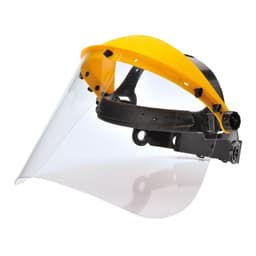
A clear visor is a polycarbonate sheet. It closes the path mesh leaves open, which is why it belongs on grinding, sanding, droplets, and fine dust. You can see a hinge through it. You cannot do that honestly through a 20 per cent mesh. The marked example here is the Portwest PW91 at £14.99. The bullets say 1 mm, EN 166 1B and 3B. Portwest's datasheet describes that as medium-energy impact protection. Do not read the 3 as molten metal. That visor is the PW96, and it is not in this set. The Jackson 14200 is the other clear browguard, at £39.12, with EN166, ANSI Z87.1 and CSA Z94.3 in the bullets, plus a side and chin guard. It weighs 794 g. Reviewers say it swings up and that film covers both sides. Portwest's bullets say the same about film: blue or green, both sides, peel before use. A green visor is usually that film. Leave it on and you will work with the screen up. Clear sheets scratch, and they can fog. Jackson reviewers mention scratches and also say that shield did not mist, so fog is not universal. The Gaomumu anti-fog line is unmarked, not a test against the Portwest. Care is mild soap and water. The Portwest names a spare, the PW92. The Jackson listing does not.

Glasses still sit underneath

STIHL's UK advice for a grass trimmer is glasses and a full-face visor together, because a visor alone will not adequately protect the eyes. That applies to mesh and to clear. On mesh, a fragment can pass a hole. On a clear sheet, the gap under the chin, a scratch you look around, and a flipped-up visor while the tool is still spinning are the same problem. Oregon's muffs bullets say goggles can go under the Q515061. A Portwest reviewer with glasses finds the PW91 useful. One Hestya reviewer with glasses reports no problem. The Gaomumu claims a raised nose bridge, and one UK reviewer still found it very snug. Fit is a trial with your frames. If muffs are in the outfit, check the seal over the arms. Only the Q515061 includes defenders, and up to 25 decibels is not an SNR.

If the title and the bullets disagree

The Oregon Q515064, at £19.62, is the clash. The title says steel mesh. The material row says alloy steel. Two bullets call it a clear polycarbonate visor and also say CE EN 1731. Reviewers describe mesh, and one says a magnet sticks, which fits steel. We do not pick a side the file does not settle. If you order it, treat mesh as what the title and the buyers report, and look at the screen before you rely on it. If you needed a page that had already agreed the sheet was clear, use the Portwest or the Jackson. The Hestya four-pack is honestly mixed: two mesh and two clear, £23.89, no standard, 3.5 from 12. Three UK reviews call it flimsy. Owning both is not the same as owning a marked version of either. One reviewer says the picture looks like a hard hat. It is not. For a hot strim of long grass, after the stones are picked up, mesh plus glasses is the combination this page recommends, and the Oregon with muffs is the mesh row that also covers noise. For a grinder, or any splash, the clear marked Portwest is the combination, film off, glasses underneath. If the listing says mesh in the title and clear in the bullets, do not average them.

Common questions

When is mesh the right screen?
When the debris is coarse, you want airflow, and you will wear safety glasses as well. Strimming and hedge cutting are the usual jobs here. BSI says BS EN 1731 is not for splash, molten metal, electrical hazard, or infrared and ultraviolet. A falling branch still needs a helmet.
When is a clear visor the right screen?
When you need a continuous sheet: fine dust, grinding, droplets, or a view of an edge. The Portwest PW91 prints EN 166 1B and 3B at £14.99. The Jackson 14200 prints EN166, ANSI Z87.1 and CSA Z94.3 at £39.12. Peel the film on both sides or the sheet will not be clear in use.
Does mesh stop dust or UV?
It does not stop fine dust. The holes are the airflow, which is why glasses stay on and grinding wants a clear visor. Mesh can stop larger chips. It is not UV protection either. JSP states that directly. Sunglasses are a separate choice, and glare through the grid is normal because transmission is kept open, with a 20 per cent minimum in that FAQ.
Can I use mesh for grinding?
Not as the default. Grinding throws fine sharp particles, and you need to see the wheel. The Portwest PW91 matches that job more closely than a mesh grid. If the only shield in the shed is mesh, get a clear sheet before you start the grinder.
Which kept listing is the clear marked one?
The Portwest PW91, £14.99, EN 166 1B and 3B, with the PW92 named as a spare. The Jackson 14200 is the other clear marked browguard, dearer and heavier. The Gaomumu and the Generic mask are clear and unmarked. The Hestya four-pack includes clear plastic and prints no standard.
What if the listing says both mesh and clear?
Do not guess. The Oregon Q515064 title says steel mesh, two bullets say a clear visor, and reviewers describe mesh, including a magnet. Inspect the screen, or choose the Portwest or the Jackson when the page must say clear and stick to it. The Hestya four-pack really does contain both, two of each, and it is unmarked.
Why does sunlight glare through mesh?
You are looking through a grid, not an even tint. JSP's 20 per cent minimum is deliberate openness. Changing your angle helps. Bending the mesh to close the holes damages it. A clear sheet is the alternative when glare stops you seeing the cut.

Related pages

Sources

Public UK sources listed below, last checked on 20 October 2026. Shelf prices and star lines are the amazon.co.uk figures for these eight listings. The price bands are this set, not a market average.

  1. HSE: using the right type of PPE (retrieved 20 October 2026)
  2. HSE: chainsaw PPE (retrieved 20 October 2026)
  3. HSE: PPE product supply (retrieved 20 October 2026)
  4. PPE at Work Regulations 1992, regulation 4 (retrieved 20 October 2026)
  5. BSI: BS EN 1731:2006 mesh eye and face protectors (retrieved 20 October 2026)
  6. DBT notice 0142/26, 15 October 2026 (retrieved 20 October 2026)
  7. BSI eyewear transition webinar, EN 166 date (retrieved 20 October 2026)
  8. Portwest PW91CLR datasheet (retrieved 20 October 2026)
  9. STIHL UK: grass-trimmer PPE (retrieved 20 October 2026)