Independent comparisons. We may earn from shop links. More info

Strimmer face shield

Updated: October 2026

You are about to edge a British lawn or take a brushcutter through long grass, and last time a stone clicked off the guard and stung your cheek. A strimmer face shield is the screen for that debris. It is not, on its own, the eye protection the machine's guidance asks for, and it is not a chainsaw helmet. Listings and scores are on the [face protection comparison](/hub/occupational-safety/face-protection). Mesh or a clear sheet is [mesh visor or clear visor](/hub/occupational-safety/face-protection/sub/face-protection-mesh-or-clear). Film, the chin gap, and washing are [how to wear a face shield](/hub/occupational-safety/face-protection/sub/face-protection-how-to-use). For a grass trimmer, wear a visor and safety glasses, clear the stones, and add hearing protection when the machine is loud. We read amazon.co.uk pages from 20 October 2026. We did not run a lab test. A qualifying purchase can earn a commission at no extra cost to you.

You are about to edge a British lawn or take a brushcutter through long grass, and last time a stone clicked off the guard and stung your cheek. A strimmer face shield is the screen for that debris.

Our top picks

On this page

What hits your face

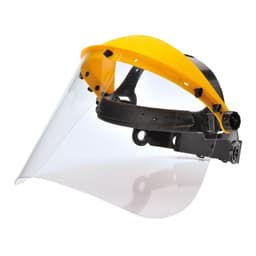
A trimmer line throws wet grass, sap, grit, and anything loose in the sward. The guard sends much of that away, and not all of it. A pea-sized pebble is enough to cut a cheek if it comes up under an open face. A brushcutter blade throws more, and further, which is why the visor that feels optional on a light edger feels late the moment you fit a blade. Reviewers already use these shields for that work. Portwest PW91 comments mention hedges and strimming. Both Oregon browguards are bought for the same garden jobs. Hestya's two-pack appears in garden notes. That is use, not a certificate. The four-pack, 3.5 from 12 and called flimsy in UK reviews, is a weak default. The Generic mask, £8.99 and six reviews, is weaker. A yellow helmet in the photo is often a headband. Believe the weight and the reviews. STIHL's UK page separates two situations. Tall scrub and falling branches are where a helmet enters. A lawn edge is not that. HSE's chainsaw list, helmet and visor and glasses as separate lines, is the boundary of this page. Do not dress a strimmer as felling because a title borrowed the word helmet.

Visor and glasses together

STIHL states that a visor alone will not adequately protect your eyes, and that safety glasses and a full-face visor belong together. The visor takes the stem and the larger stone. The glasses take the fragment that passes a mesh hole or comes under the bottom edge. HSE lists spectacles, goggles, and visors as options matched to the hazard, not as a ladder where the visor cancels the glasses. Glasses go on first. Oregon's Q515061 bullets say goggles can be worn under the mesh and muffs. A Portwest reviewer who wears glasses finds the clear PW91 useful. If your frames touch the screen, or the arms lift the muffs, change the glasses before you start. A leaked seal means the muffs come off halfway down the lawn, which is when the noise and the next stone arrive together. Mesh is the usual strimmer screen because the debris is coarse and a clear visor would trap heat. A clear sheet is better against a gravel board, when you must see the line, or when the debris is fine and dry. Do not settle it by the colour of the photo.

Clear the lawn before you start

Walk the edge before the motor starts. Pick up stones, gravel, toys, and hard clods. A parish risk assessment for hedge and brush cutting, used here as a local example and not as HSE law, says the same: pick up stones, avoid loose gravel, keep eye protection on, and stop if the public approach. A visor does not make a gravel path safe to scour. The line will still throw it toward windows, cars, and your legs. Keep people out of the arc. STIHL's GB trimmer manual says keep bystanders away, use the approved cutting attachment, and be shown the tool if you are new to it. That last point is the boundary for a novice on a powerful brushcutter. A face shield does not teach you which way the debris fan points when you tip the shaft. Set the visor below the chin while you look down at the head. One Oregon mesh reviewer says to pull the mesh that far. If the screen stops at your mouth, the stone path is open. If the headband climbs, or a Hestya strap that reviewers say fails above about 60 cm comes undone, switch off before you retighten it.

Noise is a separate decision

Only one kept listing includes ear defenders: the Oregon Q515061 at £22.79, 500 g, 4.7 from 12,284 reviews. The bullets print CE EN 352.1 and up to 25 decibels. That phrase is not an SNR. Do not compare it with a labelled muff as if the numbers were the same kind. It is still the only row where mesh and muffs arrive together, which is why it is the practical strimmer pick when you do not already own defenders. The Q515064 at £19.62 has no muffs. Reviewers say separate headphones are awkward, and the visor often will not stay up. Two bullets also call that visor clear, against a steel-mesh title, so check the screen. The Portwest PW91 at £14.99 is the clear marked visor people use for hedges, with EN 166 1B and 3B and no muffs. Add your own defenders if the machine needs them. On the Jackson 14200, one reviewer says full muffs will not fit, so a workshop shield is not automatically a strimmer outfit. Skip the Generic mask and the Hestya four-pack as the thing you rely on. Skip a forestry helmet unless the growth is tall scrub with falling branches. Stop and get someone else when the work is paid, the stems are over your head, you cannot identify a failed mount, or you have not been shown a powerful machine. An eye injury is NHS care.

Common questions

Do I need a face shield to strim?
You need a screen over the face as well as glasses, because line debris and stones come up from the head. STIHL asks for a visor and safety glasses together, and says a visor alone is not enough for the eyes. A lawn edge, stones picked up, is still that outfit. It is not automatically a chainsaw helmet.
Are safety glasses enough?
They cover the eyes and leave the cheeks open. A stone or a wet stem hits those. Glasses are the layer STIHL will not drop. They are not the whole layer. Put them under the visor, and check that muffs still seal over the arms.
Mesh or clear for long grass?
Mesh is the usual choice, because the debris is coarse and you want airflow. Wear glasses underneath. Choose clear if you must see the line against a hard edge, or if the debris is fine.
Do I need ear defenders as well?
When the machine is loud, yes. Only the Oregon Q515061 includes muffs here. The bullets say CE EN 352.1 and up to 25 decibels, which is not an SNR. If you already own defenders with a known rating, use those and confirm they seal with the visor on.
What about stones on the lawn?
Pick them up first. A visor is the backup when one remains, not a licence to strim gravel. The local risk assessment used as an example, not as the law, also says avoid loose gravel and stop if people approach.
Is a chainsaw helmet required for a strimmer?
Not for ordinary grass. STIHL ties a helmet to tall scrub and falling branches. HSE's chainsaw page is a wider kit. A browguard here does not finish that list, even when the title says chainsaw helmet.
Which listings are used for strimming, and when do I stop?
Review notes mention strimming on the Portwest and both Oregons, and garden use on the Hestya two-pack. The Oregon with muffs is the one that also covers noise. The four-pack and the Generic mask are weak defaults. Stop when the growth is above you, the job is paid, you have not been shown the machine, the mount has failed, or something has already hit an eye. That last case is NHS care.

Related pages

Sources

Public UK sources listed below, last checked on 20 October 2026. Shelf prices and star lines are the amazon.co.uk figures for these eight listings. The price bands are this set, not a market average.

  1. HSE: using the right type of PPE (retrieved 20 October 2026)
  2. HSE: chainsaw PPE (retrieved 20 October 2026)
  3. HSE: PPE product supply (retrieved 20 October 2026)
  4. PPE at Work Regulations 1992, regulation 4 (retrieved 20 October 2026)
  5. BSI: BS EN 1731:2006 mesh eye and face protectors (retrieved 20 October 2026)
  6. DBT notice 0142/26, 15 October 2026 (retrieved 20 October 2026)
  7. BSI eyewear transition webinar, EN 166 date (retrieved 20 October 2026)
  8. Portwest PW91CLR datasheet (retrieved 20 October 2026)
  9. STIHL UK: grass-trimmer PPE (retrieved 20 October 2026)