Independent comparisons. We may earn from shop links. More info

Safety goggles vs safety glasses

Updated: 21 October 2026

You are about to sand a door or strim a lawn, and the basket holds both safety glasses and safety goggles as if the words were the same product. This page is the fork: when a spectacle is enough, and when you need the rim of a goggle on your face. It does not rank the nine amazon.co.uk listings. Those sit on the [dust goggles comparison](/hub/occupational-safety/dust-goggles). Products Compared used HSE and UK marking guides on 20 October 2026, not a lab test of our own. A qualifying purchase can earn us a commission at no extra cost to you.

You are about to sand a door or strim a lawn, and the basket holds both safety glasses and safety goggles as if the words were the same product.

Our top picks

On this page

Three shapes, not three names

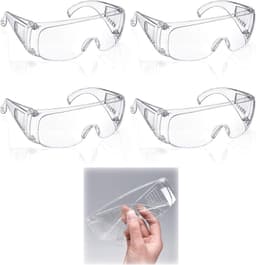
HSE describes three relevant shapes. Spectacles cover the eye from the front and may have side shields, including models that fit over everyday glasses. Goggles put the whole rim against the face. Face shields and visors cover more of the face and do not, by themselves, enclose the eyes. The name on an amazon title is not the shape. WQorphix goes further: the department line says open water swimming goggles. A title is a label, not a shape. University of Warwick's eyewear note says spectacles are not designed to stop smaller particles going around the lens. Goggles are the type it points to for dust and grinding. Side shields do not close the path the way a continuous rim does.

Dust markings that spectacles cannot carry

JSP's UK guide to EN 166 field-of-use numbers is the decoder. Field 3 is liquid droplets and is a goggle mark. Field 4 is large dust particles above 5 microns, and only on indirect-vented or non-vented goggles. Field 5 is gas and fine dust, and only on non-vented goggles. Spectacles are not marked 3, 4 or 5. A spectacle can carry F, the low-energy impact mark. Medium-energy impact B is a goggle or face-shield mark, not a spectacle mark. The order of vents and marks is the dust goggles buying guide. Buckinghamshire's note says direct ventilation is unsuitable for chemicals, gas and dust, because the hole is a path. If the amazon table is blank, which is the usual case in this set, you do not yet have the mark, whatever the title says.

A shield covers the face and still leaves the eyes open

A face shield is the right extra when a branch, a chemical splash or a grinding spark can hit the face as well as the eye. HSE is clear that a shield does not fully enclose the eyes. Buckinghamshire's eye-protection page says shields do not protect against dusts, mists or gases. The combination that closes it is goggles under the shield, not the shield instead of goggles. On a strimmer, the shield takes the sting off the cheek, and the eye still needs a rim if grit bounces up from the line. It is the wrong pair for sanding dust in a closed garage.

What can stay on safety glasses

Spectacles earn their place when the hazard is a low-energy particle from the front and you are not claiming dust or droplet performance. Side shields help for angled chips. They do not turn the spectacle into a field 4 goggle. Overspec spectacles, the kind with room for your own glasses, are still spectacles. They are discussed on safety goggles over glasses, and they are the wrong substitute when you need a seal. If the hazard is a front-only chip, shop the safety glasses comparison, and come back to dust goggles when the particle can go around the lens.

Common questions

Are safety glasses enough for sanding dust?
Not if the dust can travel around the lens. Spectacles, including ones with side shields, are not marked for the EN 166 large-dust field. Warwick's note says they are not designed to stop smaller particles taking that path. Use a goggle with the rim on the face for sanding dust, and a respirator if the dust is harmful to breathe.
What do goggles do that side shields do not?
They put a continuous rim on the skin, so the path at the temple, brow and cheek is closed if the fit is real. Side shields block some angled chips and leave a gap. The difference shows up when you look for daylight around the lens before you switch the sander on.
Can a face shield replace goggles?
No for dust, mist or gas. A shield protects the face and does not fully enclose the eyes. Use a shield as well as goggles when the face itself is exposed, for example to strimmer debris or a splash. A visor over bare eyes still leaves a route in at the brow and the chin.
What does marking 4 mean, and can spectacles carry it?
Field 4 is large dust particles above 5 microns. JSP's guide allows it only on indirect-vented or non-vented goggles. Spectacles cannot carry it, and they cannot carry field 3 for droplets either. If the number is not on the frame, the listing has not shown you that mark.
Are direct-vent goggles the same as sealed goggles?
No. Direct vents are open holes. Buckinghamshire's guidance treats them as unsuitable for dust, gas and chemicals. Indirect vents are baffled and can be marked for large dust. Only a non-vented goggle is in the running for gas and fine dust, and it will fog more easily.
Do I still need a respirator?
Yes when the dust or vapour is a breathing hazard. Eye protection and lung protection are different PPE. A well-sealed goggle does nothing for what you inhale, and a mask does nothing for a chip that comes in at the side of a spectacle.
Where do overspec glasses sit in this choice?
They are spectacles with extra room for prescription frames. They can be the right front-impact choice when you cannot wear contacts. They are not a dust goggle, and at least one overspec range says in its own words that it is not a substitute for sealed splash goggles. The seal question is on the over-glasses page.

Related pages

Sources

Public UK sources from the research digest. Shelf prices and stars are the amazon.co.uk figures for the nine listings in this comparison, shelf date 20 October 2026.

  1. HSE: Personal protective equipment (PPE) at work (retrieved 20 October 2026)
  2. HSE: Using the right type of PPE (retrieved 20 October 2026)
  3. HSE L25: Personal protective equipment at work (retrieved 20 October 2026)
  4. DBT notice 0112/25: PPE eye and face protection (retrieved 20 October 2026)
  5. BSI: A new era in eye protection, EN ISO 16321 (retrieved 20 October 2026)
  6. JSP: How to read eye protection markings (retrieved 20 October 2026)
  7. GOV.UK: Consumer product safety advice (retrieved 20 October 2026)
  8. uvex Ultrasonic goggles 9302245 (retrieved 20 October 2026)