How to use safety goggles
You already own a pair, and the easy move is to wipe a dusty lens on your shirt and carry on. This is how to use safety goggles so the rim stays on your face, the lens survives the grit, and you know when the pair is finished. It is not a buying list. Which vent and which mark to look for is the [dust goggles buying guide](/hub/occupational-safety/dust-goggles/sub/dust-goggles-buying-guide). The nine listings are on the [dust goggles comparison](/hub/occupational-safety/dust-goggles). Products Compared used HSE guidance, uvex's published cleaning steps, and review notes from this set, read on 20 October 2026. We did not lab-test coatings.
You already own a pair, and the easy move is to wipe a dusty lens on your shirt and carry on.
You already own a pair, and the easy move is to wipe a dusty lens on your shirt and carry on. This is how to use safety goggles so the rim stays on your face, the lens survives the grit, and you know when the pair is finished. It is not a buying list. Which vent and which mark to look for is the dust goggles buying guide. The nine listings are on the dust goggles comparison. Products Compared used HSE guidance, uvex's published cleaning steps, and review notes from this set, read on 20 October 2026. We did not lab-test coatings.
Our top picks
| Badge | Product | Strap | Lens in the notes | When it is finished | Note | Price | Offer |
|---|---|---|---|---|---|---|---|
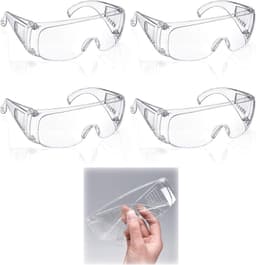
| Best overall |  luyunfei Luyunfei safety goggles, 4 pack | Page asks; the table does not say adjustable | No anti-fog claim on the page | One review: rim not flush to the forehead | 5.8 | about £12.99 | View offer |
 HowseHold HowseHold safety goggles, pack of 8 | Not adjustable; short and tight in reviews | Anti-fog is a title; fog is not a repeated note | Thin edge that digs in; one pack arrived as six | 7.6 | about £16.99 | View offer | |
| Alternative |  Stanley Stanley basic work safety goggles | Perishes within a couple of years; not replaceable | No anti-fog claim in the table | Replace the goggle; do not stitch a new band | 2.9 | about £4.21 | View offer |


On this page
Put them on so the rim meets your face
Wash grit off before you wipe
Fog means you need air or a coating, not a dry cloth
When to replace them
Common questions
How do I stop safety goggles misting up?
Should I wipe a dusty lens with my shirt?
Can I use a silicone or household cleaner?
When do I throw the pair away?
Can I replace just the elastic?
What if they fog as soon as I wear a mask?
Related pages
Sources
Public UK sources from the research digest. Shelf prices and stars are the amazon.co.uk figures for the nine listings in this comparison, shelf date 20 October 2026.
- HSE: Personal protective equipment (PPE) at work (retrieved 20 October 2026)
- HSE: Using the right type of PPE (retrieved 20 October 2026)
- HSE L25: Personal protective equipment at work (retrieved 20 October 2026)
- DBT notice 0112/25: PPE eye and face protection (retrieved 20 October 2026)
- BSI: A new era in eye protection, EN ISO 16321 (retrieved 20 October 2026)
- JSP: How to read eye protection markings (retrieved 20 October 2026)
- GOV.UK: Consumer product safety advice (retrieved 20 October 2026)
- uvex Ultrasonic goggles 9302245 (retrieved 20 October 2026)