How often to replace safety glasses: condition first

Condition decides how often to replace safety glasses in Britain. A deep scratch, a bent frame, a maker's stated life, or a new job ends the pair in your hand.
On this page
The pair on the hook was issued in January, and it is October, and the stores have said the next pair waits until the new year. How often to replace safety glasses is decided by the pair you are about to wear. In Great Britain, regulation 7 of the Personal Protective Equipment at Work Regulations 1992 requires PPE to be maintained, including replaced or cleaned as appropriate, in an efficient state, in efficient working order and in good repair. The regulation names no month and no year. Products Compared read that text, HSE's L25 guidance, uvex and Bollé's public care pages, a UK university note, and amazon.co.uk listings captured on 19 October 2026, with the Riley Flux page checked on 20 October 2026. We did not impact-test a lens. A qualifying purchase through our links can earn a commission at no extra cost to you.
In short
Replace safety glasses when the lens is deeply scratched or worn, when you cannot see the work, when the frame or a side shield has failed, when the maker's stated life has run out, or when the prescription or the task has changed. UK regulations put that replacement inside maintenance.
Condition decides the interval
HSE's L25 guidance tells you to stop using eye protection when visibility is noticeably reduced, for example when the lenses are deeply scratched or worn, or when the frame, headband, or harness is deformed. PPE also has a usable shelf life, and you replace it when that life is passed or repair is impossible or too costly. The instructions are supposed to state storage, cleaning, limitations, and the obsolescence period.
Two months of metal in the air can frost a lens, while a pair that lives in a case can still be clear the following spring. A hairline you only catch in a reflection, with the job still sharp, is a reason to watch that pair. A white groove across the optical zone is the end. The University of Reading's February 2023 note says scratched or pitted lenses may have lost impact resistance as well as clarity, and household polish does not put that resistance back.
What you check before you wear them
Look through the lens at the task distance before you start. If the edge of the work softens, stop. Then feel for a crack at the hinge, a bent bridge, and a side shield that rocks. On a goggle, the seal has to meet your face all the way round. On a faceshield, the Reading note adds warping, brittle plastic, and a headband that slips. Report the fault on the same shift, because a pair set aside for later becomes the pair a visitor picks up.
After a known impact, retire that article the same day, including when the lens still looks whole. The letter on the frame, often F on side-arm glasses, describes a test on an intact sample. Bollé's GB advice is to replace a damaged lens with the original complete product, and to replace the whole article if the frame is damaged. Keep them in a case. A dashboard or a pocket of swarf scratches a new lens before the job does.
A maker's life is a ceiling
Where the instructions state a life, L25 expects you to follow it. For its own glasses, uvex states six years unused if they stay dark and dry, below 40°C and below 70 per cent humidity, dated from manufacture on the glasses or the pack. Once you wear them, uvex recommends a maximum of two years from first use, and it asks you to record that date. A scratched pair is replaced anyway, so the two years are the latest point, and a ruined lens can arrive in month four.
Bollé's GB FAQ states no precise validity period. The two years on those pages are a guarantee against manufacturing defects from the invoice date. Scratches, cracks, and breakage from use sit outside it. Apply a maker's number only to that maker's product. Many amazon.co.uk titles are silent, so you use condition and any date you can read on the arm. In EN 166, K is an optional abrasion test, not a service life. The set captured on 19 October 2026 rarely prints a mark in the specification table, so this page awards K to none of those listings.
A new prescription or a new job
A plano wrap fails on clarity, fit, and damage. Prescription safety glasses match a named wearer and a named correction. When the optometrist changes that correction, the old glazed pair is the wrong lens even if the polycarbonate is unmarked. Adult sight tests often fall on a one-to-two-year rhythm, and Certus treats about two years as a fair budget line for industrial prescription safety eyewear. A stable prescription and a clear lens can run longer. A changed prescription ends the pair on the day you need the new numbers at work.
Reviewers of the NoCry EyeArmor+ say that close curve often will not clear ordinary glasses. The next pair is then a fit-over that does clear them, or prescription safety lenses, which is what the safety glasses for people who wear glasses comparison is for. A faceshield over your own glasses can cover a short job. A full shift usually needs the correction built in. Splash and fine dust need a seal, and HSE separates spectacles, goggles, and faceshields, so the same SKU fails when the process changes. The dust goggles comparison is the nearer shelf when dust can use that gap. Chemical splash, molten metal, arc, and laser need a matched protector, not a newer clear wrap.
Who replaces the pair
On a Great Britain site, the employer maintains the PPE it provides. When the risk assessment still needs eye protection, the next suitable pair is free of charge for employees and, from 6 April 2022, for limb (b) workers. You report a deep scratch, a bent frame, or a missing side shield on the same shift.
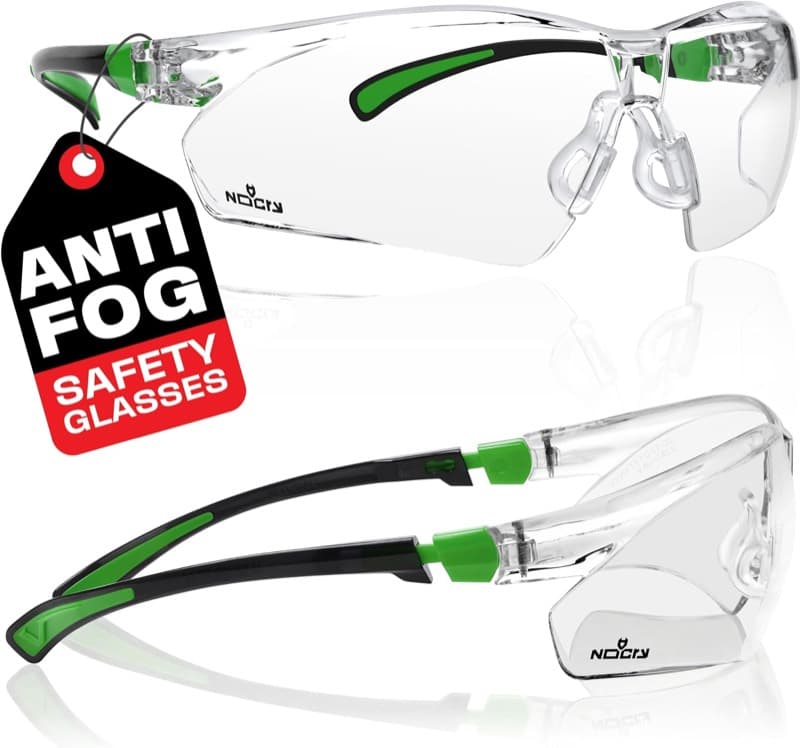
Someone self-employed and in business on their own account, and anyone at a home bench, pays. In the set captured on 19 October 2026, the top pick for a light close wrap is the NoCry EyeArmor+ in black and green, ASIN B01AWK1XAS, at £13.99. It is 28 g, the listing and details ASINs match, and the review line is 4.4 from 61,350, shared with the black and red pair. The specification table prints no EN 166 line. It is a reasonable spare for chips on a bare face, and a weak spare over prescription glasses or where a site file needs a printed mark.
The best-value single in that set is the Ansell KleenGuard Nemesis, ASIN B0FXY1HFXX, at £8.14, with matching ASINs and 4.3 from 315 reviews. Visible light transmission is listed at 50 per cent, so a dim shed will feel dimmer. The Riley Flux, ASIN B09C27XXKT, was £10.99 on 20 October 2026. The title states EN 166:2001, CE, UKCA, and ANSI/ISEA Z87.1. The ANSI line is a US mark. The safety glasses comparison holds the carton traps and the ASIN clashes. Keep the spare where the work is.
What an annual issue is for
An annual issue is a sound way to order, to record who has a pair, and to retire stock that has sat in sunlight. Mark the box and issue the older stock first. Give each person their own pair. The Reading note says a re-issued pair is cleaned and disinfected first, and a deeply scratched visitor pair still comes out of the box.
The issue fails when it becomes the only permitted replacement. Grinding, and heat on a dashboard, will beat a twelve-month plan. Record why a pair left service: deep scratch, bent frame, failed side shield, maker's life, new prescription, or new task. HSE's maintenance page asks you to follow the manufacturer's schedule, to keep spares available, and to name who checks them. Laser filters, welding shades, and sealed chemical goggles retire on their own signs. An eye injury at work is a reporting matter.
Common questions
How often do you have to replace safety glasses?
Is there a legal maximum age for safety glasses in the UK?
Do unused safety glasses expire in the box?
Are light scratches enough to bin safety glasses?
Who pays when safety glasses are scratched at work?
Does a new glasses prescription mean new safety glasses?

Peter F. is the editor for DIY & tools at productscompared.co.uk. Comparisons in this category are checked against amazon.co.uk listings, review evidence and public UK sources.
Related articles

Who pays for eye protection at work
In Great Britain the employer provides required eye protection free, including limb (b) workers from 6 April 2022.

When to bin scratched safety glasses
A deep scratch in the viewing area, or a lens you cannot see the work through, is the end of that pair.

How to clean coated safety lenses
Household sprays and dry grit are how a coating fails early. Clean with what the maker allows, then look again.