Independent comparisons. We may earn from shop links. More info

Work glove size chart

Updated: 21 October 2026

Your last knit glove went numb at the fingertips, or the cuff stopped at the wrist, and you are about to order the same letter again. A work glove size chart starts with two measurements on your dominant hand, in millimetres, and only then with S, M, or L. A clothing size, and a United States line on an amazon.co.uk page, is not the chart. The [assembly gloves comparison](/hub/occupational-safety/assembly-gloves) is where the listings sit. The pairs below are the usual EN ISO 21420 figures UK PPE sellers cite. Peter F. did not measure your hand. A qualifying purchase can earn a commission at no extra cost to you.

Your last knit glove went numb at the fingertips, or the cuff stopped at the wrist, and you are about to order the same letter again.

Our top picks

On this page

Two measurements, not a clothing size

You need palm circumference and hand length. For the length, measure from the bottom edge of the palm, at the wrist crease, to the tip of the middle finger. A shirt sleeve does not stand in for that. For the circumference, UK guides that follow the glove standard put the tape about 20 mm from the crotch of the thumb, around the palm. The Health and Safety Executive method is close but not identical: around the dominant hand just below the knuckles, thumb excluded, taken in a fist. Use one method and stay with it. If the two readings disagree by a size, trust the larger one and the chart on the glove you are buying. Write the numbers down before you open a listing. A clothing medium is not size 8 until the millimetres say so. Listings that mention a size country of the United States, France, or Italy are still amazon.co.uk pages. That attribute does not convert the glove. EN ISO 21420 covers sizes 4 to 13 from circumference and length. SATRA's note is that this standard is not a protection score. It does not tell you the cut letter.

Sizes 6 to 11 in millimetres

The pairs UK sellers repeat are these. Size 6 is about 152 mm around the hand and 160 mm long. Size 7 is 178 mm and 171 mm. Size 8 is 203 mm and 182 mm. Size 9 is 229 mm and 192 mm. Size 10 is 254 mm and 204 mm. Size 11 is 279 mm and 215 mm. On many assembly gloves, size 8 is sold as medium, size 9 as large, and size 10 as extra large. Confirm that on the listing. The letter is the seller's label. The number is the size. A worked example: a palm of 210 mm and a length of 185 mm sits just above size 8 and well below size 9. You are between sizes. UK PPE guides say take the larger glove, so you order size 9, then read whether that brand runs small. Ordering size 8 because M feels familiar is how the fingers go numb. If you fall between sizes, take the larger one and try it with the task in mind. The product chart wins if the maker prints one. These pairs are the usual scale, not a rule that every brand has knitted onto the cuff.

What tight and loose feel like

HSE's advice is practical. A tight glove tires the hand and loses grip. A loose glove folds and gets in the way of the part you are trying to feel. Sweat makes it worse. A glove that was acceptable for ten minutes can bind after an hour, and a short cuff will not grow. Tightness shows up as pale fingertips, a seam you cannot ignore, or a thumb you have to straighten with the other hand. Looseness shows up as a fold across the palm, or a fingertip you must pinch flat before you can pick up a washer. Between a slight fold and a numb finger, the fold is the smaller problem, provided it cannot catch in a rotating tool. Short cuffs are a separate complaint. A cuff that ends at the wrist bone can be the pattern, not your size. Going up a size lengthens the fingers more reliably than it lengthens a cuff that was knitted short. If the reviews name the cuff, read that as design. If they name the fingers, read that as size.

Where this set runs small

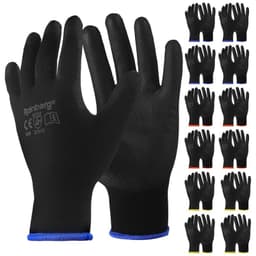
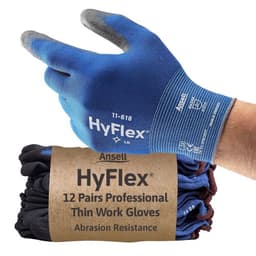
These notes are UK review comments, not a lab fit test. The HyFlex 11-618 is often called small, and the cuff is called short. A larger size does not by itself give you a longer cuff. Kebada's comments split between a usable garden fit and a baggy thin shell. QEARSAFETY draws some real-hand praise. Ripping on that glove is durability, not a size rule. Blackrock's size L is repeatedly called small: a medium hand is told to look at large. Straame's advice is the next size up. Rainberg's large, medium, and extra large are all called short in the fingers. On the HyFlex 48-101, one long-term user said a size 10 felt like a 9. AovYoo's small file includes short fingers. WFX is slim, and a large is still called tiny. The 11-840 has at least one return because the pair would not go on. KAYGO's fit comments are nearer neutral. If your last knit was tight, start from the millimetres, then move one size up on Blackrock, Straame, Rainberg, the 11-618, the 48-101 if you have seen that size-10 note, AovYoo, and the WFX. Do not move up on KAYGO unless your hand is actually between sizes. Try one pair before a box of twelve when the listing allows it. The 11-840 is that trial for foam nitrile. Stop and get advice when the gloves are for employees, when the skin is already dermatitis, or when no size goes on without numbness. This page is a measuring guide, not a fit test. The standard that sizes the glove does not score the cut. That reading is on EN 388 glove ratings.

Common questions

Where do I put the tape?
Measure length from the bottom edge of the palm to the tip of the middle finger. Measure circumference either about 20 mm from the thumb crotch, or just below the knuckles with the thumb out of the loop and the hand in a fist, which is the HSE description. Pick one method. Record both numbers in millimetres before you look at S, M, or L.
What is size 8 or 9 in millimetres?
Size 8 is about 203 mm around the hand and 182 mm long. Size 9 is about 229 mm around and 192 mm long. Sellers often label 8 as medium and 9 as large. Size 10, often extra large, is about 254 mm and 204 mm. If your palm is 210 mm, you are between 8 and 9, and the usual advice is to take the larger glove.
I am between two sizes. Which way?
Take the larger glove. That matches HSE's warning that a tight glove tires the hand and loses grip. Then read whether that brand's reviews say the label runs small, and move up again only if they do. A slight fold is easier to work in than a fingertip you cannot feel, as long as the fold cannot catch in a machine.
Why did large feel like medium?
Several knits in this set are cut small, and S, M, and L are not a shared pattern. Rainberg buyers of large, medium, and extra large describe short fingers. A 48-101 user said size 10 felt like a 9. Blackrock reviewers tell a medium hand to buy large. Measure the palm, then order the number, not the letter you wear in a shirt.
Do S, M, and L mean the same on every brand?
No. Size 8 is often medium and size 9 is often large, and a brand can still knit that number small. EN ISO 21420 allows another system if the information sheet explains it. The chart on the product wins over a generic table. Order up in these reviews is a brand problem, not proof that every large in the UK is a medium.
Are short cuffs a size problem?
On the 11-618, short cuffs are a design comment, not only a size comment. A larger pair may add finger length and still leave the wrist bare. If reviews say short cuff, do not expect the next size to fix the wrist. If they say the fingers are short, the next size is the right experiment, ideally as one pair before a box of twelve.
Should I trust a garment-size country line?
Use the millimetre chart. A line that says the size country is the United States does not convert 203 mm. If the page gives no millimetres, apply the pairs above, then size up where reviews say the label runs small.

Related pages

Sources

Public UK sources from the research digest, last checked on 20 October 2026. Shelf prices and star lines are the amazon.co.uk figures in the display file. The price bands are this set, not a market average.

  1. HSE: glove selection (retrieved 20 October 2026)
  2. HSE: using the right type of PPE (retrieved 20 October 2026)
  3. GOV.UK: PPE Regulation 2016/425 guidance (March 2025) (retrieved 20 October 2026)
  4. GOV.UK: product marking UKCA and CE regimes (retrieved 20 October 2026)
  5. SATRA: EN 388 explained (retrieved 20 October 2026)
  6. SATRA: EN ISO 21420 sizing (retrieved 20 October 2026)
  7. Uvex Safety UK: glove coatings and grips (retrieved 20 October 2026)
  8. Ansell HyFlex 11-618 (manufacturer page) (retrieved 20 October 2026)