Independent comparisons. We may earn from shop links. More info

EN 388 glove ratings

Updated: 21 October 2026

You are looking at 3121, 3131X, or 4X42C on a glove title and trying to decide whether the number is a cut score. EN 388 glove ratings are six positions at most, read in order, and they describe mechanical tests on the palm. They do not make a glove cut-proof, thorn-proof, waterproof, or safe on a bench drill. X means that character was not tested. A missing code on the amazon.co.uk page is not a secret high score. The [assembly gloves comparison](/hub/occupational-safety/assembly-gloves) is the shop table. Peter F. decoded those captured strings and did not repeat the tests. A qualifying purchase can earn a commission at no extra cost to you.

You are looking at 3121, 3131X, or 4X42C on a glove title and trying to decide whether the number is a cut score.

Our top picks

On this page

Six positions, in order

The mark, when it is fully printed, runs abrasion, then the Coupe cut test, then tear, then puncture, then a straight-cut letter, then an optional impact letter. Abrasion is 1 to 4. In the usual published tables, level 4 is 8,000 cycles. Coupe, the rotating blade, is 1 to 5, or X if that test was not used. Tear is 1 to 4. Puncture is 1 to 4. The letter is A to F from the straight-cut test, ISO 13997. P at the end, if it appears, is an impact claim. No P means no impact claim. None of the codes in this set end in P. Ansell's mechanical instructions say the performances are for the palm. A high letter does not describe the back of the hand. If a grinder spark holes the knit on the back, that is outside the palm test, which is what one Rainberg review describes. Coupe is a rotating blade under a light load. The letter is one straight cut. If the Coupe blade dulls, that digit is only indicative, and the letter is the cut result to read. If Coupe is X, the letter is the reference. A higher first digit is more abrasion cycles in that method, not a star rating. EN 388 is not a chemical standard and not a heat standard. Great Britain still recognises CE marking on PPE, with UKCA alongside it. Northern Ireland stays on the CE route. The mark does not choose the glove for your task.

Letters A to F are forces, not stars

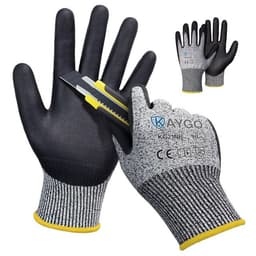
Uvex Safety UK publishes the straight-cut thresholds as A at 2 newtons or more, B at 5, C at 10, D at 15, E at 22, and F at 30. Letter C is 10 newtons. It is not the old Coupe level 5. A title that says both level 5 and a letter is mixing two generations of language. Letter D is 15 newtons. None of those figures means the glove cannot be cut. X is not a failure and not a pass. Polyco's note says X means not tested or not applicable, and 0 means the minimum was not met. A code such as 2131X has not been given a straight-cut letter. You cannot promote the X to a C because another glove carries a C. Puncture uses a rounded stylus. Polyco describes it as about 4.5 mm across, in the region of a ballpoint, not a needle. The straight-cut method does not measure needles or thorns either. A puncture digit of 2 is not a hypodermic result. A KAYGO review says thorns still penetrate a glove whose title prints 4X42C. The letter is more force in one lab test, not a promise about your sheet.

The codes printed on these listings

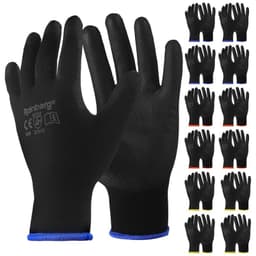
Blackrock prints EN 388:2016 2131X. Abrasion is 2, Coupe is 1, tear is 3, puncture is 1, and the straight-cut test was not run. It is a light decorating mark, not a cut glove. Kebada prints 3131X: abrasion 3, Coupe 1, tear 3, puncture 1, and no letter. Rainberg prints CE EN 388 3121: abrasion 3, Coupe 1, tear 2, puncture 1. That bullet has no fifth character, so there is no letter to invent. All three are grip gloves with a low Coupe digit. KAYGO prints 4X42C. Abrasion is 4, Coupe was not used, tear is 4, puncture is 2, and the letter is C, 10 newtons. That is the clearest cut mark in this set, on a foam-nitrile palm, and it is still not cut-proof. AovYoo's highlight prints 4X42D, the same pattern with letter D, 15 newtons, if you take the highlight as the code. The bullets also say ANSI A4, which is a different scale. QEARSAFETY names CE, EN 388, and EN 420, and prints no digits. That is not a score. The 11-618, the 11-840, the 48-101, Straame, and the WFX have no EN 388 code in the amazon.co.uk capture. Ansell's GB page for the 11-840 shows a mark that is not in the bullets we captured, so you cannot invent it. EN ISO 21420 sizes the glove and does not score protection.

ANSI A4 is a different scale

ANSI/ISEA 105 cut levels are a US scale in grams. Ansell's cut guidance puts A4 at about 1,500 to 2,199 grams. That is not EN abrasion level 4, which is a cycle count. It is not letter D, which is 15 newtons. A listing that prints both ANSI A4 and 4X42D is using two systems. You can read the EN string on its own. You cannot treat A4 as proof of the European test. AovYoo is the glove in this set that does this, and the review file is 20 posts. If you need letter D, you are relying on the highlight, not on the ANSI sentence. If the page had printed only ANSI A4, you would not have an EN 388 letter at all. Do not call any of these gloves cut-proof. Do not treat puncture as a needle or thorn test. Do not wear them as electrical gloves or as a solvent barrier, and do not wear them on a bench drill. The coating choice, once the letter is present or honestly absent, is on PU or nitrile work gloves.

Common questions

What do the four numbers mean?
In order they are abrasion (1 to 4), Coupe cut (1 to 5), tear (1 to 4), and puncture (1 to 4). On Rainberg's 3121 that is abrasion 3, Coupe 1, tear 2, puncture 1. On Blackrock's 2131 the Coupe digit is also 1. A Coupe digit of 1 is a low result on the rotating-blade test. It is not letter C. The tests refer to the palm.
What is the letter after them?
It is the straight-cut result, A to F. A is at least 2 newtons, C is 10, D is 15, and F is 30, on the thresholds Uvex publishes. KAYGO's C is that 10-newton letter. AovYoo's highlight D is the 15-newton letter. The letter is one lab method. It is not a promise that a knife or a machine cannot cut you, and it is not the old Coupe scale.
Why is there an X?
X means that position was not tested or does not apply. It is not a zero and not a hidden pass. On 2131X and 3131X the X is the straight-cut letter that was not awarded. On 4X42C the X is the Coupe test, and the letter C is the cut result to read. Do not fill an X in from another glove.
Is level C the same as the old level 5?
No. Level C is the straight-cut letter at 10 newtons. The old level 5 language usually referred to the top of the Coupe scale, a different test. KAYGO's title says Level C and prints 4X42C. Use the C, and remember a review still reported thorns going through.
Is ANSI A4 the same as EN abrasion 4 or letter D?
No. ANSI A4 is a US cut band in grams, about 1,500 to 2,199 grams in Ansell's published guide. EN abrasion 4 is a cycle count. Letter D is 15 newtons on the straight cut. AovYoo prints ANSI A4 in the bullets and 4X42D in the highlight. Keep them apart.
Does puncture 2 stop a needle or a thorn?
No. The puncture test uses a rounded stylus about the width of a ballpoint, not a needle. The straight-cut test does not measure thorns either. KAYGO prints puncture 2 inside 4X42C, and a UK review says thorns still penetrate. A digit of 1, as on 3121, is a lower result on that same probe.
If the Amazon page has no code, is the glove untested?
You cannot know, and you must not invent a code. The 11-618, 11-840, 48-101, Straame, and WFX print no EN 388 string in these captures. A manufacturer page is not the amazon.co.uk bullet. QEARSAFETY names the standard and gives no digits, which is also not a score.

Related pages

Sources

Public UK sources from the research digest, last checked on 20 October 2026. Shelf prices and star lines are the amazon.co.uk figures in the display file. The price bands are this set, not a market average.

  1. HSE: glove selection (retrieved 20 October 2026)
  2. HSE: using the right type of PPE (retrieved 20 October 2026)
  3. GOV.UK: PPE Regulation 2016/425 guidance (March 2025) (retrieved 20 October 2026)
  4. GOV.UK: product marking UKCA and CE regimes (retrieved 20 October 2026)
  5. SATRA: EN 388 explained (retrieved 20 October 2026)
  6. SATRA: EN ISO 21420 sizing (retrieved 20 October 2026)
  7. Uvex Safety UK: glove coatings and grips (retrieved 20 October 2026)
  8. Ansell HyFlex 11-618 (manufacturer page) (retrieved 20 October 2026)