Safety glasses fog with face mask: stop the air path first

Safety glasses fog with a face mask because breath rises through the gap onto the lens. A spray adds a film. It does not print an N mark or select the eyewear.
On this page
The mask is on, the safety glasses are on, and the lens clouds before the first cut is finished. You can still see the frame. You cannot see the blade, the chip, or the step. Safety glasses fog with a face mask because the breath that should have left through the fabric is leaving through the gap at the nose and travelling up the inside of the lens.
A bottle looks like the whole answer. The air path is still there after you spray. This page follows that order: where the breath goes, what a film can do, what an N mark means, and who chooses the eye protection when the glasses are PPE.
In short
Safety glasses fog with a face mask when exhaled air leaks up onto a cooler lens. Bollé calls that route a chimney effect. A spray can leave a temporary film. It does not print an N mark, and it does not replace the employer's choice of eye protection. If the lens is deeply scratched, replace it before you coat it.
What the mask does to the lens
Warm air from your mouth and nose holds water. A face mask blocks the easy route out, so a share of that air escapes at the top edge or beside the nose wire. Bollé Safety's UK note describes that leak as a chimney: the breath rises through the gap and meets the ocular. The lens is cooler than the breath, so the water sits on the surface as mist. That is Bollé's description, not a chamber test for this article.
A cloth or surgical mask that gaps at the nose is a chute pointed at the lens. A respirator can still leak at the nose bridge if the fit is wrong, and JSP's misting note treats that leak as both a mist source and a failed seal. Opening the gap further gives the chimney a wider throat. If the mask is respiratory protective equipment, do not cut, pierce, or fold it so the glasses stay clear. The person who selected the PPE corrects the fit or changes the eyewear.
Spectacle wearers meet a second surface. The prescription lens sits behind the safety ocular, or the safety glasses are the only pair, and both can mist. Pushing the safety glasses down the nose moves the coverage away from the eye. HSE's guidance is plain: you do not modify equipment to make it fit. A colder lens, from a winter site or a van left overnight, mists more readily. Wiping with a sleeve can scratch the coating. If the view is only a smear, stop until it is clear.
Fog that returns with the mask is the air path. A crazed lens is a different fault, covered in when to replace scratched safety glasses.
A spray film and an N-marked lens
Two different products get called anti-fog. One is a lens that was manufactured and marked for fogging resistance. The other is a liquid you put on afterwards. They do not do the same job, and buying the liquid does not create the mark.
On EN 166 eye protection, N is a mark on the ocular. The digest for this comparison summarises that check as at least eight seconds on the lens, not a result for the complete protector and not a full shift with a mask. K, in the same family of extra marks, is scratch resistance. Reading K as anti-mist is a common mix-up. The N-mark article reads those characters. A consumer spray does not reprint N onto an unmarked ocular.
A sprayed film is a surface treatment with a clock. ZEISS's UK anti-fog note describes a hydrophilic film and a fresh coat about every 72 hours. Bollé's UK page says washing removes some of a sprayed film. JSP points people towards N-rated lenses when misting is the problem, and treats a leaking mask or a broken seal as something the coating will not solve. A bottle does not add dust, liquid, or impact protection the pair never had.
Under a mask the film faces a steady stream of moist air, a harder duty than spectacles in a dry shop. If the mist returns before the bottle's claimed interval, look again at the air path and the marked lens. A heavier coat smears. It does not turn an eight-second ocular check into an all-day guarantee. HSE's L25 tells you to consider misting when eye protection is selected, and to use the maker's fluids. Leave solvents or household glass cleaner off the lens if the maker says they harm the coating.
What a spectacle kit can do
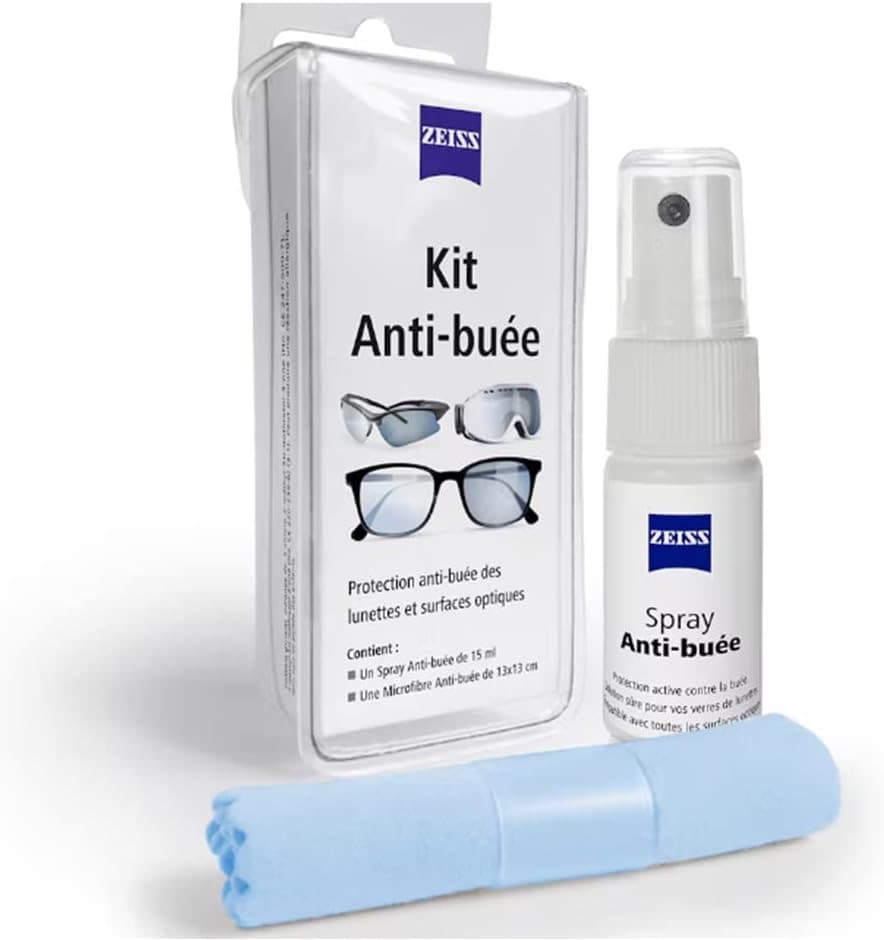
The anti-fog spray comparison lists bottles sold on amazon.co.uk. The top pick is the ZEISS Anti-Fog kit, ASIN B0BSHCT7VX, at £6.99: a 15 ml spray and a 13 cm microfibre cloth. The listing shows 4.3 out of 5 from 723 reviews and says one application lasts two to three days, beside ZEISS's note of about every 72 hours. Both are claims. This comparison did not time them on a masked face. The title mentions a pool mask, and the listing does not answer swimming goggles. The kit matches spectacles you spray and wipe dry. It is a weak match for a lens you rinse, and it is not PPE.
It does not convert ordinary lenses into safety glasses. Several pairs recoated every few days will empty 15 ml long before a 100 ml bottle empties. Problem Solved's anti-mist spray, B08YKCYWNJ, is that larger bottle, £5.49, listed for glasses, visors, goggles, and helmets, with 3.6 out of 5 from 319 reviews. Reviews that describe a method say spray, leave it to dry, then buff. Several UK reviews say a helmet visor still fogged, so the larger bottle is not proof that any lens under a mask will stay clear.
Swim gels in the same table are rinsed treatments for masks and goggles. They are not ranked here. The how to apply page holds the steps, and the safety glasses page stays with marked eyewear. If prescription glasses are not the safety pair, the kit is only a comfort product. You still wear the impact, dust, or splash protection the task requires.
Who chooses the eye protection
At work, eye protection that the risk assessment requires is chosen and paid for by the employer. HSE's pages on selection expect suitable PPE, a conformity mark, and instructions the user can follow. L25 includes misting, because a protector you cannot see through is not doing the job. Unmarked glasses and a shared bottle do not finish that selection. A worker told to buy their own pair for a required task sits under the free-provision rule HSE states for PPE the assessment requires.
You can still check the things that do not rewrite the assessment. Look for N on the lens if a mask is part of the task, and keep the frame marks legible. Confirm the respirator is the model that was selected, sealed the way that model is designed to seal. If the only way to see is to break that seal, stop. The substitute is eyewear specified for that hazard, not a slit in the mask.
Ordinary prescription spectacles are not safety glasses. A spray may let you see through them. The impact performance still lives on the marked protector. A crazed lens, a bent frame, or a stretched headband is out of service. If you are self-employed, match the marks to the hazard, then use a treatment the maker allows. The buying guide compares bottles. It does not choose your PPE.
Prices are amazon.co.uk shelf prices as Amazon showed them: £6.99 for the ZEISS kit and £5.49 for the Problem Solved 100 ml bottle. Review counts are shopper scores, not laboratory scores. Products Compared did not wear the masks, time the fog, or certify a lens. The mechanism and the duty come from Bollé Safety UK, JSP's misting guidance, ZEISS UK's anti-fog note, and HSE's L25 and PPE selection pages. A qualifying purchase through a link can earn a commission at no extra cost to you.
Common questions
Why do safety glasses fog more with a mask?
Will anti-fog spray fix safety glasses under a mask?
Should I buy N-marked lenses instead of a spray?
Does opening a gap in the mask help, and is that safe?
Can I use the same spray on prescription glasses and on PPE?
How often do I reapply under a mask?
Who should choose the eye protection at work?
Are these timings from a lab test?

Products Compared publishes British-English buying guides based on amazon.co.uk listings and public UK sources. We do not run a lab and we do not invent test scores.
Related articles

What the N mark means on safety glasses
N is a fogging mark on the lens. A bottle of spray does not print it onto the frame or the ocular.

How often to reapply anti-fog spray
A 72-hour spectacle claim is a different clock from a goggle you rinse every swim.

When to replace scratched safety glasses
A crazed lens is a replacement. Coating a damaged ocular does not restore the view.