Pinlock or anti fog spray visor: a seal beats a film

Pinlock or anti-fog spray on a visor: an insert is a sealed second lens. Spray sheets droplets and then wears off. It does not approve the helmet either.
On this page
The visor is up a crack at the lights because the inside has gone milky, and the rain is already on the outside. Pinlock or anti-fog spray is the choice riders argue about in that exact spot. One of them adds a second lens and a seal. The other leaves a film that sheets water for a while and then gives up.
This page is that split. It is not a helmet approval, and it is not a recipe for washing-up liquid. Prices are amazon.co.uk shelf prices. Products Compared did not ride in the rain, fit an insert, or time a spray. A qualifying purchase through a comparison link can earn a commission at no extra cost to you.
In short
On a visor with pins, a Pinlock-style insert is a sealed, moisture-absorbing second lens. Anti-fog spray sheets droplets and wears off. Spray can still be the treatment for spectacles inside the helmet, or a stopgap on a visor with no pins. It does not make the helmet legal, and UK reviews of the visor-titled bottles include visors that fogged anyway.
Why the visor fogs
Your breath is warm and wet. The visor is a cold sheet between that air and the rain. Moisture from the breath lands on the inner face and scatters the light, which is the milk you see at a junction. Rain on the outside is a separate film. Wiping the inside with a glove at 30 mph is how scratches start, and it does not change the temperature difference that put the mist there.
A helmet holds that breath closer to the visor than open air would. A scarf over the chin, a closed vent, or a winter ride makes the inner air wetter. Cracking the visor dumps some of that air, and it also dumps rain and grit onto the lens. Ride Guard reviews include riders who opened the visor because the spray had failed. That report is a workaround, not a method to copy in traffic.
The same breath mists spectacles worn under the helmet. Those lenses are not the visor. They sit in a smaller volume of air, they may already carry their own coating, and they fog for the same reason: warm moisture on a cold surface. Treating the helmet as one surface leads people to spray the visor, the glasses, and the outer rain film from one bottle.
None of this is an EN 166 problem. GOV.UK's note on PPE enforcement says helmets and visors under UNECE Regulation 22 sit outside the PPE Regulation's scope for eyewear. The N mark on safety glasses is an ocular fogging character for workshop eye protection. It is not printed on a motorcycle visor by a spray, and it is not the legal description of your helmet. The N-mark article stays with that PPE mark.
What an insert changes
Pinlock's own description of the insert is a moisture-absorbing lens and an airtight seal. Motorcycle News puts the same construction in plainer kit language: a double-glazed visor, plus a hydrophilic lens, as distinct from a spray that sheets droplets and then wears off. The pins locate the insert. The seal keeps wet breath out of the gap between the two layers.
The visor needs the pin geometry the insert was made for. Pressing a loose lens against the plastic does not create a seal, and gluing one in modifies a visor that was approved as a visor. If the pins are there and the insert is the one sold for that visor, fit it as the instructions say. Replace it when it is crazed or the seal no longer sits down.
An insert does not clear the outside of the visor. Rain beads or sheets out there according to the outer coating. A hydrophobic outer treatment, if the maker allows one, is a different product from the inner insert. Look at which face is wet before you change the inner lens.
Billy's Crash Helmets sets the insert against the habits people actually use: spit, washing-up liquid, and sprays. The insert is in that comparison because it is a part, not a smear. Muc-Off appears in the Motorcycle News round-up as their example, not as a reason to skip the pins.
What a spray can still do
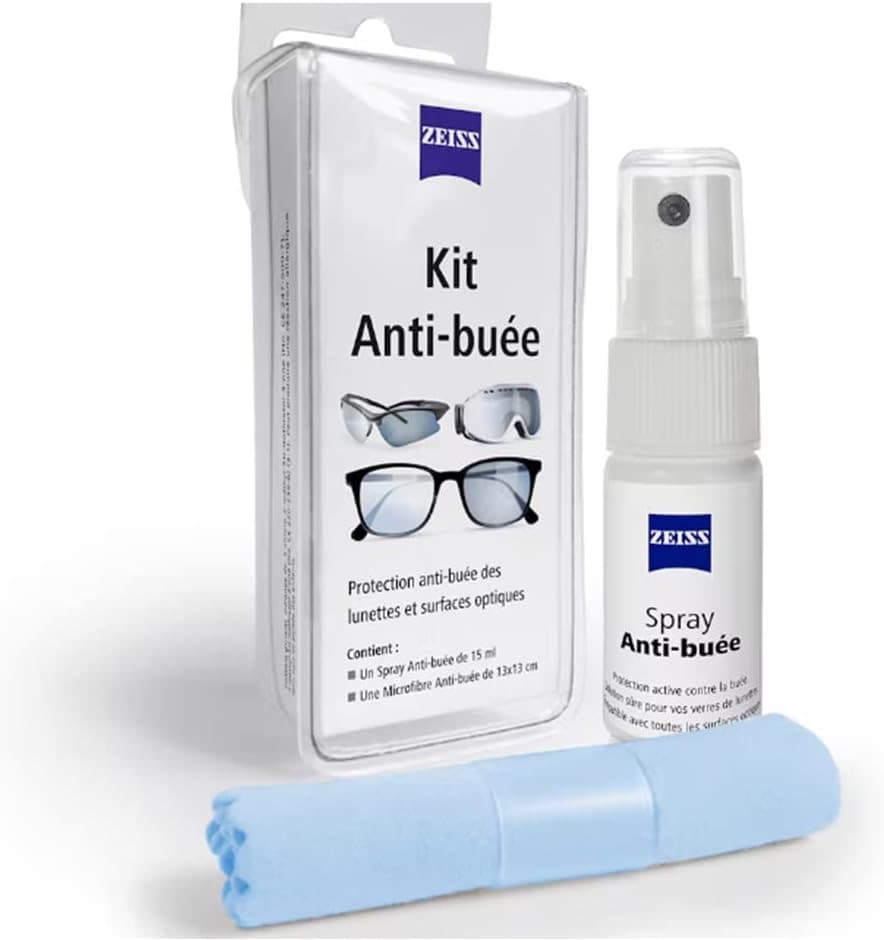
A spray still has two honest jobs. The first is spectacles or sunglasses inside the helmet, if that lens maker allows the fluid. The top pick in the anti-fog comparison is the ZEISS Anti-Fog kit, B0BSHCT7VX, at £6.99: 15 ml and a 13 cm cloth, 4.3 out of 5 from 723 reviews. The listing says two to three days. ZEISS's UK note says about every 72 hours. You spray, then wipe dry with the cloth.
That method is for a lens you can take off and buff. It is a weak match for a dive mask or a goggle you rinse, and it is not a sealed visor. Steps are on the how to apply page. Bottle sizes are on the buying guide.
The second job is a visor with no pins, where you accept a wearing film. Problem Solved, B08YKCYWNJ, is 100 ml at £5.49, 3.6 out of 5 from 319 reviews, listed for glasses, visors, goggles, and helmets, and marked made in Great Britain. Reviews that describe a method say spray, leave it to dry, then buff lightly. One costume-helmet review stayed clear for a day after two applications. Several UK reviews say a helmet visor still fogged.
A costume lid and a road visor are not the same duty. The germ-removal line on that listing is copy, not a result from this comparison. Ride Guard, B0GVW6XKNG, is two 50 ml bottles from McKLords at £11.30, 3.9 out of 5 from 69 reviews. The listing says a few sprays, then a wipe or air dry, and it names motorcycle visors among ski goggles, safety glasses, and diving masks.
The UK sample on the Ride Guard listing is 14 reviews. Several describe fog across a motorcycle visor, glasses fogged inside a helmet, and swim goggles that still misted. A wide title is not a method that held. If you use it, use it on bike goggles or glasses you will actually wipe. When the mist returns, reapply or stop relying on the film. The reapply article keeps the 72-hour spectacle claim away from a visor in British rain.
What not to smear on the visor
Do not put washing-up liquid, neat or diluted, on a visor because a forum said it sheets water. Do not spit on the inside. Those are the habits Billy's lists beside sprays, and they are not a labelled system with a seal.
Detergent left in a smear attracts dirt and can dull a coating the helmet maker told you to clean with a soft cloth and water. Spit is a poor idea on a surface that sits against your eyes for an hour. This page does not publish ratios, dwell times, or a kitchen method.
Do not spray the outer face if the outer coating is hydrophobic and the bottle is written for an inner lens. Do not use a solvent, a cream cleaner, or a paper towel on a coated visor. If the helmet maker names a visor spray, use that one, on the face they name. If they say the insert is the anti-fog system and the visor should only be rinsed, the insert is the system.
Do not read a clear half-hour as a legal state. A bottle cannot put a helmet back into conformity under UNECE Regulation 22, and EN 166 does not move across from safety glasses because both objects are clear plastic. If the visor is cracked, hazed through, or the helmet shell is damaged, replace the part. Spray on a cracked visor is a clean view of a broken part.
Pinlock's seal description is the maker's. The double-glazing contrast is Motorcycle News's. The visor complaints are reviews on the Ride Guard and Problem Solved amazon.co.uk listings. The commission does not turn a film into a pin seal.
Common questions
Is a Pinlock insert better than anti-fog spray on a visor?
My visor has no pins. What then?
Can I spray the glasses I wear inside the helmet?
How long does visor spray last?
Does spray damage the visor coating?
Is washing-up liquid or spit a safe substitute?
Does anti-fog spray make my helmet legal?
Muc-Off is on a magazine list. Is that your winner?

Products Compared publishes British-English buying guides based on amazon.co.uk listings and public UK sources. We do not run a lab and we do not invent test scores.
Related articles

How often to reapply anti-fog spray
A 72-hour spectacle note is the wrong clock for a visor that mists in the rain.

Why safety glasses fog with a mask
The same moist breath, on a different lens. A spray still does not print an N mark.

What the N mark means on safety glasses
N is an ocular mark on PPE eyewear. A motorcycle helmet sits under a different regime.