How to fit a valved FFP3: the seal check each time
You have a valved disposable in your hand and you want to know whether it will seal before you sand. How to fit a valved FFP3 is a routine you repeat every time, and a stop when that routine is not enough. Air has to come through the material, not through a gap at the nose, the cheek, or the chin. A sharp breath at the kitchen table is a user seal check, not a workplace fit test, and it will not succeed over a beard. The leaflet outranks this page if the two differ. The boxes are in the [FFP3 mask with valve](/hub/medical-protection/ffp3-mask-with-valve) comparison. A qualifying purchase can earn a commission at no extra cost to you.
You have a valved disposable in your hand and you want to know whether it will seal before you sand. How to fit a valved FFP3 is a routine you repeat every time, and a stop when that routine is not enough.
You have a valved disposable in your hand and you want to know whether it will seal before you sand. How to fit a valved FFP3 is a routine you repeat every time, and a stop when that routine is not enough. Air has to come through the material, not through a gap at the nose, the cheek, or the chin. A sharp breath at the kitchen table is a user seal check, not a workplace fit test, and it will not succeed over a beard. The leaflet outranks this page if the two differ. The boxes are in the FFP3 mask with valve comparison. A qualifying purchase can earn a commission at no extra cost to you.
Our top picks
| Badge | Product | Fastening | Shape | Nose clip | Note | Price | Offer |
|---|---|---|---|---|---|---|---|
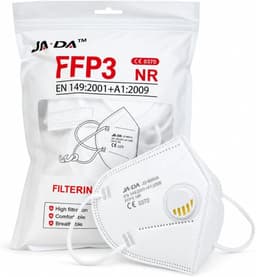
| Best overall |  Spanner In The Works Spanner valved FFP3, pack of 10 | Not stated. Reviews describe ear loops | Not stated. Reviews describe a flat mask | n/a. Reviews mention a sponge nose bridge | 6.5 | about £12.95 | View offer |
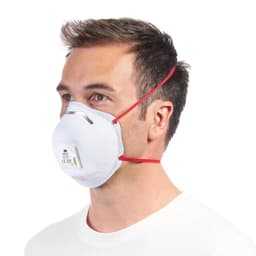
 3M 3M Aura 9332+, valved, pack of 10 | Headbands, red for FFP3. An attribute says clip | Three-panel. A shape field also says cup | Adjustable | 7.2 | about £58.03 | View offer | |
| Alternative |  3M 3M 8833 valved FFP3, pack of 2 | Twin headband | Cup | Nose foam is named. An adjustable clip is not | 4.5 | about £16.21 | View offer |

On this page
Before it touches your face
Putting it on
The seal check on a valved mask
When this page is not enough
Common questions
What do you do if air leaks at the nose?
Can you fit it over a beard?
Do glasses go on before or after the check?
Is a mirror check the same as a face fit test?
When do you throw an NR mask away?
Related pages
Sources
Public UK sources named below. amazon.co.uk prices, stars and review counts on these five listings were read on 19 October 2026. Page updated 21 October 2026.
- HSE, disposable dust masks (retrieved 19 October 2026)
- HSE, COSHH essentials R3 (retrieved 19 October 2026)
- HSE, fit testing basics (retrieved 19 October 2026)
- HSE, cutting and sanding wood (retrieved 19 October 2026)
- HSE, PPE supply (retrieved 19 October 2026)
- GOV.UK, PPE marking (retrieved 19 October 2026)
- NHS England, valved FFP3 respirators, 25 August 2021 (retrieved 19 October 2026)
- SATRA on EN 149 (retrieved 19 October 2026)