Independent comparisons. We may earn from shop links. More info

FFP3 mask with valve for wood dust after extraction

Updated: 21 October 2026

You are about to sand a door or run a circular saw through softwood, and the fine dust is the part you do not want in your lungs. An FFP3 mask with valve for wood dust is the class the Health and Safety Executive points at for most cutting and sanding, worn after extraction. The valve does not earn that class. If the sanding runs for more than about an hour, a disposable is the wrong plan. The boxes are compared on [FFP3 mask with valve](/hub/medical-protection/ffp3-mask-with-valve). A qualifying purchase can earn a commission at no extra cost to you.

You are about to sand a door or run a circular saw through softwood, and the fine dust is the part you do not want in your lungs.

Our top picks

On this page

What HSE asks for on this job

HSE’s page on cutting and sanding wood puts on-tool extraction first, at least M class, H class where the task needs it, with an antistatic hose. Respiratory protective equipment comes after that. For most cutting and sanding, particularly in enclosed spaces, HSE asks for an assigned protection factor of 20, and an FFP3 disposable is the example. A 15 to 30 minute burst of trigger time can still need that protection. It is not the one-hour limit below. The factor of 20 assumes a clean-shaven seal. It is not a property of the valve. If you are choosing which marks to insist on, use the FFP3 valved mask buying guide. A hobby vacuum with no class rating is not repaired by stepping from FFP2 to FFP3.

Where the valve fits

Wood dust is a particle, so the filter and the seal are what HSE’s class is about. The valve lets warm air out, which is why some wearers say glasses steam less. Reviews in this set disagree: one person still had fogged goggles, and another said safety glasses steamed less. MDF, hardwood, and old paint are dust jobs reviewers mention. If the dust is making you wheeze, HSE notes a raised risk of occupational asthma for carpenters and joiners, and health surveillance is a workplace decision. A new box of masks is not that advice.

How long, and when to change approach

WIS23 says disposable filtering facepieces are a poor choice for more than about one hour. WD7 says that if sanding continues past that, powered respiratory protective equipment is the usual step up, and a disposable is discarded at the end of the shift or when breathing gets hard. HSG53 also limits continuous wear of this row to under one hour. A short burst with extraction running can match this category. A day of floor sanding cannot, even at FFP3. Facial hair rules the mask out. Glasses can lift the nose seal, which WIS23 notes, so you check again after they are on. If the seal check fails, you do not start the tool.

What buyers in this set used them for

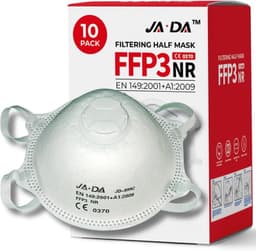
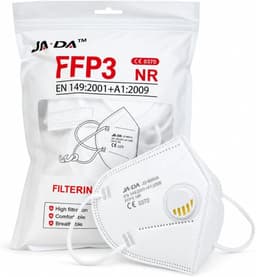
The review notes are user stories, not a filtration test. On the Spanner valved ten-pack, buyers describe sawing, sanding, loft soot, MDF, and woodturning. On the moulded Spanner box, they describe sanding old paint and a circular saw. On the 9332+ listings, sanding and loft insulation appear. The 8833 pair has no review text. None of that shows a protection factor of 20 on the day. You still need the extractor, a clean-shaven seal, and a mask you throw away when breathing gets hard. Which box prints the standard, names the valve, and has one pack count is the job of best FFP3 mask with valve. A valve that exists only in a small review sample is a weaker reason to buy than a valve the listing itself names.

Common questions

Is FFP3 the class HSE points at for sanding wood?
Yes, as an example of assigned protection factor 20, after on-tool extraction, for most cutting and sanding and particularly in enclosed spaces. HSE’s construction page is the source. The class assumes a mask that fits. A valved FFP3 that leaks at the nose is not delivering that factor, and a title that merely says FFP3 has not shown you EN 149.
What has to happen before the mask?
Extraction. HSE asks for on-tool extraction of at least M class, H class where the task requires it, and an antistatic hose. A household vacuum with no dust class is not that control. You then put on a fitting FFP3 if the task still needs assigned protection factor 20. The mask is additional. It is not the first or only control.
How long can a disposable stay on?
WIS23 and WD7 treat disposables as unsuitable for continuous woodworking beyond about one hour, and as something you discard at the end of the shift or when breathing gets hard. HSE’s separate remark about 15 to 30 minutes of trigger time is about short, dusty tasks that still need protection. It is not a second way of saying the one-hour limit. Do not add the numbers together.
What if the sanding goes on for more than an hour?
Plan on powered respiratory protective equipment rather than another disposable from the same box. WD7 states that step for hand-held sanding that continues past about one hour. A cheap ten-pack does not become an all-day mask because it has a valve. If you are already past that point and still in a disposable, stop and change the approach before you carry on.
Which kept listings do buyers actually mention for sanding or sawing?
Review text for the Spanner valved ten-pack mentions sawing, sanding, MDF, and woodturning. The moulded Spanner notes mention sanding paint and a circular saw. 9332+ reviews mention sanding. The 8833 file has no reviews to cite. These are reports of use, not proof that any listing met a protection factor. Match the printed marks on the best page before you treat a review as a recommendation.

Related pages

Sources

Public UK sources named below. amazon.co.uk prices, stars and review counts on these five listings were read on 19 October 2026. Page updated 21 October 2026.

  1. HSE, disposable dust masks (retrieved 19 October 2026)
  2. HSE, COSHH essentials R3 (retrieved 19 October 2026)
  3. HSE, fit testing basics (retrieved 19 October 2026)
  4. HSE, cutting and sanding wood (retrieved 19 October 2026)
  5. HSE, PPE supply (retrieved 19 October 2026)
  6. GOV.UK, PPE marking (retrieved 19 October 2026)
  7. NHS England, valved FFP3 respirators, 25 August 2021 (retrieved 19 October 2026)
  8. SATRA on EN 149 (retrieved 19 October 2026)