Independent comparisons. We may earn from shop links. More info

How to use a lux meter

Updated: 22 October 2026

The digits on a new illuminance meter will not match tomorrow's note unless the method matches too. How to use a lux meter, for the handhelds in this amazon.co.uk set, is a short habit: cap off, unit written down, sensor on the task, body out of the light, factor included. One point is not a room average and not a legal survey. If you have not bought yet, the table is the [light meter comparison](/hub/measuring-equipment/light-meter). Peter F. did not calibrate the samples. A qualifying purchase can earn a commission at no extra cost to you.

The digits on a new illuminance meter will not match tomorrow's note unless the method matches too.

Our top picks

Dr.meter Dr.meter LX1330B

Best overall

Dr.meter Dr.meter LX1330B
6.6/10about £29.99
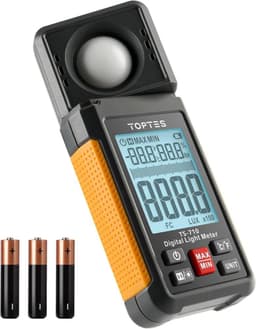
TopTes TopTes TS-710

Rank 2

TopTes TopTes TS-710
7.4/10about £29.99
On this page

Before you trust the first number

Take the white cap off, and put it back for storage if the meter has one. Reviews of the TopTes, the BINTA, and the Dr.meter mention that cap. Leave it on and you meter a diffuser, usually far too low. Fit the cells and glance at the battery mark. A fading cell can look like a fading room. Write lux or foot-candles in the notebook. One foot-candle is about 10.76 lux. Temperature on the same screen is not illuminance. Let discharge lamps warm up. A laboratory note uses about 15 minutes, as guidance rather than UK law. LEDs generally settle faster. What the families omit is the light meter buying guide.

Put the sensor on the task

A meter reads one point, not a room average. For a desk, a UK survey note uses about 0.75 m, and an Australian lab note, useful only as method, uses about 0.72 m for a desk and about 0.85 m for a bench. Use the real task height if you know it. Corridors are measured at the floor. Plants are on the light meter for plants page. Stand in the beam and the reading falls while the room has not changed. Step aside, or use hold and then move. The TopTes head turns through about 180°. The Dr.meter cable and the yellow URCERI split head leave the sensor on the desk.
Dr.meter Dr.meter LX1330B

Testsieger

Dr.meter Dr.meter LX1330B
6.6/10about £29.99

Read the factor, not just the digits

On the black V·Resourcing, a UK owner watched the display move from a decimal, to whole lux, to a klux mark. Write the factor. A ×10 mark means multiply by ten, not that the meter is more accurate. A BINTA review describes a factor change above about 2,000 lux. That review is not marked United Kingdom. Two brands can disagree under blue-rich LEDs because many photometers are calibrated toward tungsten. The Institution of Lighting Professionals notes that an LED does not by itself need a special meter. Repeat with the same meter, the same factor, and the same plane.

When to stop and not file the number

Stop if the meter was dropped. A UK Sekonic review described readings that reversed after a fall, with no crack. Retire it. A return under the Consumer Rights Act 2015 is the route for a dead unit. One window reading is not a workplace survey. Regulation 8 of the Workplace (Health, Safety and Welfare) Regulations 1992 requires suitable and sufficient lighting and states no lux figure. None of these listings states BS 667 Type F. Write the time and the weather if daylight is in the scene. If the job is an f-stop, this was the wrong instrument.

Common questions

Do I take the white cap off?
Yes, whenever you are measuring. The cap is for storage and transport on the meters that include one, including models reviewers cite such as the TopTes, the BINTA, and the Dr.meter. Measuring through the cap cuts the light, so tomorrow's cap-off reading will not match.
Where do I hold the sensor for a desk?
At the working plane, where papers or a keyboard actually sit. Conventions in the notes we used are about 0.72 m to 0.75 m for a desk and about 0.85 m for a bench. Face the cell toward the light that serves that spot, and keep your body off to the side. One point is that spot only.
Why does the number jump when I move?
Because illuminance changes with distance, angle, and shadow, and these meters update quickly. A few centimetres toward a lamp, or a hand across the cell, moves the digits. That is the meter seeing a new point, not a fault by itself. Freeze the reading with hold if you have it, step back, and see whether the jump was your silhouette.
What does ×10 or klux mean?
It is a range factor, not a second kind of light. Klux means multiply the digits by 1,000 to get lux. A ×10 annunciator means multiply by ten. A UK review of the V·Resourcing shows the screen walking through those modes, including a reading that looks small because the unit is large. Write the factor in the note.
Should I stand between the lamp and the meter?
No. Your body becomes the measurement. Stand to the side, or place a remote head on the desk and step away. The TopTes swivel, the Dr.meter cable, and the yellow URCERI split head make that easier. Hold exists so you can capture the digits and then move.
How long should lamps be on first?
Let discharge lamps warm up. A practical laboratory note uses about 15 minutes. Treat that as guidance, not a legal wait. LEDs usually need less. Use the same wait for both fittings. A lamp at switch-on is not a fair pair with one measured later.
Can one reading prove an office is legal?
No. UK workplace law asks for suitable and sufficient lighting and does not print a lux pass mark. A survey uses a grid, a plane, and a meter of a stated class. None of these listings states BS 667 Type F. One window reading cannot close a compliance file.
What do I do if the meter was dropped?
Stop using it for any decision you would mind getting wrong. A Sekonic reviewer saw readings reverse after a drop with no visible crack, so an intact case is not proof. If it disagrees with a second meter on a known lamp, retire the dropped one.

Related pages

Sources

Public UK and manufacturer sources from the research digest. Shelf prices and star lines are the amazon.co.uk figures in this batch, not a live recrawl. The price bands are this set, not a market average.

  1. Workplace (Health, Safety and Welfare) Regulations 1992, regulation 8 (retrieved 22 October 2026)
  2. HSE HSG38: Lighting at work (retrieved 22 October 2026)
  3. HSE: Lighting (retrieved 22 October 2026)
  4. BSI: BS EN 12464-1:2021 (retrieved 22 October 2026)
  5. BSI: BS 667:2005 illuminance meters (retrieved 22 October 2026)
  6. ILP Guidance Note 7: choosing a photometer (retrieved 22 October 2026)
  7. Sekonic L-308X specification (retrieved 22 October 2026)
  8. Michigan State University: light terminology for plants (retrieved 22 October 2026)
  9. Royal Veterinary College: reptile heating and lighting (retrieved 22 October 2026)