Independent comparisons. We may earn from shop links. More info

Light meter for plants

Updated: 22 October 2026

A houseplant on a UK windowsill looks tired, and the grow lamp was sold in watts, which says nothing at the leaf. Lux is what a human eye weights. Plants use photosynthetic photon flux density, in micromoles per square metre per second. This shelf has no quantum sensor. You can rank the same lamp at two heights. Do not publish a converted PPFD as if it were measured. The table is the [light meter comparison](/hub/measuring-equipment/light-meter). Peter F. did not laboratory-test these meters. A qualifying purchase can earn a commission at no extra cost to you.

A houseplant on a UK windowsill looks tired, and the grow lamp was sold in watts, which says nothing at the leaf. Lux is what a human eye weights.

Our top picks

Dr.meter Dr.meter LX1330B

Best overall

Dr.meter Dr.meter LX1330B
6.6/10about £29.99
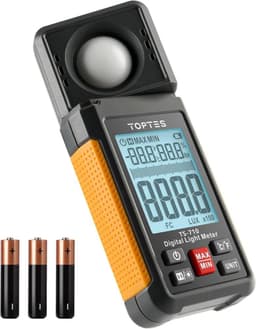
TopTes TopTes TS-710

Rank 2

TopTes TopTes TS-710
7.4/10about £29.99
On this page

What the plant is using

A room that feels bright at 9pm can still be dim for a leaf. Michigan State University treats lux and foot-candles as units weighted for human vision, not for photosynthesis. Virginia Tech's note on daily light integral says the eye is a poor judge. The Royal Horticultural Society talks about aspect and season and does not publish a lux table. Do not invent one. A lux meter can compare one lamp, one spectrum, at two distances, sensor at the canopy. It cannot give the micromole rate of a red-and-blue lamp or the UVB in a reptile tube. A V·Resourcing reviewer mapped visible bright spots in a tank. The Royal Veterinary College says UVB needs a UVB meter.

A fair lux comparison

Hold the sensor at the leaf, not on the lamp housing. A reading on the shade cap flatters a weak lamp. Cap off, cell facing as the leaf faces, hand out of the beam. Write the height. 18 cm and 2,400 lux against 40 cm and 700 lux is a comparison. The lamp is 2,400 is not. Change only the distance. Noon daylight and a white LED can both read 3,000 lux and still differ. Watts were never lux. Cap, plane, and range factor are in how to use a lux meter.
Dr.meter Dr.meter LX1330B

Testsieger

Dr.meter Dr.meter LX1330B
6.6/10about £29.99

When the conversion is a guess

Hobby tables sometimes say a white LED is about 15 micromoles per square metre per second for every 1,000 lux, and nearby notes say about 14. That is a rule of thumb for white LEDs only, if you name the spectrum. It is a poor fit for red-blue lamps. Write white LED, rule of thumb, not measured PPFD beside any sum. Do not attribute a lux chart to the RHS. If yield depends on spectrum, or you run a commercial bench, use a quantum meter. A plant review here preferred a lux meter to a phone app. Neither tool is calibrated PPFD.

Which meter in this set, and what to skip

Any illuminance meter here can rank one spectrum against itself. A title that mentions plants does not add a quantum filter. The TopTes turns through about 180°, which helps at a canopy. It is still not a PAR meter. The black V·Resourcing at £16.99 is the cheaper lux tool if you watch the range factor. Skip the TTArtisan and the Sekonic: a shoe meter has no lux at the leaf, and the Sekonic lux mode wants a lumidisc this kit does not list. A France-marked review of the yellow URCERI says it is weak below about 20 lux. The family split is the light meter buying guide.

Common questions

Can a lux meter tell me if a grow light is strong enough?
It can tell you whether one position gets more of that same light than another. It cannot give a micromole target, and this set has no PAR meter. For a white lamp, the higher lux reading at the leaf is the stronger spot. A wattage on the box is not a substitute.
What is the difference between lux and PPFD?
Lux is illuminance weighted for human vision. PPFD counts photons in the photosynthetically active band and is reported in micromoles per square metre per second. A leaf does not use the lux weighting. Two lamps can match in lux and differ for the plant, especially if one is red and blue. Use lux to compare one spectrum with itself.
Can I convert lux to micromoles?
Only as a labelled rule of thumb, and only for white LEDs. A figure near 15 micromoles per 1,000 lux appears in hobby tables and is discussed in the research literature. It is spectrum-specific and a poor fit for red-blue lamps. Write the assumption next to the number. Do not treat the result as a measured PPFD, and do not attribute a lux chart to the RHS.
Where do I hold the meter, at the leaf or at the lamp?
At the leaf, or at the height of the canopy you care about, with the cap off and your body out of the beam. A reading on the lamp housing ignores the fall-off to the lowest leaf. Note the distance in centimetres. Repeat with only one thing changed. For plants the task plane is the foliage, not the pot rim, unless the seedling is still at the compost.
Why do two white LEDs with the same wattage read differently?
Because wattage is electrical power, not illuminance at a leaf. Optics, spectrum inside white, and distance change the lux. Measure both at the same height and angle before you decide one has failed. If the gap remains, the meter has done its job. It has not told you the micromole rate of either lamp.
Is a phone app enough for houseplants?
An app is a weaker relative tool. A plant review in this set preferred a handheld lux meter to the phone. Neither is a quantum meter. If you already own a lux meter from this shelf, use that, at the canopy, and keep the phone for the note. If the decision is a crop's spectrum, neither the app nor these listings is the instrument.
Will this meter check a reptile UVB lamp?
No. Lux meters in this set read visible light. A reviewer mapped visible bright spots in a tank with a V·Resourcing meter, which does not measure UVB. The Royal Veterinary College's guidance points to a UVB meter for that lamp. Do not infer ultraviolet output from a lux number or from how bright the tube looks.

Related pages

Sources

Public UK and manufacturer sources from the research digest. Shelf prices and star lines are the amazon.co.uk figures in this batch, not a live recrawl. The price bands are this set, not a market average.

  1. Workplace (Health, Safety and Welfare) Regulations 1992, regulation 8 (retrieved 22 October 2026)
  2. HSE HSG38: Lighting at work (retrieved 22 October 2026)
  3. HSE: Lighting (retrieved 22 October 2026)
  4. BSI: BS EN 12464-1:2021 (retrieved 22 October 2026)
  5. BSI: BS 667:2005 illuminance meters (retrieved 22 October 2026)
  6. ILP Guidance Note 7: choosing a photometer (retrieved 22 October 2026)
  7. Sekonic L-308X specification (retrieved 22 October 2026)
  8. Michigan State University: light terminology for plants (retrieved 22 October 2026)
  9. Royal Veterinary College: reptile heating and lighting (retrieved 22 October 2026)