Independent comparisons. We may earn from shop links. More info

Safe hay storage moisture

Updated: 22 October 2026

You are in a UK barn and need to know whether the moisture means leave it, watch it, or call 999. Safe hay storage moisture is not one number for every bale. Fire services split small rectangular bales from large ones, and they treat temperature as a separate decision from the percent on a meter. This page follows Devon and Somerset, Avon, and Mid and West Wales Fire and Rescue Service, plus the AHDB drying target. The [hay moisture meter comparison](/hub/measuring-equipment/hay-moisture-meter) does not pick a probe here. Sampling is on the [how to use a hay moisture meter](/hub/measuring-equipment/hay-moisture-meter/sub/hay-moisture-meter-how-to-use) page. A qualifying purchase can earn a commission at no extra cost to you.

You are in a UK barn and need to know whether the moisture means leave it, watch it, or call 999. Safe hay storage moisture is not one number for every bale.

Our top picks

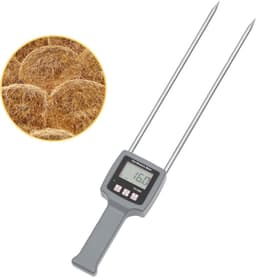
Kalageen Kalageen TK100H

Best overall

Kalageen Kalageen TK100H
8.1/10about £76.50
YUKERMARB YUKERMARB moisture meter

Alternative

YUKERMARB YUKERMARB moisture meter
4.8/10about £31.09
On this page

Wet hay is the fire risk

Hay stacked damp can heat by itself. Devon and Somerset Fire and Rescue Service says hay above about 22% moisture is more likely to heat, that hay above 15% can start heating within three to seven days, and that fires are most likely within six weeks of baling. A meter reading says whether the hay was damp enough to start heating. A thermometer on a schedule says whether it is still running. Call 999 when smoke or the temperature steps below say the fire service should have it.

Moisture bands for small and large bales

Devon and Somerset and Avon use the same bands. Small rectangular bales should not go above 18–22%. Large bales should not go above 16–18%. Mid and West Wales also uses 22% as a ceiling for stored bales. A large round at 20% is still outside the large-bale band. Hay dried to about 15–20% is an AHDB drying target for making the crop, not a fire statute. Use 15–20% in the field. Use 18–22% and 16–18% in the barn. If readings on one bale scatter, the higher credible figure decides. Devon and Somerset also asks for at least 10 metres between stacks.
Kalageen Kalageen TK100H

Testsieger

Kalageen Kalageen TK100H
8.1/10about £76.50

Temperature steps and who to call

Mid and West Wales warns that above 35°C hay can keep generating heat, and it offers a free temperature and moisture check on 0800 169 1234. Devon and Somerset’s separate note is that above 55°C the hay can produce flammable gas. The watching schedule from Devon and Somerset is then specific. At 65°C, check daily. At 70°C, check every four hours. At 80°C, wet the hay and remove it. At 85°C, flames are likely if air reaches the hot hay. At 100°C, call 999. Avon says not to walk on a suspect stack. Smoke or smouldering is 999 as well. A caramel or musty smell, in Avon’s wording, means start a temperature check.

Signs, and what a meter cannot certify

Steam, a sweet or sickly smell, browning, tobacco-like hay, and a sinking stack are the signs to take seriously. Caramel smell means you are already late for a moisture-only decision. Stay off the top, and do not open a hot stack to let it air. Air at that point feeds a fire. A meter does not certify the stack. No British Standard in the sources used here turns a handheld into an official test. The percent is evidence from your method. A stack climbing through 65°C is on the fire-service timetable.

Common questions

What moisture is safe for small square bales in a UK barn?
Devon and Somerset and Avon say small rectangular bales should not be stored above 18–22%. Above about 22%, hay is more likely to heat. If the pokes disagree, keep the higher credible figure. AHDB’s 15–20% drying target is the field aim, not a looser barn limit. A small square at 24% stays out of the stack.
What moisture is safe for large round or large square bales?
Large bales should not go above 16–18%. They hold heat and hide a wet core, so the band is tighter than for small squares. A large bale at 20% is under the 22% headline and still over the large-bale rule. A dry face is not 16% if the probe never reached the middle.
Is 22% the same rule as the AHDB 15–20% drying target?
No. About 22% is where Devon and Somerset says stacked hay is more likely to heat, and Mid and West Wales uses it as a ceiling. AHDB’s 15–20% is a drying target, not a fire statute. Large bales are tighter again, at 16–18%. Use one figure in the field and the other in the barn.
What should you do at 65°C, 70°C, 80°C and 100°C?
At 65°C, check daily. At 70°C, check every four hours. At 80°C, wet the hay and remove it. At 85°C, flames are likely if air gets in. At 100°C, call 999. Those Devon and Somerset steps are not the 35°C warning from Mid and West Wales, and not the 55°C note about flammable gas. Do not walk on the stack.
Why must you not walk on a stack that might be heating?
Avon says the inside can burn while the surface still holds you, until a pocket collapses. Check from the side, not by climbing. If the only look is from on top, that look is the wrong one. Smoke or a stack already at 100°C is 999, not a closer inspection.
Who offers a free bale temperature check in Mid and West Wales?
Mid and West Wales Fire and Rescue Service, on 0800 169 1234, for a temperature and moisture check when the stack is not smoking. Their early flag is hay above 35°C. Smoke or smouldering is 999, not that line. Outside the area, use your own fire service’s farm advice and still dial 999 for smoke.
When is the fire risk highest after baling?
Devon and Somerset says fires are most likely within six weeks, and that hay above 15% can start heating within three to seven days. A first warm spell is not proof the stack has finished. Keep checking through that window if the hay went in damp, if the temperature has climbed, or if you can smell caramel or see steam.

Related pages

Sources

Public UK sources from the research digest, last checked on 20 October 2026. Shelf prices and star lines are the amazon.co.uk figures captured with these three listings. The price bands are this set, not a market average.

  1. Devon and Somerset Fire and Rescue Service: storing hay safely (retrieved 20 October 2026)
  2. Avon Fire and Rescue Service: farm fires (retrieved 20 October 2026)
  3. Mid and West Wales Fire and Rescue Service: farm fire safety (retrieved 20 October 2026)
  4. AHDB: cutting management for multi-species swards (retrieved 20 October 2026)
  5. Wile 27 datasheet (retrieved 20 October 2026)
  6. Haymatic Digital manual (retrieved 20 October 2026)
  7. Delmhorst: measuring moisture in hay versus grain (retrieved 20 October 2026)
  8. National Society of Master Thatchers: material quality (retrieved 20 October 2026)