Independent comparisons. We may earn from shop links. More info

How to use a hay moisture meter

Updated: 22 October 2026

A hay moisture meter only helps if the next bale is measured the same way as the last. One poke on the dry face can hide a wet core, and two careless readings will not tell you whether the hay changed or the method did. You already have a probe. This page is the routine: where the tip sits, how many times you push, and what to do when the numbers disagree. The [hay moisture meter comparison](/hub/measuring-equipment/hay-moisture-meter) is the product table. If the stack is steaming or smells sweet, stop and use the [safe hay storage moisture](/hub/measuring-equipment/hay-moisture-meter/sub/hay-moisture-meter-safe-storage) page. A qualifying purchase can earn a commission at no extra cost to you.

A hay moisture meter only helps if the next bale is measured the same way as the last. One poke on the dry face can hide a wet core, and two careless readings will not tell you whether the hay changed or the method did.

Our top picks

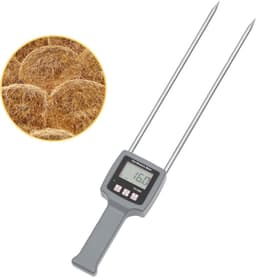
Kalageen Kalageen TK100H

Best overall

Kalageen Kalageen TK100H
8.1/10about £76.50
YUKERMARB YUKERMARB moisture meter

Alternative

YUKERMARB YUKERMARB moisture meter
4.8/10about £31.09
On this page

The meter only sees the hay at the tip

On a conductance meter such as the Haymatic Digital, only the tip senses. You are measuring the hay the tip touches, not a blend of the bale. If the tip sits in a gap between slices, the reading is the gap. The Haymatic manual tells you to go across the slices rather than between them, so the tip passes through layers instead of running along a crack. University of Florida extension material, a method note rather than a UK rule, suggests the uncut side and an angle around 45 degrees, then several readings. A fast display is still the hay at the end of the probe, not an average of the bale.

Several readings, not one face

Take more than one reading when the bale is large or the first figures disagree. The Wile 27 instructions use five readings on big bales, because moisture varies, and often one measurement on a small traditional bale. The Haymatic asks for at least five when the first results scatter. On a round bale the centre is often wetter than the face. Probe from more than one direction, as deep as the pin allows. Delmhorst’s guide for baled hay is about 10 to 18 inches. If your pin is a few centimetres, you measured the face. Write down the high figure as well as the average. A bale at 14% in four places and 24% in one is not a 14% bale.
Kalageen Kalageen TK100H

Testsieger

Kalageen Kalageen TK100H
8.1/10about £76.50

Density and the wet end

A tighter bale can read higher than a looser bale of the same hay. The Wile 27 has a density setting on some small-bale scales, and it often uses 180 kg/m³ as a shortcut when you have not weighed a small bale. That figure is a Wile shortcut, not a constant. Do not enter it on a TK100H, Yosoo, or YUKERMARB. They do not state a density scale. Compare the same bale type and the same press. Above about 30%, stop treating the digits as a precise percent. The Haymatic calls that region qualitative. Delmhorst calls it very wet. On the Haymatic, LO is below 10% and HI is above 80%. Leave that bale out of a fine storage decision.

Make the next bale comparable

Compare readings only when each poke hits hay at the tip, in more than one place, on the same kind of bale, and on the same scale if the meter has one. A grain code on one bale and a hay wording on the next are not a pair you can subtract. The Yosoo needs four AA cells, not included, and switches off after 15 minutes. The YUKERMARB switches off after 5 minutes. Finish the set for that bale before the meter sleeps, and discard a session if a low-battery icon stays on after a fresh set. The high figure you have checked twice is the one to carry forward. If bales steam, brown, sink, or smell sweet, the next step is a temperature check.

Common questions

How many times should you probe one bale?
Probe a big bale about five times. That is the Wile instruction and the Haymatic minimum, with extra tests if the first readings scatter. A small traditional bale often needs one measurement, repeated if it is high. One poke on the outer face is not the bale, and it is never the whole stack.
Should the probe go between the slices or across them?
Go across the slices. The Haymatic warns that a gap leaves the tip out of the hay, and on that meter only the tip senses. An angle around 45 degrees helps the pin stay in the stem. If it slides in with almost no resistance, you are in a gap. Pull it out and move.
Why is the middle of a round bale wetter than the face?
The face dries in the air and the core does not. A short probe keeps recording the outside. Do not stack a large round on that outer number. Several directions, as deep as the pin allows, are what show the wetter middle.
What does a reading over 30% mean?
Treat it as very wet. The Haymatic says readings over 30% are qualitative, and Delmhorst uses the same idea rather than a precise percent. A decimal there is not an oven moisture. Leave the bale out of a tight decision until you can measure drier hay the same way.
Does density change the number?
It can. Packed hay may read higher on a meter that responds to density. The Wile’s 180 kg/m³ shortcut is for that meter’s small-bale scales, not for the TK100H, Yosoo, or YUKERMARB. With no density control, compare the same bale type and the same press, and take several pokes.
What if the meter switches off after 5 or 15 minutes?
The YUKERMARB states 5 minutes and the Yosoo 15. Switch on again and finish that bale before you move. Do not average a half-finished round with a later session. Fit batteries first. A low-battery icon that survives a cell change is a reason to discard the session.
Can one reading stand for the whole stack?
No. One reading is the hay at the tip on that poke. Other bales still need their own checks, and big bales need about five because moisture varies. Carry forward the repeated high reading, not the driest face you could find.

Related pages

Sources

Public UK sources from the research digest, last checked on 20 October 2026. Shelf prices and star lines are the amazon.co.uk figures captured with these three listings. The price bands are this set, not a market average.

  1. Devon and Somerset Fire and Rescue Service: storing hay safely (retrieved 20 October 2026)
  2. Avon Fire and Rescue Service: farm fires (retrieved 20 October 2026)
  3. Mid and West Wales Fire and Rescue Service: farm fire safety (retrieved 20 October 2026)
  4. AHDB: cutting management for multi-species swards (retrieved 20 October 2026)
  5. Wile 27 datasheet (retrieved 20 October 2026)
  6. Haymatic Digital manual (retrieved 20 October 2026)
  7. Delmhorst: measuring moisture in hay versus grain (retrieved 20 October 2026)
  8. National Society of Master Thatchers: material quality (retrieved 20 October 2026)