Independent comparisons. We may earn from shop links. More info

Magnetic field meter or RF meter

Updated: October 2026

You said radiation and you might mean the fuse board, or the router. A magnetic field meter or RF meter is not one instrument with two labels. Milligauss is magnetism from current in a cable. Radiofrequency is a different band, in megahertz and gigahertz. This page says when you want each, on the [EMF meters](/hub/measuring-equipment/emf-meter) comparison. Peter F. updated it on 16 October 2026 from those amazon.co.uk files and from UKHSA, ICNIRP and Ofcom. No laboratory test. A qualifying purchase can earn a commission at no extra cost to you. UK mains are 230 V at 50 Hz. The [EMF meter buying guide](/hub/measuring-equipment/emf-meter/sub/emf-meter-buying-guide) puts the buying order around the split.

You said radiation and you might mean the fuse board, or the router. A magnetic field meter or RF meter is not one instrument with two labels. Milligauss is magnetism from current in a cable.

Our top picks

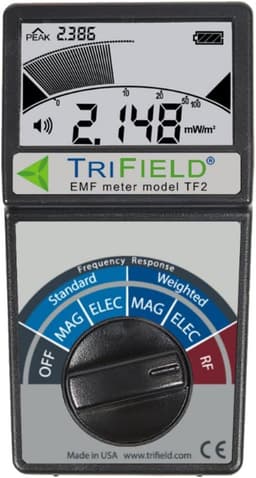
TriField TriField TF2 EMF Meter

Best overall

TriField TriField TF2 EMF Meter
7.5/10about £198.99
On this page

Two instruments hiding in one name

If the unit is milligauss or microtesla, you are looking at a magnetic field. Ten milligauss is 1 microtesla. Volts per metre is an electric field, which can remain around a plugged-in charger. You cannot turn milligauss into a radio unit. The public magnetic reference level UK policy points to, in Council Recommendation 1999/519/EC, is 100 µT at 50 Hz, with 5 kV/m electric. That is not a radio power-density limit. ICNIRP’s 2020 guidelines cover 100 kHz to 300 GHz. A meter specified up to 20 kHz cannot see a router. The RT-50 states 30 Hz to 20 kHz at £19.99 and still mentions Wi-Fi routers. The band does not include Wi-Fi. The KAIWEETS states the same span.

What counts as a magnetic meter

Magnetic LED indicators here are the RT-50, the KAIWEETS, the Spiritseek and the Eddrfy. The Spiritseek states 1.5 to 20+ mG and no frequency, so you cannot confirm a 20 kHz ceiling from the file. The LATNEX MG-2000T is the clear ELF meter: triple axis, 30 Hz to 2000 Hz, 2 to 200 µT, ±3.0%, £146.98, with 3.9 from 51 ratings and one written UK review. It claims no electric or radiofrequency mode. Buy it for a fuse board. Do not buy it for the router. The RT-100 shows an alarm at 0.4 µT or 40 V/m and does not state a radio band.
TriField TriField TF2 EMF Meter

Testsieger

TriField TriField TF2 EMF Meter
7.5/10about £198.99

What counts as an RF meter

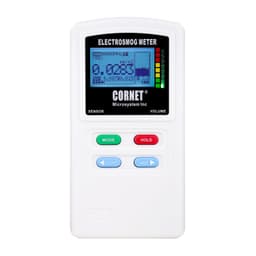
The Cornet ED98QPro5G listing prints 100 MHz to 8 GHz, at £194.99 with 4.4 from 115 ratings, plus magnetic, electric and light-flicker modes. The technical table’s part number is ED88T Plus, which does not match the title. You are choosing a stated band plus an unresolved part number. The TriField TF2, B078T2R64C, is £198.99 with 4.6 from 3,538 ratings. It names magnetic, electric and RF modes. The amazon bullets do not print frequency ends. AlphaLab’s manual, a separate file, states radiofrequency from 20 MHz to 6 GHz. Say manual when you use those ends. The best EMF meter page explains why that review file is the top pick, and why it is still not a compliance certificate.

Geiger, 5G, and Ofcom

The YOJOCK title says handheld Geiger counter. The bullets describe switched electric, magnetic and radiofrequency modes at ±5%, at £34.19. A Geiger-Müller tube counts ionising radiation. Nothing in that mode list is a tube. A gauss meter is not a Geiger counter, and a 20 kHz band does not see 5G. Ofcom’s EMF condition binds certain spectrum licensees, not a bedroom screenshot. A high LED step near a router is not a licence breach. The how to use an EMF meter page tells you how to hold the meter. It does not turn a kilohertz LED into a Wi-Fi meter.

Common questions

Will a milligauss meter see my router?
No. Milligauss is a magnetic unit. The RT-50 and the KAIWEETS state bands that stop at 20 kHz, which is mains magnetism, not Wi-Fi. A bullet that mentions a router does not add a gigahertz range. You need a listing that prints a megahertz or gigahertz span, such as the Cornet’s claimed 100 MHz to 8 GHz, and you should read that page’s part-number clash.
What unit tells me I am looking at magnetism rather than radio?
Milligauss or microtesla means magnetism. Volts per metre means an electric field. A radio listing in this set uses a radio unit or a stated gigahertz band, not a milligauss step. Ten milligauss equals 1 microtesla. Do not convert that figure into a radio power density, and do not set it beside the 100 µT reference level as if it were the same measurement.
Which listing in this set is ELF only?
The LATNEX MG-2000T. It states triple-axis magnetic fields from 30 Hz to 2000 Hz, 2 to 200 µT, ±3.0%, at £146.98. It does not claim electric or radiofrequency modes. The written UK review in the file is a single review. It fits a fuse-board log. It does not fit a Wi-Fi check.
Which listing prints a gigahertz band?
The Cornet listing prints 100 MHz to 8 GHz. It costs £194.99 and has 4.4 from 115 ratings. The same technical table says ED88T Plus, which does not match the ED98QPro5G title. The TF2 manual, not the amazon bullets, states 20 MHz to 6 GHz. Keep those two sources separate.
Why does the TF2 page have two different frequency stories?
The amazon bullets on B078T2R64C name magnetic, electric and radiofrequency modes and do not print the ends. The owner’s manual states magnetic coverage from 40 Hz to 100 kHz and radiofrequency from 20 MHz to 6 GHz. Both can be true of different documents. Do not write the manual’s ends onto the amazon specification as if the listing had printed them.
Is the meter with Geiger in the title a Geiger counter?
No. The YOJOCK title says Geiger counter. The function list is electric, magnetic and radiofrequency, switched one at a time, with a stated ±5%. That is not ionising radiation and not counts per minute. Reviews also call the readings erratic. Buy it only if you want those three modes and you will ignore the Geiger word.
Does a high reading let me complain to Ofcom?
No. Ofcom’s EMF condition applies to certain spectrum licensees, not to a consumer screenshot of a bedroom meter. A high LED step is not a licence breach. Faulty wiring, heat or scorch still goes to an electrician. A power-line measurement request goes to the network operator, as UKHSA describes.

Related pages

Sources

Public UK sources on home background, the 1999 reference levels, radiofrequency guidance and employer duties. Listing prices, stars and review themes are from the amazon.co.uk extracts in this comparison, dated 16 October 2026. Prices move.

  1. UKHSA, electromagnetic fields: sources and health effects (retrieved 16 October 2026)
  2. UKHSA, electromagnetic fields: policies and regulations (retrieved 16 October 2026)
  3. UKHSA, electric and magnetic fields: reducing exposure (retrieved 16 October 2026)
  4. Council Recommendation 1999/519/EC (retrieved 16 October 2026)
  5. ICNIRP, RF guidelines 2020 (retrieved 16 October 2026)
  6. Control of Electromagnetic Fields at Work Regulations 2016 (retrieved 16 October 2026)
  7. HSE, electromagnetic fields regulations (retrieved 16 October 2026)
  8. Society for Psychical Research, EMF meter note (retrieved 16 October 2026)