Independent comparisons. We may earn from shop links. More info

EMF meter for ghost hunting

Updated: October 2026

You have seen five lights and you want the same box for a dark landing. An EMF meter for ghost hunting is a magnetic indicator with colour steps. The lights respond to wiring, phones and movement. They are not a message. The still hold is on [how to use an EMF meter](/hub/measuring-equipment/emf-meter/sub/emf-meter-how-to-use), and the reference level is on the [EMF meter buying guide](/hub/measuring-equipment/emf-meter/sub/emf-meter-buying-guide). Peter F. updated this on 16 October 2026 from the [EMF meters](/hub/measuring-equipment/emf-meter) listings and from the Society for Psychical Research. They are not ghost detectors. No laboratory test. A qualifying purchase can earn a commission at no extra cost to you.

You have seen five lights and you want the same box for a dark landing. An EMF meter for ghost hunting is a magnetic indicator with colour steps. The lights respond to wiring, phones and movement. They are not a message.

Our top picks

On this page

What the five lights are doing

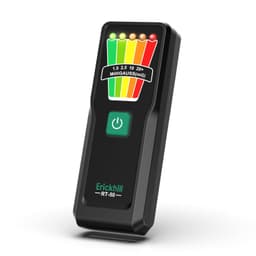
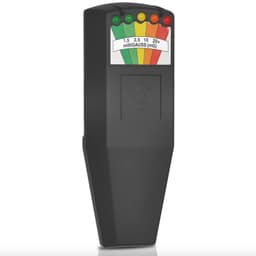
The hobby shape here is a row of lamps over roughly 1.5 mG to 20 mG. The Spiritseek states 1.5 to 20+ milligauss on five LEDs. The KAIWEETS KEMF-2 states 0.1 to 20 milligauss, 30 Hz to 20 kHz, ±5%. The RT-50 states 0–20+ mG and 30 Hz to 20 kHz. UK mains are 50 Hz, so a meter built around that band is doing its job when it lights beside a cable. PSI’s note on the K-II style says the flashing, including from waving the box, is why it became popular, and it was not designed as a paranormal tool. Our listings are not that branded K-II. The Eddrfy at £10.99 also prints 5 mGyS, which is not a magnetic unit, and UK reviews include a unit that stayed dead after a cell swap. If the lights never come on, you have a dead box, not a quiet room.

Walls and phones

A light beside a wall with no visible appliance is what a magnetic meter is for. Cables run inside partitions. UK reviews of the RT-50 describe it lighting near chargers, a microwave and wiring. A spike at the skirting is a reason to think about the cable route. A handset in a pocket, or a friend filming the lights, can flash a poorly shielded LED meter. Move every phone to another room. If the lamps pulse only beside the handset, you measured the phone. That pulse is not a code.

Movement, taps, and a spike you keep

Walking, waving, and tapping the case move the sensor and can jar the reading. Spiritseek reviews include a spike when the case is tapped. PSI notes flashing from waving a K-II style meter. If the colour changes only while someone is moving the box, do not write it down. Set the meter on a still surface and wait. Before you keep any spike, rule out a nearby cable or plugged-in charger, every phone in the room, and your own movement. If the step survives all three, you still have an unexplained magnetic reading, not a message.

If you still want one in the basket

The listings that match the video are the five-LED boxes. The RT-50 at £19.99 has 4.6 from 232 ratings, the longest file, and a battery line that conflicts. The KAIWEETS at £13.99 has 4.2 from 100 ratings, a 9 V cell in the box, and UK reviews that mention Halloween once the lights make sense. The Eddrfy is the one to skip if you want it to work out of the box. Where a band is stated, it stops at 20 kHz. Leave the RT-100 at home for a dark vigil. One buyer called that screen too bright. The TF2 is a poor buy if the goal is five lamps. The best EMF meter page says who should pay for separate modes. Heat, scorch, or a device that keeps tripping is an electrician, not a haunting.

Common questions

Will this meter detect a ghost?
No. It indicates a magnetic field, usually as five colour steps over a few tens of milligauss. The Society for Psychical Research states that EMF meters are not ghost detectors. A flash means the sensor saw a field, or a false coupling from movement or a phone, until you have ruled those out. It does not encode a sentence.
Why does it light beside a wall with no appliance?
Cables are often inside the wall. UK reviews of the RT-50 describe it lighting near wiring and being used to trace wires. That is the job of a 50 Hz magnetic indicator. A lamp at the skirting is a reason to think about the cable, not a reply from the room. Heat or scorch at a socket is an electrician’s problem.
Why does it flash next to a phone?
Phones and radios sit in bands and at distances that can couple into a cheap LED meter. Move every handset to another room and watch whether the step stops. If it pulses only beside the phone, you measured the phone. That pulse is not a code and not a second event.
Why does walking or tapping change the lights?
The sensor moves through the field, and a tap can spike the reading on its own. Spiritseek reviews mention a spike when the case is tapped. PSI notes that waving a K-II style meter makes it flash. Put the meter down, wait until the lamps settle, and only then decide whether a step remains.
Which listings are the hobby LEDs, and which are the wrong tool for a dark room?
The hobby LEDs here are the KAIWEETS KEMF-2, the RT-50, the Spiritseek and the Eddrfy, from £10.99 to £19.99. The Eddrfy has a dead-battery review and a 5 mGyS line that is not milligauss. The RT-100 is a bright numeric screen one buyer found wrong for a vigil. The TF2 is a three-mode meter, not a five-lamp prop.
What should I rule out before I keep a spike?
Rule out a nearby cable or plugged-in charger, every phone in the room, and your own movement or a tap on the case. If a still meter, with phones elsewhere, still shows a step, you have a magnetic reading you have not identified. You do not have a message. Write the place and the colour, then stop.
Is a high reading near a microwave a haunting?
No. Microwaves are ordinary strong sources at short range, and a consumer LED meter is not a door-seal test. A high step in the doorway is distance and the oven’s fields, not a presence. If the door, latch or seal looks damaged, or the oven sparks, stop using it and use a competent repairer.

Related pages

Sources

Public UK sources on home background, the 1999 reference levels, radiofrequency guidance and employer duties. Listing prices, stars and review themes are from the amazon.co.uk extracts in this comparison, dated 16 October 2026. Prices move.

  1. UKHSA, electromagnetic fields: sources and health effects (retrieved 16 October 2026)
  2. UKHSA, electromagnetic fields: policies and regulations (retrieved 16 October 2026)
  3. UKHSA, electric and magnetic fields: reducing exposure (retrieved 16 October 2026)
  4. Council Recommendation 1999/519/EC (retrieved 16 October 2026)
  5. ICNIRP, RF guidelines 2020 (retrieved 16 October 2026)
  6. Control of Electromagnetic Fields at Work Regulations 2016 (retrieved 16 October 2026)
  7. HSE, electromagnetic fields regulations (retrieved 16 October 2026)
  8. Society for Psychical Research, EMF meter note (retrieved 16 October 2026)