Independent comparisons. We may earn from shop links. More info

EMF meter buying guide

Updated: October 2026

You have typed EMF meter into a UK search and landed on boxes from about £11 to about £200. A few mention Wi-Fi. This EMF meter buying guide is the order of decisions before you compare those prices on the [EMF meters](/hub/measuring-equipment/emf-meter) page. Peter F. updated it on 16 October 2026 from those listings. No laboratory test. A qualifying purchase can earn a commission at no extra cost to you. UK mains are 230 V at 50 Hz.

You have typed EMF meter into a UK search and landed on boxes from about £11 to about £200. A few mention Wi-Fi.

Our top picks

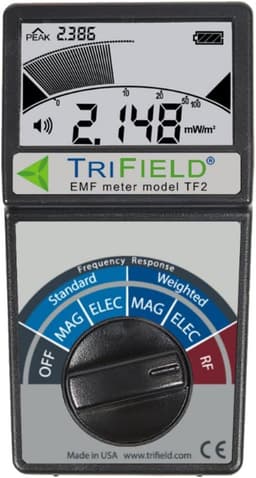
TriField TriField TF2 EMF Meter

Best overall

TriField TriField TF2 EMF Meter
7.5/10about £198.99
KAIWEETS KAIWEETS EMF Meter KEMF-2

Alternative

KAIWEETS KAIWEETS EMF Meter KEMF-2
7.1/10about £13.99
On this page

Name the field before the brand

Start with the job, then the brand. Magnetism from household wiring is milligauss or microtesla. An electric field is volts per metre. Radiofrequency sits in megahertz and gigahertz. The ERICKHILL RT-50, at £19.99, states 30 Hz to 20 kHz and 0–20+ mG. It can respond to UK mains magnetism. It cannot see Wi-Fi, even where a bullet mentions a router. The KAIWEETS KEMF-2 states the same span and 0.1–20 mG. The magnetic field meter or RF meter page sorts that split. You remove an electric field by unplugging, not only by switching off.

A number beats five lights

Five colour LEDs fold a wide span into one step. On a meter marked 0–20+ mG, 3 mG and 9 mG can look the same. Ten milligauss equals 1 microtesla. The Eddrfy at £10.99 prints 5 mGyS, which is not a magnetic unit, and lists no cell. UK reviews include a unit that stayed dead after a cell swap, on 19 ratings. Once a number is on the screen, follow how to use an EMF meter. Who that number is for is on the best EMF meter page. A single-axis sensor under-reads unless you rotate it. Buy a tri-axis claim only when the listing states it.
TriField TriField TF2 EMF Meter

Testsieger

TriField TriField TF2 EMF Meter
7.5/10about £198.99

What the red light is allowed to mean

A red lamp is a colour step, often around 20 mG, which is 2 µT. Council Recommendation 1999/519/EC, which UK policy points to, sets 100 µT magnetic and 5 kV/m electric at 50 Hz. The 2010 ICNIRP figure of 200 µT is not the UK public figure used here. The RT-100, at £31.00, alarms at 0.4 µT (4 mG) or 40 V/m. That trip is the maker’s setting, not a legal limit. If a socket is hot, scorched, or a device keeps tripping, use an electrician. A power-line measurement request goes to the network operator. The Control of Electromagnetic Fields at Work Regulations 2016 bind employers.

Axis, battery, and the title

The RT-50 bullets say one 9 V cell. The technical table says two AAA cells, and ±3% beside a ±5% bullet. Both pairs are unresolved. The Spiritseek file, £13.99 with 3.6 from 17 ratings, states no frequency. UK reviews add a spike when the case is tapped. The YOJOCK at £34.19 says Geiger counter, then describes switched electric, magnetic and radiofrequency modes at ±5%. Those modes are not ionising radiation. The Cornet claims 100 MHz to 8 GHz, then prints ED88T Plus, which does not match the title. The TF2 bullets name three modes and do not print frequency ends.

Common questions

What should I decide before I look at prices?
Decide the field, then whether you need a number. Magnetism at 50 Hz, an electric field in volts per metre, and radiofrequency in megahertz or gigahertz are different jobs. A five-LED box between £10.99 and £19.99 can hint at a nearby cable. It cannot log 3 mG as distinct from 9 mG. Screens in this set start at £31.00. Open the main table only after that choice.
Is a red LED the UK safety limit?
No. A red step around 20 mG is 2 µT. The public magnetic reference level UK policy points to, in Council Recommendation 1999/519/EC, is 100 µT at 50 Hz. The RT-100’s alarm at 0.4 µT or 40 V/m is the maker’s setting, not that reference level. A hot or scorched socket is an electrician’s job, whatever the lamp shows.
Do I need three axes?
You need three axes when the listing states a tri-axis or 3-axis sensor and you do not want to rotate the meter. A single-axis sensor under-reads unless you turn it and keep the highest settled step. The LATNEX states triple-axis ELF magnetism. Several LED files do not state an axis at all. Do not assume a tri-axis sensor from a photo of a black box.
Will a £15 meter see Wi-Fi?
Not if its band stops at 20 kHz. The KAIWEETS at £13.99 and the RT-50 at £19.99 state 30 Hz to 20 kHz. That can cover mains magnetism. Wi-Fi needs a megahertz or gigahertz band printed on the listing. Naming a router in a bullet does not add that band. The Cornet file is the one in this set that prints 100 MHz to 8 GHz, with a part-number clash you should read before you rely on it.
What is a normal reading in a UK house, away from appliances?
UKHSA puts usual home background magnetism at about 0.01 to 0.2 µT, which is 0.1 to 2 mG, away from appliances. Close to an appliance the field is much higher, and it falls as you step back. Your meter’s middle-of-the-room figure is the one to write down. Do not treat the published range as your result, and do not treat 2 mG as a pass or fail for the whole house.
Why do two lines on one listing disagree about the battery?
Because the file was not edited into one specification. The RT-50 says 9 V in the bullets and two AAA cells in the technical table. The Spiritseek table does not settle the cell either. Leave the conflict as unresolved and check what arrives. Do not average the two lines into a battery the page never chose.
When is this an electrician or the network operator, not a new meter?
Call an electrician for scorch, heat, burning smell, or a device that keeps tripping. Ask the network operator for a measurement request near a power line, which is the route UKHSA describes. Use the employer’s process for a workplace, and the clinic for an implanted device. A new meter does not certify a home as safe, and Ofcom’s radio rules bind certain licensees, not a neighbour’s router via your screenshot.

Related pages

Sources

Public UK sources on home background, the 1999 reference levels, radiofrequency guidance and employer duties. Listing prices, stars and review themes are from the amazon.co.uk extracts in this comparison, dated 16 October 2026. Prices move.

  1. UKHSA, electromagnetic fields: sources and health effects (retrieved 16 October 2026)
  2. UKHSA, electromagnetic fields: policies and regulations (retrieved 16 October 2026)
  3. UKHSA, electric and magnetic fields: reducing exposure (retrieved 16 October 2026)
  4. Council Recommendation 1999/519/EC (retrieved 16 October 2026)
  5. ICNIRP, RF guidelines 2020 (retrieved 16 October 2026)
  6. Control of Electromagnetic Fields at Work Regulations 2016 (retrieved 16 October 2026)
  7. HSE, electromagnetic fields regulations (retrieved 16 October 2026)
  8. Society for Psychical Research, EMF meter note (retrieved 16 October 2026)