Independent comparisons. We may earn from shop links. More info

Diamond tester moissanite: what a thermal beep is allowed to mean

Updated: 22 October 2026

The pen beeped diamond, and someone at the stall has already said moissanite. A diamond tester moissanite question starts there. On a thermal pen, synthetic moissanite is allowed to say diamond, so the beep has not cleared the stone. Peter F. checked that against GIA's 1997 study, IGI's note of 24 May 2022, Quicktest's distinguishing guide, and the amazon.co.uk listings for this set in October 2026. There was no laboratory test of these pens. A qualifying purchase can earn a commission at no extra cost to you. The listings sit on the [diamond tester comparison](/hub/measuring-equipment/diamond-tester). This page is the false pass, the electrical check that comes next, and the point where a valuable stone still goes to a laboratory. Laboratory-grown diamond remains diamond, and it has its own page.

The pen beeped diamond, and someone at the stall has already said moissanite. A diamond tester moissanite question starts there.

Our top picks

On this page

What the beep is allowed to mean

A thermal pen heats a tip and times how fast the heat leaves. Diamond carries heat quickly, and synthetic moissanite does too. GIA's Winter 1997 article recorded that thermal probes treat synthetic moissanite as diamond. IGI restated the false pass in 2022: the heat response is similar, so a thermal tester cannot make the split. A diamond lamp may be diamond, moissanite, a cold stone just in from a UK winter market, or a sensitivity setting that has wandered. Cubic zirconia is a different case. A working thermal pen can often show that glass or cubic zirconia is not diamond. VivaStride's only UK review says the pen beeps for diamond and for moissanite and sorts them from cubic zirconia. That matches the physics, and it does not clear a diamond beep. A stone that passes still leaves moissanite in play. Settle the setup, including a cold stone and a tip on the claw, on the how to use page before you treat a buzz as a material.

Thermal pen versus an electrical check

Once a stone might already be diamond, the practical split is electrical. Moissanite often conducts and diamond generally does not. Quicktest puts basic thermal pens at about £22.50 to £82.50 and says those pens read moissanite as diamond. Combined testers, about £199.50 to £359, add electricity a moment later. An add-on electrical unit is £79 on the same page. Keep the figure in the sentence you are reading. A separate electrical tester is for stones that have already passed a thermal test. The second test still misses. Quicktest says some newer, low-conductivity moissanite can read as diamond, and a more sensitive tester then calls some laboratory-grown diamonds moissanite. IGI describes that side effect too. A finger or a fridge can also read as moissanite. Presidium's FAQ adds that a stone held off a metal tray can make a multi tester report diamond, because the circuit never completes. The prices sit in the buying guide.
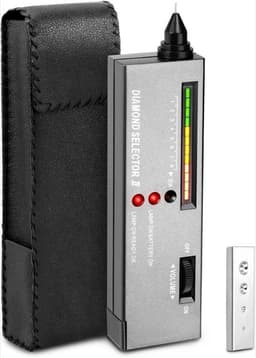
QWORK QWORK LED diamond tester

Testsieger

QWORK QWORK LED diamond tester
6.8/10about £9.99

What these Amazon listings actually say

Vakler, Jiyeo and Ignara print moissanite on a thermal pen. The word in the title is not an electrical circuit after the heat reading, and these notes do not describe one. That is still the heat method GIA and IGI say cannot make the split. RIZGHWOY's bullets claim a thermal separation anyway. Treat that line as advertising. The Gain Express JEM-II at about £55.99 says it is unresponsive to moissanite. No UK review confirms that on a named stone, and the ultraviolet lamp is a fluorescence look, not the electrical check. The Gain Express DMT-3 at about £104.90 claims a split of diamonds and moissanite from fakes, and says the pen is not for laboratory-grown diamonds. Notes from outside the UK review text say moissanite was read as diamond or flipped on a retest. Those notes do not prove the claim. The electrical rung is the Quicktest class of tester, from the £79 add-on up to the combined units.

When the answer is still to send the stone

Send the stone when the money is real, or when a moissanite lamp might be a diamond of another origin. A thermal diamond beep has not excluded synthetic moissanite. An electrical moissanite beep has not excluded every laboratory-grown diamond, because some HPHT material conducts and some low-conductivity moissanite does not. The laboratory-grown diamonds page takes that mix-up from here. GIA's position is that a definitive identification is a laboratory job once the handheld testers have run out of road. On a costume stone, at room temperature, with a steady ready lamp and the tip on the table, a failure to read as diamond is often glass or cubic zirconia. A pass is the moment you stop trusting the beep. If the centre stone costs more than the pen, the next spend is an electrical or combined tester, then a laboratory if the name still changes the price. Another thermal pen from this set repeats the first question.

Common questions

Will moissanite pass a diamond tester?
Yes, on a thermal pen. GIA's 1997 study found that thermal probes treat synthetic moissanite as diamond, and IGI repeated that in 2022 because the heat response is similar. Quicktest says the same of pens in its roughly £22.50 to £82.50 band. The beep may be diamond, moissanite, a cold stone or a bad sensitivity setting. Cubic zirconia is different: a working pen can often show that it is not diamond.
What does an electrical test add?
It asks whether the stone conducts, after heat has said the stone might be diamond. Moissanite often conducts and diamond generally does not. Quicktest lists a £79 add-on and combined testers around £199.50 to £359 for that step. The circuit has to be complete. Off a metal tray, Presidium says a multi tester can report diamond, and a finger or a fridge can read as moissanite.
Can a newer moissanite still read as diamond?
Yes. Quicktest says some low-conductivity moissanite still reads as diamond on an electrical test. Chasing that faint material with a more sensitive unit then calls some laboratory-grown diamonds moissanite, which IGI also records. An electrical pass is a stronger screen than heat alone. If the price hangs on the name, the stones left over go to a laboratory.
Does moissanite in the title mean a second test?
No. Vakler, Jiyeo and Ignara put the word on thermal pens, and the notes show no electrical circuit there. RIZGHWOY's bullets claim a thermal split, which is the method GIA and IGI say cannot do it. The second test is a different instrument. It still misses some low-conductivity moissanite, so the title is not a feature you can buy your way around.
What do the JEM-II and DMT-3 notes actually show?
The JEM-II at about £55.99 says it is unresponsive to moissanite, and no UK review in the notes confirms that on a named stone. Its ultraviolet lamp is a fluorescence check. The DMT-3 at about £104.90 claims a split from fakes and also says it is not for laboratory-grown diamonds. Notes from outside the UK reviews say moissanite read as diamond or flipped on a retest. Treat both lines as unproven claims.
Could a moissanite lamp be a laboratory-grown diamond?
It could, where electricity mixes the two up. IGI says some HPHT laboratory-grown diamonds conduct because of metal left from growth, and some boron-bearing blue diamonds conduct too. Sensitive testers aimed at faint moissanite flag some laboratory-grown diamonds as well. The lamp is a reason to look again. If the stone is worth more than the tester, a gemological laboratory is the step that can put an origin in writing.

Related pages

Sources

Public sources listed below, last checked on 20 October 2026. Shelf prices and star lines are the amazon.co.uk figures captured with these eleven listings. The price bands are this set, not a market average. Quicktest figures are shop estimates.

  1. IGI: Diamond detection and handheld testers (retrieved 20 October 2026)
  2. GIA: Synthetic moissanite (Winter 1997) (retrieved 20 October 2026)
  3. GIA FAQ: identify laboratory-grown diamonds (retrieved 20 October 2026)
  4. GIA: Laboratory-grown diamonds update (Summer 2024) (retrieved 20 October 2026)
  5. Quicktest: guide to buying diamond testers (retrieved 20 October 2026)
  6. Quicktest: diamond tester troubleshooting (retrieved 20 October 2026)
  7. GOV.UK: hallmarking is the law (retrieved 20 October 2026)
  8. Consumer Rights Act 2015, section 9 (retrieved 20 October 2026)
  9. amazon.co.uk listings for the eleven ASINs (retrieved 20 October 2026)