Independent comparisons. We may earn from shop links. More info

Diamond tester lab grown: why the beep does not name the mine

Updated: 22 October 2026

You are about to pay serious money for a colourless stone, and a handheld pen has just beeped diamond. A diamond tester lab grown check has a short answer. Mined diamond and laboratory-grown diamond are both diamond, so they share thermal conductivity, and every thermal pen on the [diamond tester comparison](/hub/measuring-equipment/diamond-tester) fails that split. Peter F. took this from GIA and IGI, from UK specialist shop pages, and from the amazon.co.uk listings for this set in October 2026. There was no laboratory identification of a stone. A qualifying purchase can earn a commission at no extra cost to you. Moissanite, a different material, has its own page. This one stays with diamond versus diamond, and with what you do once the beep has already said diamond.

You are about to pay serious money for a colourless stone, and a handheld pen has just beeped diamond. A diamond tester lab grown check has a short answer.

Our top picks

On this page

The beep does not choose a mine or a factory

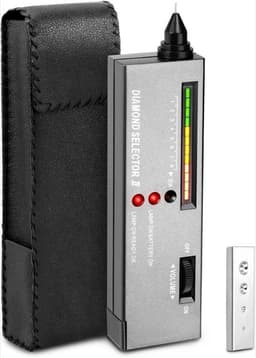
A thermal pen heats a probe and watches how fast that heat leaves the tip. Laboratory-grown diamond carries heat the same way as mined diamond, because the material is the same. IGI's note of 24 May 2022 states that both test as diamond on a thermal pen. GIA's FAQ says the two are essentially the same chemically and optically, and that traditional instruments do not separate them. The beep is consistent with diamond. It says nothing about a mine or a factory. That limit covers this whole Amazon set, up to the Gain Express DMT-3. None of these listings describes a pass or refer screen, so a fresh cell or a dearer pen repeats the same heat question. A working thermal pen can often show that glass or cubic zirconia is not diamond. That smaller job still does not name an origin. If the stone might be moissanite, read the moissanite page next.

Pass or refer is a different tool

Trade screening is another instrument, used after a stone might already be diamond. GIA's Summer 2024 update describes the usual output on colourless to near-colourless diamonds as pass or refer. Pass means natural on that instrument. Refer means more work, and the stone can be natural or laboratory-grown. GIA also says no cheap tool identifies every laboratory-grown diamond, and melee is harder. A girdle line that reads laboratory-grown is a clue to photograph. Phosphorescence alone fails because low-dose irradiation can change an HPHT reaction. On Quicktest the Presidium Arete Duo was £730 and includes a thermal Diamond Experior, so the heat test still comes first. The Presidium Ari was £995. Ari's wording treats a CVD / HPHT / Type IIa reading as a chance of synthetic, because a rare natural Type IIa can show the same way. Dynagem listed the Ari at £1,235. About £750 to £1,134 covers the Quicktest pair. Dynagem sits above it, so keep the two shelves apart. GIA's FAQ still says a definitive answer means a gemological laboratory. The buying guide places these prices above a pocket pen.
QWORK QWORK LED diamond tester

Testsieger

QWORK QWORK LED diamond tester
6.8/10about £9.99

The DMT-3 sentence is a limit

One listing in this set mentions laboratory-grown diamonds at all. The Gain Express DMT-3, at about £104.90, says it is for natural diamonds and is not suitable for laboratory-grown diamonds. Read that as the boundary of the pen. The sentence does not mean the DMT-3 finds a laboratory-grown stone, flags CVD, or shows pass or refer. No other listing describes that screen. Choosing it because the words sit near lab-grown still buys a thermal pen whose own page has put this job outside its scope. A £10 pen that never mentions a factory sits under the same limit. The DMT-3 is simply the model that prints the warning. Price bands are on the best diamond tester page. They do not turn the warning into a detection feature. When the money on the stone is larger than the pen, the next spend is a screener in the hundreds of pounds, or a laboratory if you need the origin in writing.

When an electrical moissanite reading is still open

An electrical tester is built to split diamond from moissanite, and it has a side path into this problem. IGI notes that some HPHT laboratory-grown diamonds can read as moissanite because metal-catalyst remnants from growth let them conduct. Some boron-bearing blue diamonds conduct as well. An electrical moissanite lamp can be moissanite, or one of those conducting diamonds. It is not a rule that every such lamp is laboratory-grown, and it is not a rule that every laboratory-grown diamond conducts. You test thermally first, because a screener is for stones that might already be diamond. A Type IIa style reading is a prompt for more work, including the chance of a rare natural stone. Hallmarks do not close the gap. GOV.UK's account of the Hallmarking Act 1973 covers gold, silver, platinum and palladium. The pen does not assay the shank, and a hallmark does not name the stone. If the centre is worth more than the tester, a laboratory report is the sentence you can show someone else.

Common questions

Can a diamond tester tell a lab-grown diamond from a mined one?
No, on a thermal pen of the kind in this Amazon set. Mined and laboratory-grown diamond share thermal conductivity, so both beep as diamond. IGI said so on 24 May 2022, and GIA's FAQ says traditional instruments do not separate stones that match chemically and optically. A second cheap pen repeats the heat test. Screening can sort a stone, and GIA still points to a gemological laboratory for a definitive origin.
Is a refer result a lab-grown verdict?
Pass or refer is how trade screeners answer on colourless to near-colourless diamonds, in GIA's Summer 2024 account. Pass means natural on that instrument. Refer means more work, and the stone can be either natural or laboratory-grown. GIA also says no cheap tool catches every laboratory-grown diamond. None of the pens in this set shows that screen. A refer lamp sends you on. It does not name the stone on a receipt.
The DMT-3 says it is not for lab-grown diamonds. Can it find them?
No. The listing, at about £104.90, says the pen is for natural diamonds and is not suitable for laboratory-grown diamonds. That is a limit on a thermal tester. It does not describe a CVD reading, an HPHT reading or a pass or refer display, and no other listing in the set does either. The sentence tells you where the pen stops.
Can an electrical tester call a lab-grown diamond moissanite?
It can, in cases IGI names. Some HPHT stones conduct because metal-catalyst remnants remain from growth, and some boron-bearing blue diamonds conduct, so the unit may say moissanite. Plenty of laboratory-grown diamonds do not conduct, and plenty of moissanite lamps really are moissanite. If the stone is valuable, treat the lamp as a prompt and move to a screener or a laboratory.
What if the stone is worth more than the pen?
Send it when you need the origin in writing. The thermal beep has finished the only job these pens can do. Quicktest listed an Arete Duo at £730, with a thermal tester included, and an Ari at £995. Dynagem listed that Ari at £1,235. A Type IIa style reading is a chance of synthetic, because rare natural Type IIa diamonds can look the same. GIA's FAQ still ends at a gemological laboratory.
Is a girdle inscription enough on its own?
Photograph it, then keep going. GIA's 2024 update treats a laboratory-grown girdle line as one clue beside screening and a laboratory report. A loupe can miss the mark on a tiny stone. Phosphorescence is the same kind of partial clue, because low-dose irradiation can change an HPHT reaction. When the price depends on the word natural, the inscription is a reason to send the stone.

Related pages

Sources

Public sources listed below, last checked on 20 October 2026. Shelf prices and star lines are the amazon.co.uk figures captured with these eleven listings. The price bands are this set, not a market average. Quicktest figures are shop estimates.

  1. IGI: Diamond detection and handheld testers (retrieved 20 October 2026)
  2. GIA: Synthetic moissanite (Winter 1997) (retrieved 20 October 2026)
  3. GIA FAQ: identify laboratory-grown diamonds (retrieved 20 October 2026)
  4. GIA: Laboratory-grown diamonds update (Summer 2024) (retrieved 20 October 2026)
  5. Quicktest: guide to buying diamond testers (retrieved 20 October 2026)
  6. Quicktest: diamond tester troubleshooting (retrieved 20 October 2026)
  7. GOV.UK: hallmarking is the law (retrieved 20 October 2026)
  8. Consumer Rights Act 2015, section 9 (retrieved 20 October 2026)
  9. amazon.co.uk listings for the eleven ASINs (retrieved 20 October 2026)