Independent comparisons. We may earn from shop links. More info

Diamond tester buying guide

Updated: 22 October 2026

You are looking at a ring from a private sale or a car-boot box, and a beep feels like the quick way to know the stone. A diamond tester buying guide has to slow that down. The tool only answers the question you bought it for, and a thermal pen, an electrical tester and a laboratory screen are three different questions. The eleven listings on the [diamond tester comparison](/hub/measuring-equipment/diamond-tester) are almost all thermal pens, from about £9.99 to £104.90 on amazon.co.uk, captured on 20 October 2026. This page is the ladder between those pens and the specialist instruments outside the table. It does not rank the eleven ASINs, and it does not teach you how to hold the probe. A qualifying purchase can earn a commission at no extra cost to you.

You are looking at a ring from a private sale or a car-boot box, and a beep feels like the quick way to know the stone. A diamond tester buying guide has to slow that down.

Our top picks

On this page

Three questions, three tools

Start with the question, not the brand. A thermal pen heats a probe and reads how fast that heat leaves the tip. A working pen can often show that glass or cubic zirconia is not diamond. GIA's 1997 study found that thermal probes treat synthetic moissanite as diamond, and IGI's note of 24 May 2022 records the same false pass. The beep may be diamond, moissanite, a cold stone, or a sensitivity error. Moissanite versus a stone that might already be diamond is an electrical check, or a combined tester after that result. Quicktest's buying guide, updated 28 May 2026, puts combined testers in a higher band. Cooksongold's Presidium Multi Tester III, item 997-2712, is for colourless stones, with a 0.02 carat claim and three AAA cells, and it is not for coloured diamonds such as blue or black. IGI adds that an electrical tester can read some HPHT laboratory-grown diamonds as moissanite. That is why the laboratory-grown diamonds page exists. Mined or laboratory-grown is the third question. Both are diamond and share thermal conductivity, so every thermal pen here fails that split. Trade screeners mostly return pass or refer, and GIA's FAQ still says a written answer is a laboratory. Nothing on these amazon.co.uk listings is that screener.

What this Amazon set actually is

Place the eleven pens on the first rung. Under about £25, from about £9.99 to £22.59, you are buying a costume screen: two QWORK pens, Vakler, Jiyeo, Ignara, VivaStride, the RIZGHWOY kit, the Divinge loupe kit and the NIUPIKA. UK reviews often say a unit in this band does not start. Check a fresh 9V cell, whether the listing admits the moissanite limit, and whether a valuable stone still goes elsewhere. The Gain Express JEM-II at about £55.99 is ultraviolet and thermal, with a claim down to 2 points, a pouch and a loose-stone platform. A seller line says it is unresponsive to cubic zirconia and moissanite. No UK review in these notes confirms that on a named moissanite. The ultraviolet lamp is a fluorescence look, and the listing does not call the JEM-II a thermal-plus-electrical multi tester. The Gain Express DMT-3 at about £104.90 claims a split of diamonds and moissanite from fake stones, and says it is not suitable for laboratory-grown diamonds. That second sentence is a warning. Between about £56 and £105 this set buys accessories and stronger wording. Jobs for each price are on the best diamond tester page.
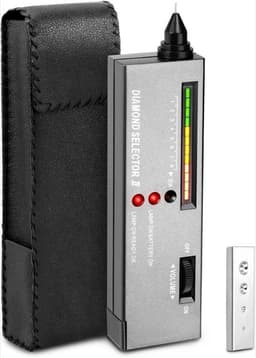
QWORK QWORK LED diamond tester

Testsieger

QWORK QWORK LED diamond tester
6.8/10about £9.99

Prices outside Amazon

Specialist figures are not extra rows here. Quicktest calls a thermal pen under £50 a costume-jewellery screen and points at about £82.50 for a better basic thermal model. Tiles on its electronic gem-tester collection included a Diamond Selector II at £19.50, a Diamond Experior at £82.50, a Multi-Experior at £199.50, an ARCUS at £230 and a SAM at £349. The guide mentions an add-on MOISS-4 at £59, while the collection tile showed £79. Keep the figure in the sentence you are reading. Combined testers on that guide sit around £199.50 to £359. Cooksongold's Multi Tester III product total was £320.04 including VAT. A category tile showed £296.64 including VAT, so this page keeps £320.04 and does not merge the two captures. Laboratory-grown screening is another shelf: an Arete Duo at £730, a Presidium Ari at £995, an APEX at £989 and an OTi at £1,379. About £750 to £1,134 is that class of tool.

What not to trust on a listing

A lamp for jade, ruby or sapphire on a thermal pen is not a species identification. Quicktest says claims of that kind are not reliable, and a chart that ties lamp counts to diamond or agate is a seller diagram. UK reviews of the RIZGHWOY listing say the kit does not distinguish silver from base metal. GOV.UK's summary of the Hallmarking Act 1973 covers gold, silver, platinum and palladium over set weights. The pen does not strike that mark, and a hallmark does not name the stone. A CE mark or a NIST-traceable line is not a trial this comparison verified. No British Standard in these sources certifies pocket-tester accuracy. The Consumer Rights Act 2015, sections 9 and 11, still matters if the description promises a job the goods do not do. If the money on the stone is real, stop at the beep and use a jeweller or a laboratory.

Common questions

Is a thermal pen enough if I only want to spot glass and cubic zirconia?
Yes, that is the job a working thermal pen is for, and the limit travels with it. A diamond indication can still be moissanite, a cold stone, or a bad sensitivity setting, which is how Quicktest's buying guide and the GIA 1997 moissanite study line up. Glass and cubic zirconia are the simulants a working pen can often rule out. The pen does not certify the stone. A unit that never shows a steady ready lamp has not tested anything, however many gem names are printed on the box.
Why can a diamond beep still be moissanite?
Synthetic moissanite moves heat in a way thermal probes treat as diamond. GIA reported that in the winter 1997 issue of Gems & Gemology, and IGI repeated the false positive for handheld thermal testers in 2022. The beep is allowed to mean diamond or moissanite until a second method is used on a stone that already might be diamond. A title that only contains the word moissanite does not add that second method.
What does an electrical or multi tester add, and what does it still get wrong?
An electrical check looks for conductivity that many synthetic moissanites show and that diamond usually does not. Quicktest prices combined testers from about £199.50, and Cooksongold's Multi Tester III total was £320.04 including VAT for a colourless-stone instrument. The same shops say some newer, faintly conductive moissanite can still read as diamond. IGI says some HPHT laboratory-grown diamonds can read as moissanite. You have bought a sharper question, not a certificate.
Are the pens under £25 in this set a different product from an £80 thermal tester?
They are the same idea, a heated probe, at a different build and a different honesty of wording. Quicktest calls thermal pens under £50 a costume screen and cites about £82.50 for a better basic thermal model on its own pages. In this Amazon set, under £25 is where UK reviews most often say the pen does not start. The £82.50 figure is a shop estimate. It is not an eleventh row you can click on amazon.co.uk from this comparison.
Does UV on the JEM-II replace a moissanite test?
No. The JEM-II listing pairs an ultraviolet lamp with a thermal sensor, and a seller sentence says it is unresponsive to moissanite. No UK review in these notes confirms that sentence on a named stone. Ultraviolet light on this page is a fluorescence check. Where a moissanite separation exists, it is an electrical measurement, and even that measurement has misses on low-conductivity material and on some laboratory-grown diamonds.
When is the next step a screener or a laboratory rather than another pen?
When you need mined versus laboratory-grown, or a written identification because the money matters. Trade screeners mostly say pass or refer, and the synthetic-diamond tools on Quicktest in this search started around £730 for an Arete Duo. GIA's FAQ still says a definitive answer means sending the stone to a gemological laboratory. Another £10 pen only repeats the first question.

Related pages

Sources

Public sources listed below, last checked on 20 October 2026. Shelf prices and star lines are the amazon.co.uk figures captured with these eleven listings. The price bands are this set, not a market average. Quicktest figures are shop estimates.

  1. IGI: Diamond detection and handheld testers (retrieved 20 October 2026)
  2. GIA: Synthetic moissanite (Winter 1997) (retrieved 20 October 2026)
  3. GIA FAQ: identify laboratory-grown diamonds (retrieved 20 October 2026)
  4. GIA: Laboratory-grown diamonds update (Summer 2024) (retrieved 20 October 2026)
  5. Quicktest: guide to buying diamond testers (retrieved 20 October 2026)
  6. Quicktest: diamond tester troubleshooting (retrieved 20 October 2026)
  7. GOV.UK: hallmarking is the law (retrieved 20 October 2026)
  8. Consumer Rights Act 2015, section 9 (retrieved 20 October 2026)
  9. amazon.co.uk listings for the eleven ASINs (retrieved 20 October 2026)