Independent comparisons. We may earn from shop links. More info

Sliding bevel vs combination square

Updated: 22 October 2026

Two tools both look like a stock with a metal blade. A combination square registers 90°, 45°, and a depth along its rule. A sliding bevel copies an angle that is already there. That is the sliding bevel vs combination square split. Peter F. drew it from Axminster’s squares guide, ITS on OX squares, and Find My Tool, and checked it against the [sliding bevel comparison](/hub/measuring-and-marking-tools/sliding-bevel) on 22 October 2026. Prices for that tool live in the [combination square comparison](/hub/measuring-and-marking-tools/combination-square). A qualifying purchase can earn a commission at no extra cost to you. How to carry an angle to the saw is on [how to use a sliding bevel](/hub/measuring-and-marking-tools/sliding-bevel/sub/sliding-bevel-how-to-use).

Two tools both look like a stock with a metal blade. A combination square registers 90°, 45°, and a depth along its rule. A sliding bevel copies an angle that is already there.

Our top picks

On this page

What each tool is for

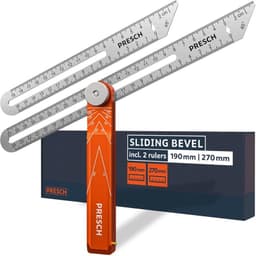
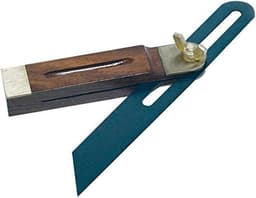
A combination square is a stock that slides on a graduated rule. One face of the stock is 90° to the rule. Another is 45°. Axminster puts that with layout rather than with free angles. ITS describes the same job on the OX range: depth, 90°, and 45°. A sliding bevel, or T-bevel, is a stock and a blade that swings and then locks. Find My Tool calls it a template. It will hold 90° if that is what you copied, and it will also hold 87° or the pitch of a string. It will not tell you which, and there is no depth rod. A picture-frame corner or a square shelf end is the square. An old wall, scribed skirting, or a stair string is the bevel.

When the square is enough

Use the combination square when the angle you want is 90° or 45°, or when you need a short depth. A hinge recess, a tenon shoulder, and a mitre on a frame that you are making square on purpose all sit there. Carpenter’s Equip makes the speed point for a true 45° face. Depth is the other job the bevel lacks. Set the combination square’s rule to stick out 12 mm, lock it, and scribe parallel to an edge. Stray marks on a bevel blade, including a 0–7 feet line on a blade about 22 cm long, are a poor depth gauge. Check the square by marking, flipping, and seeing whether the lines stay parallel. Copying a 91° corner with a bevel and calling the copy square repeats the wall.
Bahco Bahco 9574-300, 300 mm

Testsieger

Bahco Bahco 9574-300, 300 mm
8.7/10about £35.94

When the corner is not square

Old plaster, a chimney breast, and a skirting run in a Victorian terrace often meet at an angle no stock square contains. The sliding bevel takes that angle without first converting it to degrees. Stock on one wall, blade on the other, tighten, finger-push the blade, and carry it to the saw. ITS describes the same move for an awkward wall or a stair. The bevel lifts the angle. It does not announce it. A blade that moves on the way to the saw has stored a new angle. A speed square is a fixed triangle for 90°, 45°, and often a roof pitch. It does not swing to an odd plaster corner, and it does not give you a sliding depth.

When you still need a number

Sometimes the saw, a drawing, or another person needs degrees. The bevel will not supply them. Axminster’s tip is to pair a sliding bevel with a digital angle finder when you need the number as well as the template. Read the finder on the corner, or on the locked bevel if you can keep the blade still, and write the number down. Our angle finder category is that third tool. Subtracting the reading from 90 degrees is a method stair fitters use on an angle finder to speak to a mitre saw. If the blade will not stay still, it has stopped being a template.

Common questions

Can a combination square copy a crooked corner?
It can sit in the corner, and the rule will point somewhere, but the stock is built around 90° and 45°. You are not locking an arbitrary angle the way a bevel blade locks. For a wall that is out of square, the sliding bevel is the tool that stores that shape. The combination square remains the right marker when you want the joint to be square even though the wall is not, for example a cabinet standing against a lean.
Which tool marks a 45° mitre faster?
The combination square. The 45° face is part of the stock, so you hold it and mark. A sliding bevel can be set to 45° only by copying a true 45° or by fiddling until a separate gauge says so. For a picture frame or a trim end you are making square on purpose, the fixed face is the quicker mark. The bevel is quicker only when the corner in the room is already the angle you must match.
Which tool marks skirting on a wall that is not 90°?
The sliding bevel. Seat it in the corner, lock it, and transfer the whole angle, then halve it if two boards share the joint. The steps and the offcut test are on the how-to page. A combination square will mark a tidy 45° that leaves a gap on a wall that is 88° or 93°. That gap is the square doing its own job in the wrong room.
Do I need both?
You need both if the same day includes square layout and an existing odd corner. Shelves, depths, and frame mitres belong to the combination square. Scribed skirting, an out-of-square alcove, and a stair pitch belong to the bevel. If you only build square work, the bevel stays in the drawer. If you only match old corners, the square’s 45° face sees less use, though the depth rule is still handy.
Where do I read the angle as a number of degrees?
Read it on a protractor or a digital angle finder, then keep the bevel as the template you can lay on the saw. A plain T-bevel does not display degrees. Decorative ticks and a handful of detents are those marks only. The angle-finder category on this hub is where that readout is compared. Write the number down, because resetting the bevel deletes the shape and the finder is what still has the figure.

Related pages

Sources

Public sources named in the research digest, plus the amazon.co.uk listings compared on this page. Retrieved October 2026.

  1. DIY Doctor, Sliding bevel (retrieved October 2026)
  2. Find My Tool, What is a sliding bevel? (retrieved October 2026)
  3. Common Woodworking, Buying a sliding bevel (retrieved October 2026)
  4. MyToolShed, Sliding bevels (retrieved October 2026)
  5. ITS, OX squares and bevels (retrieved October 2026)
  6. Approved Document K (retrieved October 2026)
  7. legislation.gov.uk, Consumer Rights Act 2015, section 9 (retrieved October 2026)
  8. Which?, What to do with a faulty product (retrieved October 2026)