Independent comparisons. We may earn from shop links. More info

How to use a measuring wheel

Updated: 22 October 2026

You already have a measuring wheel, or a school trundle that clicks, and the number has to mean the line you think it means. A wrong reading is easy: the counter was not zero, the tyre left the ground, or you walked a curve and wrote it down as the straight edge. This is how to use a measuring wheel, including the point where you stop and ask a surveyor. Peter F. used public guidance and the amazon.co.uk notes from 19 October 2026. We did not certify a wheel. Prices are on the [measuring wheel comparison](/hub/measuring-and-marking-tools/measuring-wheel). A purchase through our links may earn us a commission at no extra cost to you.

You already have a measuring wheel, or a school trundle that clicks, and the number has to mean the line you think it means.

Our top picks

On this page

It counts the path of the tyre

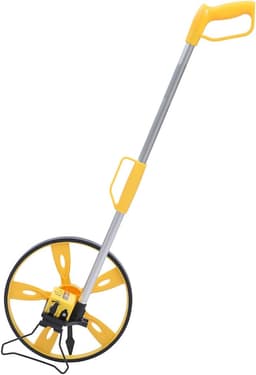
The counter adds the distance the tyre travels along the surface. It is the straight line between two stakes only if you walked that straight line. A curve around a bed is longer than the chord across the grass. On a slope, the surface distance is longer than the horizontal distance a survey usually books. Air time under-reads. Following every dip over-reads. A 0.1 m step is how small a change the dial shows, not the error after a bounce. Diameter and units, if you are still choosing, are the measuring wheel buying guide.

Walk one line

Confirm the unit before you move. A UK reviewer of an orange Zozen received metres after expecting feet. Stand still and zero the counter. If it will not return to zero, do not start. Seat every joint on a folding or telescopic handle. Put the tyre on the start mark and walk the line you mean, in contact with the ground. At the end, lift the wheel before you read it, so an extra turn is not counted. A second walk that matches checks your procedure. It is not a survey band.

A click is optional

A school trundle often clicks once per metre so a class can count a pitch. BBC Skillswise describes that pattern. A counter wheel replaces the click with a dial. The mechanical TOPWAY shows 0.1 m and does not tick each metre. Silence on that listing is normal. Count clicks only if you know the interval. One click per metre on a 30 m path is 30. One click per decimetre is 300, and mixing them invents a length. A blank screen is not zero. Fit fresh cells and start again from a mark you can see.

Check it on a taped distance

Tape a known length on the same surface before a number becomes a quote. A 20 m path is enough for a home check. Something nearer 100 m is better before a pitch. Zero, walk, lift, and read. If the listing says a reverse roll subtracts, walk back and see whether you return to zero. A wheel that will not, which UK reviewers report on the Bosch GWM 32, is not ready to quote. If you are 1 m long on a taped 20 m, do not use the number as a price. A kitchen-floor check does not describe gravel. Wheel versus tape is measuring wheel vs tape measure.

Stop when the job needs a survey

Stop for a legal boundary, a measured survey with an accuracy band, or construction setting-out. RICS treats a trundle as a tool for a long external distance, not a millimetre method. A matching pair of walks shows that you repeated a path. It does not show that the path was the horizontal distance on a drawing. Call a surveyor when you cannot afford to defend the length. Stay off rail tracks and live carriageways unless the site has put you there.

Common questions

Do I count clicks or read a dial?
Read the dial on a counter wheel. Count clicks only when you know the interval, often one per metre on a school trundle, as BBC Skillswise describes. The mechanical TOPWAY shows 0.1 m and does not tick, which is normal for that listing. A decimetre click counted as metres multiplies the length by ten. If there is no click, use the counter after you have lifted the wheel.
How do I reset it?
Stop, use the reset control, and watch every digit return to zero. The mechanical Zozens advertise a one-key reset. If the dial will not zero, which reviewers report on a Bosch GWM 32, do not start. On some listings a reverse roll subtracts, so that is an undo, not a reset, unless you meant to take back an overshoot. These listings do not describe a calibration screw.
How do I check it against a tape?
Tape a straight known length on the same surface, zero, walk, lift, and read. Twenty metres is a useful home check. Nearer 100 m is better before a pitch. If you are about a metre out on 20 m, do not price from the wheel. A paving check does not describe gravel. York’s £99 ex VAT certificate is paperwork for firms, not a DIY adjustment.
What if the display goes blank halfway?
Stop and treat the run as lost. A blank screen is not a zero. Reviews of the digital Zozen describe cut-outs on long runs and batteries that drain while the unit is off. Fit fresh cells, zero at a mark you can identify, and walk from there. Do not estimate the missing stretch. If the compartment will not hold the cells, return or repair the wheel before you rely on it.
Does a curve count as the straight distance?
No. The wheel records the tyre’s path, so a curve is longer than the straight line between the same ends. On a slope the surface path is also longer than the horizontal survey distance. Use a tape or a laser for the chord when you can see both ends. Use the wheel for the curved edge, and say that you measured the curve. The two results answer different questions.

Related pages

Sources

Sources from the research digest. Shelf date 19 October 2026.

  1. Measuring Instruments Regulations 2016, regulation 3 (retrieved 19 October 2026)
  2. GOV.UK units of measurement (retrieved 19 October 2026)
  3. Consumer Rights Act 2015, section 22 (retrieved 19 October 2026)
  4. PUWER 1998 (retrieved 19 October 2026)
  5. Bosch Professional UK, GWM 32 (retrieved 19 October 2026)
  6. BBC Skillswise measuring equipment (retrieved 19 October 2026)
  7. RICS APC measurement skills (retrieved 19 October 2026)
  8. York Survey, Trumeter land measurer (retrieved 19 October 2026)