Independent comparisons. We may earn from shop links. More info

How to sharpen a carpenter's pencil

Updated: 22 October 2026

You are marking a joist or a plasterboard line and the pencil in your pocket has gone blunt after a few cuts. A flat, oval or triangular carpenter's pencil is built to take a chisel edge, and a spinning sharpener fights that shape. This page shows how to sharpen a carpenter's pencil with a knife, and when the cutter in the box is the wrong tool. Prices and review counts sit in the [carpenter's pencil comparison](/hub/measuring-and-marking-tools/carpenter-s-pencil). Peter F. wrote this on 22 October 2026 from amazon.co.uk listings and public UK sources, with no lab test. A qualifying purchase can earn us a commission at no extra cost to you.

You are marking a joist or a plasterboard line and the pencil in your pocket has gone blunt after a few cuts.

Our top picks

On this page

Why the pack sharpener fights the pencil

A rotating sharpener cuts a cone. Wonkee Donkee notes that a school sharpener does not fit a rectangular or oval body, and that a carpenter pencil sharpener still leaves a conical point. On a wide flat core that cone rounds off the shape you bought. The useful tip is a wedge that can sit against a square. On a UK Workshop thread, a pack sharpener that forced a round point was thrown out. The replies favoured a Stanley knife, a chisel, a belt sander or sandpaper. The Tracer ACP1 4H, about £5.95 on the stored amazon.co.uk listing (B0CC33FQN7), draws the same complaint. Several reviews say the included sharpener tears the wood, and one buyer found the blade already chipped. A chipped blade in the box is a goods question under the Consumer Rights Act 2015. A point you snap by levering the lead is down to the cut. Wear of a 4H against an HB is on the carpenter's pencil lead grades page. A chisel edge still comes from a knife or an abrasive.

Cut a chisel edge away from you

Work on a bench, with the pencil supported. The Health and Safety Executive's hand-knife guidance was written for textiles, and it remains the UK source for this cut: move the blade away from your body, and do not carry an open knife loose in a pocket. Hold the blade shallow on the two wide faces until a short length of flat lead shows and the sides still back it. US pages often specify an inch of bare lead. That length is not a UK standard, so stop when the core is just proud. Then dress the narrow edges into a wedge. A steeper angle gives a finer line on planed timber. A shallower angle lasts longer on coarse studs. Leave the lead in its slot. Levering it out snaps the tip, and that break is the cut, not a fault under the Consumer Rights Act. On brick or a rough stud, the wider edge stays readable where a fine point chips at once. Axminster's measuring note is the limit: a pencil line has thickness, and a true knife line is bench layout. If you are not confident with a blade, hand the mark to someone who cuts that joint regularly.
Tracer Tracer AMK1 deep-hole kit

Testsieger

Tracer Tracer AMK1 deep-hole kit
9.2/10about £11.71

Which wooden box includes a sharpener

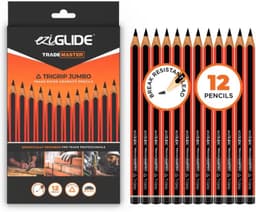
The Tracer ACP1 is the wooden pencil here that lists a sharpener, and the reviews reject it. The Trademaster TriGrip, about £9.99 on the stored listing (B0DXQ766MG), does not include one, and a review there turns to a knife. XTSUN's HB oval does not list a sharpener either. Plan to sharpen a builders pencil with a blade you already own. Which body to buy is the job of the carpenter's pencil buying guide.

Holster sharpeners dress a round refill

Holster sharpeners dress a round refill. Tracer AMK1, Pencil 2.0, Tough, Precision, MECHEER and Nicpro will not cut a chisel edge on a flat core. AMK1 reviews say waste left inside makes a mess, and a lead left extended snaps in the holster. Retract the lead and empty the cutter. Olivvia's long-nose pencil, about £4.99 on the stored listing (B0G6ZDGTN9), has no sharpener in five UK reviews, and one review is titled as having no sharpener. A missing extra the page promised is a description problem you can raise with the seller. A cutter in the carton helps when the lead is round. On a flat core, the knife remains the tool.

Common questions

Can you use a school sharpener on a flat pencil?
A school sharpener fits a round or hexagonal barrel, so a flat or oval carpenter's pencil will not sit in the hole. Forcing it chews the corners. A carpenter pencil sharpener may take the wider body, though Wonkee Donkee notes that rotation cuts a cone. For a line against a square, use a knife on the bench.
What is a chisel point?
A chisel point is a wedge on the flat lead. You shave the wood back so one face of the core is longer than the other, and the line can sit against a square. Wonkee Donkee treats the tip as a knife cut, thick or thin by the angle. No set length of exposed lead makes it correct.
Which way do you cut?
Cut away from your body, with the pencil on a bench and the blade shallow. Health and Safety Executive hand-knife guidance, written for textiles, is the UK source: the edge moves away from you, and an open blade stays out of a pocket. Shave towards the tip and leave the lead seated. If the blade heads for your hand, turn the pencil first.
What if the lead is already broken inside a new pencil?
Sharpen once and look before you force the core. One Tracer ACP1 review found the lead already broken on the first sharpen. A core or a blade that arrives damaged is a satisfactory-quality point under the Consumer Rights Act 2015, and you can raise it with the seller. A tip you snap by prising the lead is down to the cut.
When is a blunt wide tip better than a fine one?
Use the wide edge on brick, block or a rough stud, where a fine point chips after one line. A steeper angle suits planed timber when you want a narrower mark, though a pencil line still has thickness. Axminster's note is the limit: a true knife line is bench work. If you cannot hold that tolerance, ask someone who sets out that joint for a living.

Related pages

Sources

Public UK sources listed below, then the stored amazon.co.uk listings for these eleven pencils. Prices are the stored shelf prices, not a live ticker.

  1. Axminster Tools, measuring and marking (retrieved 22 October 2026)
  2. ISO 9180:1988, wood-cased black leads (retrieved 22 October 2026)
  3. Faber-Castell UK, pencil FAQ (retrieved 22 October 2026)
  4. Consumer Rights Act 2015, section 9 (retrieved 22 October 2026)
  5. HSE, hand knives (retrieved 22 October 2026)
  6. Wonkee Donkee, parts of a pencil (retrieved 22 October 2026)
  7. Hultafors, which marker or pencil (retrieved 22 October 2026)
  8. Bradfords, Tracer deep-hole pencil (retrieved 22 October 2026)