Independent comparisons. We may earn from shop links. More info

Moving straps on stairs

Updated: 22 October 2026

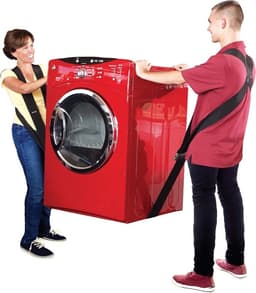
You are at the foot of a flight with a washer, fridge, or sofa, and someone suggested shoulder straps because the appliance has no handles. Moving straps on stairs is a clearance and balance question, not a kilogram bullet on the listing. This page covers tread clearance, who carries the downhill weight, and whether the buckle holds when the lower person’s knees bend deeper. Product choice is in the [carrying strap comparison](/hub/lifting-equipment/carrying-strap). Peter F. read those listings on 20 October 2026. There was no lab test. A qualifying purchase can earn a commission at no extra cost to you.

You are at the foot of a flight with a washer, fridge, or sofa, and someone suggested shoulder straps because the appliance has no handles.

Our top picks

On this page

Why a strap does not cancel the stair

On stairs the person on the lower steps always takes more of the mass. Ship It Appliances and UK remover guides describe the same shift: the uphill partner guides, and the downhill partner bears weight through bent legs. A harness moves load onto the shoulders. It does not remove gravity or shorten the object. HSE’s carrying filter assumes a load held against the body for about ten metres on level ground. A fridge on a stair fails that picture before you argue about a 500 kg bullet. Shoulder Dolly’s sheet says the item needs clearance under the tread, citing at least twelve inches or thirty centimetres, with the load level, arms straight, and tension consistent. That is a maker note, not a guarantee for your landing. UK reviews split: some pairs moved a washer on steps, others found descent worse, or never got lift height. Plan for that split.

Clearance and a level load

Measure the diagonal the appliance will sweep, not just the height of the box. American fridge-freezers and tall sofas eat headroom on a half landing when you pivot. If the bottom corner cannot clear the tread nosing with the load level, shortening the webbing might help a few centimetres, but it cannot invent a shorter appliance. Keep the object upright when the manufacturer requires it. Fridge guides warn about compressor oil migration, and washing machines need transit bolts before you move them at all. Trial-lift on the bottom step before you commit to the full flight. Thread as on the how to use a shoulder lifting strap page, rise a few centimetres, pause, and check buckle creep. If the strap pays out while you are angled, lowering on a stair is harder than on laminate. One correct-looking set-up still paid out in a UK Shoulder Dolly review. Treat the trial as pass or fail.

What UK buyers reported

Positive reports often involve two fit adults, a straight stair with a landing pause, and appliances in the rough hundred-kilogram class those buyers guessed from experience, not from a scale. Complaints cluster around short harness adjustment, URAQT comfort on steps, and descent where the lower person could not see the tread. ZIZINET reviews mention bent posture when straps ran out of holes. None of that is a measured stair rating. It is a reason to agree a stop word and rest on landings even when the first step felt fine. Do not repeat remover marketing that straps double what you can lift. W & W Movers use eighty kilograms as their own prompt to consider a ramp or a dolly. That is their rule of thumb, not a limit we set for your fridge. Mixed evidence means the honest outcome may be that the straps helped on one step only, or that you rolled back and booked a stair crew.

When to roll it or hire

If clearance fails the trial, if either person lacks confidence on the lower side, or if the mass is unknown, a stair-climber sack truck or a professional crew is the straight answer. Straps remain useful on the flat approach to the stair and on the final pivot into a room. They do not replace a wheeled climber on a narrow, twisting flight. BIL Group’s furniture guidance points fridges on stairs toward equipment beyond a harness. Treat that as equipment-class advice, not a product advert. Wheeled kit suits a long flat run. A harness suits a short teamed carry when hands must steer. Solo carrying upstairs with any strap in this category sits outside the two-person harness design. The sack truck 200kg comparison is the wheeled option when the trial on the bottom step fails.

Common questions

Can two people take a fridge upstairs on straps?
Sometimes, if clearance, fit, and the buckle pass a trial lift, and you accept the extra downhill load on the lower person. Many UK reviews say no for their stair. A kilogram line does not decide the flight.
Who should stand on the lower steps?
The stronger partner, calling each tread, ready to stop if the buckle creeps. That person takes more of the mass through bent knees. The uphill partner guides.
How much clearance do you need under the appliance?
Shoulder Dolly’s maker sheet cites at least thirty centimetres, also given there as twelve inches. Measure your worst tread and nosing, not an average step.
Is down harder than up?
Often yes. Control shifts to the lower person while the weight sits on bent knees, and UK reviews that mention stairs often call the descent worse. Keep the load level on the way down.
What about a single step rather than a flight?
A threshold can suit straps better than a full flight. The same trial still applies: rise a few centimetres, pause, and lower if the webbing pays out.
When is a stair sack truck or a crew the better plan?
When the trial clearance fails, the load is unknown, health limits a team lift, or the flight is narrow and twisting. A first step that felt fine does not clear the landing.
Should the fridge stay upright?
Yes for a compressor appliance unless the maker says otherwise. That protects the compressor oil. Fit transit bolts on a washing machine before you move it.

Related pages

Sources

Public UK sources named below. amazon.co.uk prices, stars and review counts on these six listings were read on 20 October 2026. Page updated October 2026.

  1. HSE INDG143: Manual handling at work (retrieved 20 October 2026)
  2. HSE: Manual handling risk filters (retrieved 20 October 2026)
  3. HSE: LOLER overview (retrieved 20 October 2026)
  4. HSE INDG474: Lifting accessories (retrieved 20 October 2026)
  5. HSE: Carrying controls (retrieved 20 October 2026)
  6. BSI: BS EN 1492-1 flat woven webbing slings (retrieved 20 October 2026)
  7. Consumer Rights Act 2015, section 9 (retrieved 20 October 2026)
  8. Shoulder Dolly: instructions (retrieved 20 October 2026)