Independent comparisons. We may earn from shop links. More info

Round or star strimmer line at 3mm?

Updated: October 2026

Your head already accepts 3.0 mm line, but the shelf offers smooth round cord beside star profiles with five cutting edges. Choosing round or star strimmer line at 3mm is not simply a durability contest: shape changes how much nylon sits inside the stated diameter, how the edge meets vegetation and how the cord behaves in the head. The [3 mm trimmer line comparison](/hub/lawn-and-garden-equipment/trimmer-line-3mm) includes both shapes and a round dual-material option. Choose star for a more defined edge only if your head has already handled shaped line cleanly.

Your head already accepts 3.0 mm line, but the shelf offers smooth round cord beside star profiles with five cutting edges.

Our top picks

On this page

The same 3.0 mm number contains different sections

A round 3.0 mm cord fills a circular cross-section. A star cord measured at 3.0 mm across its points has recesses between those points, so it contains less nylon in that envelope. That is geometry, not a laboratory result that every round line lasts longer. Heat, winding, vegetation and stone can outweigh shape. Round nylon is the conventional starting point: easy to identify and straightforward to wind. Concrete and rough walls can still wear it quickly. Star line uses its points as defined edges. Oregon markets its yellow 3.0 mm star line with five edges and claims resistance to wear and welding. Those are manufacturer claims. If the manual limits the head below 3.0 mm, neither shape is suitable. The guide to 3 mm line and head limits is the check, not the profile.

What the five edges can and cannot promise

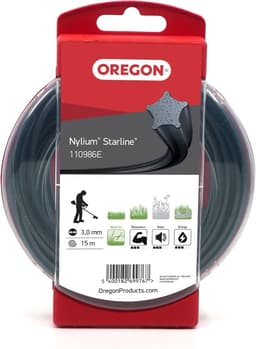
Star cord can suit nettles, long grass and weeds because the points present edges rather than a smooth circle. Oregon's 15 m star line costs £9.60 and Zeqeey's 50 m star spool costs £10.99. One allotment user says a 15 m Oregon pack lasted 18 months of fortnightly work on two plots. Another says the same amount disappeared in roughly ten minutes. Zeqeey has three visible UK texts calling the cord strong, and one person found it less durable on briars. Its 59 ratings are a smaller pool. A defined edge does not turn nylon into a blade. Keep the guard and line knife fitted. Welding is line inside the head fusing instead of releasing. Loose winding, heat and rough eyelets can contribute. UK operators have reported shaped profiles welding, then a return to round line. Those accounts cover mixed gauges, so they are not proof that all star cord welds. If shaped line has already fed evenly, star remains reasonable for tougher vegetation.
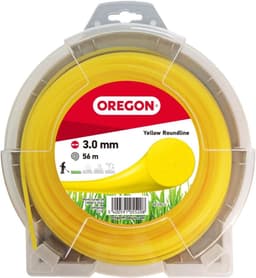
Oregon Oregon round 3.0 mm, 56 m

Testsieger

Oregon Oregon round 3.0 mm, 56 m
9.4/10about £18.78

Duoline stays round, then choose by the task

Oregon Duoline sits on the round side. The 120 m spool costs £36.47 and combines a carbon-loaded core with an outer skin that the manufacturer claims resists welding. It is not a second type of star line, and an aluminium-particle bullet on another SKU does not make it Nylium. It is a bulk round choice where the manual permits 3.0 mm. Even tension and equal tails reduce feed problems. Overfilling thick cord can jam the spool before cutting starts. The how to fit 3mm strimmer line guide covers those steps. Choose round line for a first refill, ordinary grass, or shaped cord that has fused. The 15 m round pack is £7.79. The 56 m pack at £18.78 is the regular-use quantity. The 169 m listing is harder to recommend because its stated 360 g conflicts with the 56 m pack at 580 g. Choose star when the head has already fed shaped line cleanly. Choose Duoline when you will use 120 m against abrasive boundaries.

Shape follows the head you already have

Round line is the starting profile because the section is full and the wind is familiar. Star line is the edge option only after that head has released shaped cord without welding. Duoline stays in the round group: a dual-material 120 m spool, not a five-edge cord. Geometry does not settle service life on its own.

Common questions

Does star line cut nettles better at 3 mm?
Its points provide defined contact edges, so star line can be a reasonable choice for nettles and coarse weeds when the head feeds it correctly. Available reviews do not establish that it always cuts better or lasts longer than round line. Machine speed, technique and vegetation also matter.
Does round 3 mm line last longer than star?
Round line contains more nylon within the same 3.0 mm outer diameter, but that geometry does not guarantee longer service. Material formulation, abrasive surfaces, heat and feed behaviour can dominate. Treat lifespan claims without a like-for-like test as conditional rather than settled.
Why does shaped line weld in the head?
Heat, loose winding, crossed layers and drag at the eyelets can cause line to stick or fuse. Some UK operators report the problem with shaped cord in particular heads, but those accounts cover mixed gauges. Inspect the head and winding before blaming shape alone.
Is Duoline round or star?
Oregon Duoline 106504E is round, dual-material 3.0 mm line. Oregon describes a carbon-loaded core and anti-weld skin. It belongs with round cord in a shape comparison, although its construction and 120 m bulk quantity distinguish it from ordinary yellow nylon.
Is the Oregon star line on Amazon the same as Nylium?
Do not assume so. The retained 15 m Amazon SKU is model 110986E and its bullet mentions aluminium particles, but that does not justify merging it with every Oregon Nylium or Starline product. Compare the exact model and specification rather than the marketing family name.
Which shape is easier to wind?
Round line is the simpler starting point because it has no points and is familiar in conventional spools. Either shape can feed correctly when wound in the marked direction with even tension. A star profile that has previously welded in your head is a reason to return to round.

Related pages

Sources

Sources checked for this comparison; last retrieved on 16 October 2026.

  1. Oregon UK, Duoline 3.0 mm x 120 m (106504E) (retrieved 16 October 2026)
  2. Oregon UK, head capped at 3 mm (108461A) (retrieved 16 October 2026)
  3. HSE, brush cutters and chain flails (retrieved 16 October 2026)
  4. ISO 11806-1:2022, brush-cutters and grass-trimmers (retrieved 16 October 2026)
  5. HSE INDG480, hand-arm vibration (retrieved 16 October 2026)
  6. Control of Noise at Work Regulations 2005 (retrieved 16 October 2026)
  7. Consumer Rights Act 2015, section 22 (retrieved 16 October 2026)
  8. amazon.co.uk listings for the ASINs in this comparison (retrieved 16 October 2026)