Independent comparisons. We may earn from shop links. More info

Is 3mm strimmer line too thick for your head?

Updated: October 2026

Your thinner cord has snapped again, and 3.0 mm looks like a sturdier replacement. Yet 3mm strimmer line is too thick whenever the machine or fitted head specifies a lower maximum, even if you can force the cord through an eyelet. This page helps you locate the real limit, separate diameter from spool capacity and recognise the symptoms of an unsuitable gauge. If your manual already permits 3.0 mm, the [3 mm trimmer line comparison](/hub/lawn-and-garden-equipment/trimmer-line-3mm) is the next step. If it does not, none of those seven spools is the correct repair.

Your thinner cord has snapped again, and 3.0 mm looks like a sturdier replacement.

Our top picks

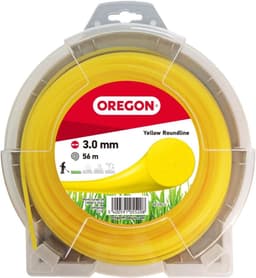
Oregon Oregon round 3.0 mm, 56 m

Best overall

Oregon Oregon round 3.0 mm, 56 m
9.4/10about £18.78
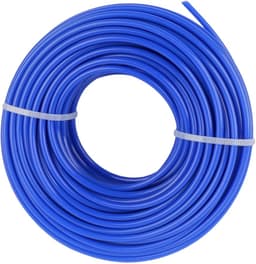
Navoys Navoys 3 mm, 15 m

Alternative

Navoys Navoys 3 mm, 15 m
8.6/10about £4.29
On this page

Find where the maximum diameter is written

Begin with the manual for the exact strimmer and cutting head, not a general chart for the brand. The maximum may sit in the replacement-line section, beside a spool diagram or on the head itself. Match the full model number, because similar-looking machines can use different heads. The eyelet is not the specification. If 3.0 mm line will not enter freely, stop rather than drilling or forcing the opening. If it does pass, you still need the published limit. Oregon's 108461A manual nylon head is marketed for roughly 25–40 cc straight-shaft machines and states a maximum of 3 mm. That is the ceiling for that head, not a passport for every 25 cc machine. Light electric machines often use about 1.2–1.6 mm, many cordless tools sit around 1.6–2.0 mm, and petrol machines often start around 2.4 mm. Those are patterns, not approval.

Maximum diameter and head capacity are different

Maximum diameter is how thick the cord may be. Capacity is how many metres of that cord fit in the spool. A head marked up to 3 mm does not mean a 120 m retail donut goes into the head at once. The larger spool is a shelf supply. One brush-cutter manual allows line up to 3 mm and gives roughly 6 m for a 10 cm head. That is an illustration, not a universal capacity. Overfilling can cross the layers and stop a bump feed from releasing cord. Oregon sells 15 m, 56 m and 120 m packs here, and those numbers are the retail supply. Use the how to fit 3mm strimmer line guide once you know the permitted diameter and the refill length.
Oregon Oregon round 3.0 mm, 56 m

Testsieger

Oregon Oregon round 3.0 mm, 56 m
9.4/10about £18.78

What happens when line is too thick

An oversized cord can jam in the eyelets, bind on the spool or refuse to advance. A thicker section has more mass and drag, so it can add load. On a cordless tool that may show as poor speed or a shorter runtime. Stop and check rather than keep running. The Health and Safety Executive notes that incorrect line length can contribute to vibration. Do not remove the guard to fit more cord. Snapping is not always a diameter problem: dry nylon, a damaged eyelet, kerbs, crossed winding and line shape can all shorten life. An aftermarket head may advertise 3.0 or 3.3 mm, yet the motor, shaft and guard still belong to a specified system. Never replace nylon with wire, chain or an improvised flail. The HSE has warned about dangerous flail-type attachments on brush cutters.

When 3.0 mm is the right ceiling

Stay with 3.0 mm only when the exact manual permits it, the guard is complete and the cord feeds without binding. A thinner approved line may still be the better choice for ordinary lawn edges. If compatibility is confirmed, compare shape and pack length in the 3mm strimmer line buying guide. If it is not, leave this category and use the gauge your manufacturer specifies.

The manual decides, then the eyelet

3.0 mm is too thick whenever the fitted head's maximum is lower, even if the cord can be forced through. Up to 3 mm means 3 mm is the ceiling on that head, as on Oregon 108461A, not a target for every machine. Pack length is a shelf quantity. Load only the metres the head instructions allow.

Common questions

How do I find my strimmer's maximum line size?
Check the exact model manual, the cutting-head label and the manufacturer's support page. Look for maximum line diameter or the replacement-line specification. Do not infer the limit from the brand, engine size alone or an Amazon compatibility bullet, because different heads under one brand can have different limits.
Is 3 mm the maximum for a normal bump head?
It is the stated maximum for some heads, including one Oregon manual head aimed at roughly 25–40 cc machines. Other heads permit less or more. There is no single normal bump-head limit, so use the documentation for the fitted head rather than treating 3.0 mm as universal.
Can thicker line damage a cordless strimmer?
Line above the specified diameter can feed badly and add load, potentially reducing speed and battery runtime. Whether lasting damage occurs depends on the machine and use, so do not wait for failure as a test. If the manual limits the head below 3.0 mm, use the approved thinner gauge.
Why does the spool pack show 120 m?
That is the total retail supply, not the amount loaded into the head. A head may take only a few metres per refill, with the exact length set by its design and instructions. Cut the specified amount and store the remainder rather than trying to maximise each fill.
My thinner line snaps. Should I move to 3 mm?
Only if 3.0 mm is within the stated limit. First inspect the eyelets, winding, line condition and the surfaces you are striking. Repeated contact with stone or concrete can break any nylon, while dry line and damaged guides may explain the fault without changing diameter.
What if I already bought 3 mm line and it will not fit?
Do not force it through the eyelet or modify the head. Recheck that the supplied line matches the listing and return it if it is not as described. If it is correctly supplied but your machine requires a thinner gauge, obtain the manufacturer-specified line instead.

Related pages

Sources

Sources checked for this comparison; last retrieved on 16 October 2026.

  1. Oregon UK, Duoline 3.0 mm x 120 m (106504E) (retrieved 16 October 2026)
  2. Oregon UK, head capped at 3 mm (108461A) (retrieved 16 October 2026)
  3. HSE, brush cutters and chain flails (retrieved 16 October 2026)
  4. ISO 11806-1:2022, brush-cutters and grass-trimmers (retrieved 16 October 2026)
  5. HSE INDG480, hand-arm vibration (retrieved 16 October 2026)
  6. Control of Noise at Work Regulations 2005 (retrieved 16 October 2026)
  7. Consumer Rights Act 2015, section 22 (retrieved 16 October 2026)
  8. amazon.co.uk listings for the ASINs in this comparison (retrieved 16 October 2026)