Independent comparisons. We may earn from shop links. More info

How to fit 3mm strimmer line safely

Updated: October 2026

You have checked the manual, confirmed that the head accepts 3.0 mm cord and now need to reload it without creating a jam. Learning how to fit 3mm strimmer line is mainly about isolation, the direction marked on your spool, an appropriate fill and balanced tails. This guide covers a conventional refill while leaving model-specific catches and routing to the manufacturer's instructions. If you still need cord, compare pack lengths on the [3 mm trimmer line comparison](/hub/lawn-and-garden-equipment/trimmer-line-3mm). If the line will not enter the eyelet freely, stop and check the diameter rather than forcing it.

You have checked the manual, confirmed that the head accepts 3.0 mm cord and now need to reload it without creating a jam.

Our top picks

On this page

Make the machine safe before opening the head

Put the strimmer on stable ground and isolate its power source. Unplug a mains model, remove the battery, or follow the petrol-machine manual for preventing an unintended start, which may include disconnecting the spark-plug lead. Waiting for the head to stop while the machine stays energised is not enough when your hands will be beside the cutting attachment. Check for cracks, worn eyelets and line wrapped behind the head towards the gearbox. Keep the manufacturer's guard and line-cutting knife fitted. The Health and Safety Executive links incorrect line length with increased vibration, so the guard is functional protection. Open the spool as the manual shows. Forcing a hidden catch can crack the housing.

Wind in the marked direction and respect the fill

Cut the refill length specified for your head. One manual for a 10 cm brush-cutter head gives roughly 6 m of line up to 3 mm. Another design may take less, use two separate lengths or load without removing the spool. The 15 m, 56 m or 120 m figure on a retail pack is the stored supply, not one refill. For a spool that takes one folded length, find the centre and engage it as instructed. Keep both sides even, then wind in the direction of the arrow on the spool. There is no universal clockwise answer. BLACK+DECKER and other manufacturers say to follow the arrow because spool designs differ. Lay the line in even rows. Do not fill above the marked line. A 3.0 mm cord occupies more space than a thinner gauge, so a length copied from a 2.0 mm setup may overfill the same spool. Route each end through its eyelet, seat the cap, then release the ends from any parking slots.
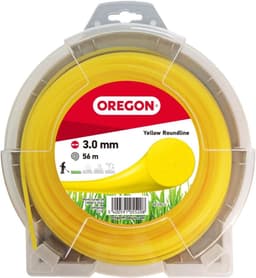
Oregon Oregon round 3.0 mm, 56 m

Testsieger

Oregon Oregon round 3.0 mm, 56 m
9.4/10about £18.78

Set equal tails, then stop if the line will not fit

Pull the two tails to similar lengths before restoring power. Allow the guard knife to trim only a small excess. Do not leave long tails or remove the guard to widen the cut. Clear people, pets and loose debris. The NPTC assessment schedule uses a 15 metre exclusion distance for brush-cutter work. Wear eye protection, sturdy footwear and leg protection. If line dumps out or will not advance, isolate the machine before you touch it. If 3.0 mm cord will not pass the eyelet, do not shave it or enlarge the opening. The 3 mm head and diameter guide explains why an aftermarket head rating does not approve a larger gauge for the whole machine. If shaped line repeatedly welds, the round versus star line guide is the case for returning to round cord. Never substitute wire, cable, chain or a flail head. The HSE has warned that non-standard flail attachments can release dangerous components.

When the refill is finished

A correct refill is an isolated machine, line wound with the arrow, a spool that is not overfilled, and two tails the guard knife can trim. The metres on the retail pack stay on the shelf. If the cord will not enter the eyelet, or the guard and head are damaged, stop. Fitting technique cannot correct an incompatible diameter or a physically damaged head.

Common questions

Do I need to disconnect the strimmer first?
Yes. Unplug a mains tool, remove the battery or follow the petrol-machine procedure for preventing an unintended start before opening the head. Keep the machine isolated until the spool, cap and guard have been checked and your hands are away from the cutting area.
Which direction should I wind 3 mm line?
Follow the arrow moulded or printed on your spool. There is no universal clockwise direction because head designs differ. Wind under even tension in tidy layers, avoid crossing the line and keep both sides balanced if the spool uses a centred length.
How much 3 mm line fits in a bump head?
Use the exact head manual. Roughly 6 m on a 10 cm head appears in one manual, but it is not a general capacity. A thicker cord occupies more spool space, so do not reuse a refill length intended for a smaller diameter.
Why does the line dump out or refuse to feed?
Common causes include overfilling, crossed or loose winding, reversed spool orientation, tails left in parking slots and an incorrectly seated spring or cap. Isolate the machine and compare the assembly with its diagram. Persistent failure may indicate worn eyelets or another damaged component.
Should I soak dry strimmer line?
Some manufacturers recommend moisture conditioning for nylon, but their methods and times differ. Follow the maker's advice for your line and condition the spare cord away from the tool. Soaking cannot fix a wrong diameter, a damaged eyelet or poor winding.
Can I use wire if nylon keeps breaking?
No. Do not fit wire, chain, cable or an unapproved flail in place of nylon line. Investigate the specified diameter, line condition, eyelets and contact with hard surfaces. If the task genuinely requires another attachment, use only one approved for the machine and have it fitted correctly.

Related pages

Sources

Sources checked for this comparison; last retrieved on 16 October 2026.

  1. Oregon UK, Duoline 3.0 mm x 120 m (106504E) (retrieved 16 October 2026)
  2. Oregon UK, head capped at 3 mm (108461A) (retrieved 16 October 2026)
  3. HSE, brush cutters and chain flails (retrieved 16 October 2026)
  4. ISO 11806-1:2022, brush-cutters and grass-trimmers (retrieved 16 October 2026)
  5. HSE INDG480, hand-arm vibration (retrieved 16 October 2026)
  6. Control of Noise at Work Regulations 2005 (retrieved 16 October 2026)
  7. Consumer Rights Act 2015, section 22 (retrieved 16 October 2026)
  8. amazon.co.uk listings for the ASINs in this comparison (retrieved 16 October 2026)