Independent comparisons. We may earn from shop links. More info

How to top dress a lawn in the UK

Updated: October 2026

You have a bag of sand, a lawn that dips under the mower, and three different figures for how much to apply. One is a couple of kilograms per square metre. Another is in millimetres. A trade rule of thumb is a large fraction of a cubic metre. They are not one number averaged together. This page is the material, the season and the rate, and the point where you stop because the grass would have to be buried. The stroke is a separate job. Listings are the [lawn squeegee comparison](/hub/lawn-and-garden-equipment/lawn-squeegee). Rates are quoted from the named sources. A trial plot was not weighed. A qualifying purchase through our links can earn a commission at no extra cost to you.

You have a bag of sand, a lawn that dips under the mower, and three different figures for how much to apply. One is a couple of kilograms per square metre. Another is in millimetres.

Our top picks

DAKEPOLE DAKEPOLE 76 cm bullet

Best overall

DAKEPOLE DAKEPOLE 76 cm bullet
9.4/10about £21.99
TITECK TITECK 114 cm plate

Alternative

TITECK TITECK 114 cm plate
9.0/10about £69.99
On this page

What top dressing is

Top dressing is a thin layer worked into the surface so shallow hollows fill and the grass is still there afterwards. The Royal Horticultural Society gives a home mix: three parts sandy loam, six parts horticultural sharp sand, and one part compost or leaf mould, after aeration, at about 2–3 kg per square metre. Sharp sand here is horticultural sand, not builders' sand. A sack labelled lawn sand usually means a moss treatment, not that three-part mix. Compost in the RHS mix is one part in ten. If you cannot rub the mix through your fingers, it is not ready.

How much, and why the figures differ

Keep each rate with its source. The RHS figure is about 2–3 kg per square metre of that sandy mix, after aeration. Gardeners' World says you will usually use 2–4 kg per square metre, and up to 6 kg if the lawn needs a heavy dressing. Those ranges overlap. They are not an instruction to add them. Rolawn works in depth: up to about 3 mm in spring and autumn, about 3 litres per square metre, and about 1.5 mm in summer. The grass has to stay visible. Do not average those litres with the RHS kilos. The UK Lawn Care Association's rule of thumb is about 0.5–1 cubic metre per 100 square metres for a fuller dressing. That is already thicker than Rolawn's 3 litres per square metre. Do not average it with the RHS 2–3 kg rate. A dip cannot take enough to hide the grass.
DAKEPOLE DAKEPOLE 76 cm bullet

Testsieger

DAKEPOLE DAKEPOLE 76 cm bullet
9.4/10about £21.99

When to do it, and when not to

Dress when the grass is growing and the surface is dry enough to work. Rolawn puts the thicker coat, about 3 mm, in spring and autumn, and the thinner 1.5 mm coat in summer. Skip frozen or waterlogged ground. Do not top-dress in a drought. Rolawn states that limit. Sand on a browned, dormant sward gives you nothing to brush into. Hosing a dressing onto a dry lawn is not the exception. Patches that look like fusarium, or any spreading brown patch you do not recognise, are a reason to leave the sand in the bag. If water sits after rain, the job is under the turf.

Hollows the dressing should not bury

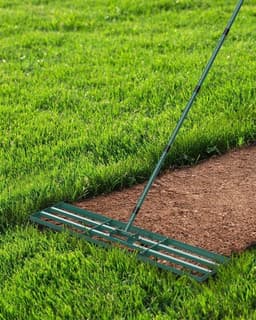
If you would have to bury the sward to hide the hollow, you are no longer top-dressing. The RHS repairing page describes an H-shaped cut: slice the turf, fold it back, add or remove soil underneath, firm it, and lay it down. A sandy dressing then goes in the seams, not as a blanket. A plate or a rake only moves what you put on the surface. Even a thin coat waits for the mower. Gardeners' World says at least a week, and ideally two. The push-and-pull once the mix is down is on how to use a lawn levelling rake. If the hollow is still obvious after a thin coat and a season of growth, repeat a thin coat or cut and lift. Do not make up the difference in one day with the cubic-metre rule on a single dip.

Common questions

How do I top-dress a lawn in the UK?
Aerate if the lawn needs it, then apply a thin sandy mix while the grass is growing and the surface is dry. Keep the tips visible. Do not dress in drought. Wait at least a week before you mow. Deep hollows are an H-cut, not a thicker coat.
How much top dressing per square metre?
Quote the source you are following. The RHS says about 2–3 kg. Gardeners' World says usually 2–4 kg, and up to 6 kg for a heavy dressing. Rolawn says up to about 3 mm, about 3 litres per square metre, in spring and autumn, and about 1.5 mm in summer. The association's 0.5–1 cubic metre per 100 square metres is a fuller job. Do not average them.
Can I top-dress in a dry summer?
No. Rolawn's limit is not to top-dress in drought. Wait until the lawn is growing and rain has wetted the soil. A 1.5 mm summer coat is for a lawn that is still active, not for brown, dormant grass. A hose does not turn a dry lawn into the autumn job.
Is builders' sand the same as sharp sand?
No. The RHS mix asks for horticultural sharp sand and says that is not builders' sand. If the bag does not say horticultural or sharp sand, it is not the six parts in that recipe. Lawn sand sold as a moss treatment is a third product and is not this dressing.
What if the hollow is still there after a thin coat?
Leave it, then either repeat a thin coat in the next growing window or lift the turf. One RHS-scale dressing will not erase a deep dip. If filling the hole would hide the grass, use the H-cut: soil underneath, turf back on top, dressing only in the cuts.
How long before I can mow?
Wait at least a week, and ideally two, which is Gardeners' World's line. Rolawn says not to mow immediately. Mowing sooner picks the dressing up and empties the hollows.

Related pages

Sources

Public UK sources are listed below. Shelf prices and star lines are from the amazon.co.uk listings in this comparison. We did not lab-test edge shape, stiffness or how a plate spreads sand.

  1. RHS, Lawn care in autumn (retrieved 23 October 2026)
  2. RHS, Repairing lawns (retrieved 23 October 2026)
  3. Rolawn, Top dressing (retrieved 23 October 2026)
  4. BBC Gardeners' World, Top-dressing a lawn (retrieved 23 October 2026)
  5. GOV.UK, General Product Safety Regulations 2005: Great Britain (retrieved 23 October 2026)
  6. Business Companion, Selling and supplying goods (retrieved 23 October 2026)
  7. HSE, Manual handling in agriculture (retrieved 23 October 2026)
  8. UK Lawn Care Association, Advice for homeowners (retrieved 23 October 2026)