Independent comparisons. We may earn from shop links. More info

Pole hedge trimmer vs handheld: chest height or tall

Updated: October 2026

You can buy a short cordless trimmer or a pole, and the hedge in front of you may not need both. Pole hedge trimmer vs handheld is a choice of shape. A handheld is the precise tool when the hedge sits at chest height and your elbows stay down. A pole is for the top that would otherwise put you on a ladder. The [cordless telescopic hedge trimmer comparison](/hub/lawn-and-garden-equipment/cordless-telescopic-hedge-trimmer) ranks poles only, after you have decided you need a shaft. The Products Compared editorial team used UK buying guides on 22 October 2026, not a side-by-side cut. A qualifying purchase can earn a commission at no extra cost to you.

You can buy a short cordless trimmer or a pole, and the hedge in front of you may not need both. Pole hedge trimmer vs handheld is a choice of shape.

Our top picks

On this page

A handheld is the precise tool at chest height

A handheld hedge trimmer is balanced around your hands. You can see the teeth, and you are not holding a shaft that gets heavier as it gets longer. Which? puts handheld tools on hedges you can reach. Trusted Reviews makes the same split: a standard trimmer is centred and precise, while a pole reaches, pivots and is top-heavy. A short boundary, a newly planted beech, or a box you trim with your elbows down does not need a telescopic shaft. If your current handheld already finishes the hedge without a ladder, keep it. Short cordless cutters sit in the cordless hedge trimmer comparison.

A pole is for the top you would otherwise climb to

Choose the pole when the top of the hedge would put you on a ladder, and you can still steer the blade from the ground. The head locks flatter for the top and nearer vertical for the far face. Which? describes long-reach tools as the answer for a tall hedge from the ground, and also as often underpowered and unwieldy. A pole is safer than a ladder only when you can still see and hold it. An overhead line, a face you cannot see, or a stem the tooth will not take are stops. What tall means, including lines and brown conifer, is tall hedges. Do not make the pole do the waist-high run along a low boundary.
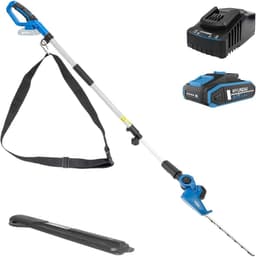
Hyundai Hyundai 20V, 2.6 m pole

Testsieger

Hyundai Hyundai 20V, 2.6 m pole
7.8/10about £88.99

Many gardens want both, and a cord only if the socket is beside the hedge

A lot of gardens have one hedge at chest height and another that has become a screen. Use the handheld where you can see the teeth without raising your arms for long, and the pole where the alternative is the stepladder. A corded pole is a third option. Wickes lists a Flymo EasiCut Reach 480 at about £135 with a 10 m cable. Which? puts the corded risk in one place: you can cut the lead. It is a poor bargain if the cable has to cross the lawn or the blade.

Pick the shape, then the listing

If the top is above a comfortable handheld reach and you can steer it from the ground, buy the pole and then open the comparison. If the hedge is within a comfortable reach, keep the handheld. If you have one of each height, keep both. A pole does not cut more thickly because it is longer. If the condition for a pole is met, the buying guide is next: shaft versus a reach that includes you, a tooth around 14–16 mm, a battery in the box, and a strap that only shares the weight. If the condition is not met, every row on the pole page is still a pole.

Common questions

When is a handheld the better buy?
When you can trim the hedge with your elbows down and still see the teeth. Chest-height beech, privet and a short boundary are that job, which is how Stihl and Which? split the tools. You get a centred cut and less fatigue. You do not get the top of a screen that has grown past your hands. If a ladder is not in the plan, a pole is extra weight for no reach you need.
When is the pole worth the weight?
When the top would otherwise be a ladder, and you can still hold and see the head from the path. The pivot lets you take the top and the far face without climbing. The cost is a top-heavy tool and a cut that is less precise than a short bar at chest height. If a previous pole was already too heavy, another shaft will not fix your arms. Reach you cannot steer is not a benefit.
Can one tool do both the low boundary and the tall screen?
Poorly. A pole on a waist-high hedge is slow and clumsy. A handheld on a tall screen sends you up a ladder. Gardens with both heights are better with both tools, used on the hedge each one fits. That is two purchases with a clear job each, not a compromise bar that is wrong twice. If you only have one height, buy the one shape and stop.
Is a corded pole a third option?
Yes, if the socket is next to the hedge and you will keep the cable out of the blade. A Flymo Reach and a Stihl HLE 71 are sold with about 10 m of lead. Which? treats cut cables as the corded risk, and runtime is no longer the limit. If the lead has to cross the garden, a battery pole with a second pack is the cleaner choice. This comparison is cordless poles. The cord is a fork, not a hidden winner.
Is a pole safer than a ladder by itself?
It is safer than a ladder when you can steer the head from the ground. It is not a general safety upgrade. A line within about 6 m horizontally, a top you cannot see, or a wet grip on a head-heavy shaft are still reasons to stop. The Health and Safety Executive’s point is to avoid the height, not to declare every pole safe. If the pole does not remove the ladder, it has not done the job you bought it for.

Related pages

Sources

Public UK sources from the research digest, last checked on 22 October 2026.

  1. GOV.UK: hedgerow management rules, cutting and trimming (retrieved 22.10.2026)
  2. GOV.UK: wild birds, protection, surveys and licences (retrieved 22.10.2026)
  3. RSPB: birds' nests (retrieved 22.10.2026)
  4. HSE: work at height, step by step (retrieved 22.10.2026)
  5. HSE: ladders, when and how to use them safely (retrieved 22.10.2026)
  6. BSI: BS EN 62841-4-2 hedge trimmer safety (retrieved 22.10.2026)
  7. GOV.UK: Supply of Machinery (Safety) Regulations 2008 (retrieved 22.10.2026)
  8. Electrical Safety First: hedge trimmers (retrieved 22.10.2026)