Independent comparisons. We may earn from shop links. More info

How to use a telescopic hedge trimmer from the ground

Updated: October 2026

The pole is out of the box, the hedge is above the reach of a short trimmer, and the blade is still covered. How to use a telescopic hedge trimmer is a sequence: look, dress, set the head with the battery out, cut the sides and then the top, and stop when the tool jams, the weather turns, or the job is no longer yours. This page does not rank the listings. The [cordless telescopic hedge trimmer comparison](/hub/lawn-and-garden-equipment/cordless-telescopic-hedge-trimmer) is where the poles sit. The Products Compared editorial team used UK manuals and public guidance on 22 October 2026. A qualifying purchase can earn a commission at no extra cost to you.

The pole is out of the box, the hedge is above the reach of a short trimmer, and the blade is still covered.

Our top picks

On this page

Check the hedge and yourself before the pack goes in

Walk the length before the battery goes in. Look for wire, old fencing, and birds going in and out. Damaging a nest that is in use or being built is an offence under the Wildlife and Countryside Act 1981 in England, Scotland and Wales. Northern Ireland uses the Wildlife (Northern Ireland) Order 1985. The RSPB advises against cutting from March to September because that is when most nests are active. An active nest is the stop. Eye protection, hearing protection, gloves and boots are the set Sealey’s CP20VPHT instructions expect, and head protection matters once the blade is overhead. Do not work in the rain. The UK 3-pin plug belongs to the charger, indoors. Fit the strap if the listing supplied one.

Set the pole and the head with the battery removed

Take the battery out before you change the length, the head angle, or anything near the teeth. Sealey’s instructions say the pack comes out before adjustments, before you clear a blockage, and before you leave the tool. Extend only as far as you can still see the tips. Set the head nearer vertical for the face, and flatter for the top, each time with the pack out. If the listing prints two angles, as the BlueMars one-pack does with 135° in the title and −45° to 90° in the bullets, follow the detent you can feel. A two-hand start means the lock and the trigger together. Do not tape a switch down. Shaft, tooth and battery, before you buy, are the buying guide.
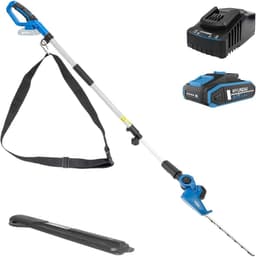
Hyundai Hyundai 20V, 2.6 m pole

Testsieger

Hyundai Hyundai 20V, 2.6 m pole
7.8/10about £88.99

Cut the sides, then the top, and keep the head off your face

Start on the sides, working upwards from a height you can already see, and leave the top until the faces are even. A string line along the top stops the blade wandering. Keep a slight tilt so the clippings fall away. The tooth will take about a year’s soft growth when the gap is in the usual 14–16 mm band. If the stem will not enter, do not force it with the pack still fitted. Stop when your arms tire.

Jam, rain, and the moment a professional takes over

Switch off, take the battery out, and wait until the blade has stopped before you pull a stem free. Do not put a hand between the teeth with the pack still on the tool. If it is raining, or the hedge is wet, stop. Do not stand on a ladder to gain the last half-metre. How high you should go, and what an overhead line changes, is tall hedges. Call a professional when you cannot control the top from the ground, when the hedge overhangs a road or a neighbour’s glass, when an overhead line is inside a clearance you cannot guarantee, or when old wood has to come off.

Common questions

Do I cut the sides or the top first?
Cut the sides first, from growth you can see, and do the top once the faces are even. A string line keeps the top from sloping. Keep the blade skimming, with a slight tilt so the clippings drop clear, and do not bury the teeth. That order is the usual UK guidance. It is not a reason to keep cutting after your arms have gone, or after you have found a nest.
How do I set the head without the blade running?
Take the battery off, then move the head and the shaft, then lock them. Bosch and Sealey both put the pack out before an adjustment. If the listing prints two different angles, use the lock you can feel rather than splitting the difference. Put the pack back only when the cover is off, the head is locked, and you are ready to cut. A switch that needs a second hand is there to be used, not taped.
What do I do when the blade jams?
Let go of the trigger, take the battery out, and wait until the teeth stop. Then clear the stem. Forcing a thick branch with the pack fitted is how these poles stall, especially on old hedges and on conifer that is past a light tip. If the stem is fatter than the tooth gap, stop and leave it. A jam cleared with the battery still in is the mistake the manuals are written to prevent.
Can I use it in the wet?
No. Stop if it rains or the foliage is wet enough to soak you and the tool. The cutter is battery, so unplug means the pack comes off. The charger’s UK 3-pin plug stays indoors. Electrical Safety First’s cable and RCD advice is for a corded trimmer. It does not make a wet battery pole acceptable, and a wet grip makes an already top-heavy head harder to hold.
What if I see birds going into the hedge?
Stop. Damaging a nest in use or being built is an offence, and the RSPB’s advice is not to cut from March to September because nests are likely. That is not the same as the England farm rule, which closes covered agricultural hedgerows from 1 March to 31 August. A house hedge can still be trimmed in summer if you have checked and there is no active nest. If you are unsure, leave that section.

Related pages

Sources

Public UK sources from the research digest, last checked on 22 October 2026.

  1. GOV.UK: hedgerow management rules, cutting and trimming (retrieved 22.10.2026)
  2. GOV.UK: wild birds, protection, surveys and licences (retrieved 22.10.2026)
  3. RSPB: birds' nests (retrieved 22.10.2026)
  4. HSE: work at height, step by step (retrieved 22.10.2026)
  5. HSE: ladders, when and how to use them safely (retrieved 22.10.2026)
  6. BSI: BS EN 62841-4-2 hedge trimmer safety (retrieved 22.10.2026)
  7. GOV.UK: Supply of Machinery (Safety) Regulations 2008 (retrieved 22.10.2026)
  8. Electrical Safety First: hedge trimmers (retrieved 22.10.2026)