Independent comparisons. We may earn from shop links. More info

Water softener for limescale and hot water

Updated: 17.10.2026

A water softener for limescale and hot water can protect domestic water through a cylinder, a combi heat exchanger or an electric shower. That is a different circuit from the sealed heating system, whose filling point stays on untreated mains. Peter F. used amazon.co.uk extracts from 15 October 2026 and public UK sources. There was no laboratory test. Compare the listings on the [water softening systems comparison](/hub/hot-water/water-softening-systems), then have the pipes checked before installation. A qualifying purchase through our links can earn us a commission at no extra cost to you.

A water softener for limescale and hot water can protect domestic water through a cylinder, a combi heat exchanger or an electric shower.

Our top picks

AquaHouse AquaHouse 9 litre

Best overall

AquaHouse AquaHouse 9 litre
7.1/10about £399.99
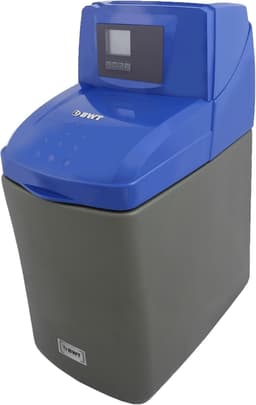
BWT BWT WS355

Rank 2

BWT BWT WS355
8.9/10about £599
Eddy Eddy ED6002P-UK

Alternative

Eddy Eddy ED6002P-UK
8.1/10about £139
On this page

Separate domestic hot water from radiator water

Hard mains water can leave scale in a kettle, a shower or a domestic hot-water heat exchanger. On a combi that is the tap-water side. With a cylinder it is the stored domestic water. An ion-exchange softener can remove calcium and magnesium before that water is heated. The radiator circuit is a closed primary system. It needs the boiler maker’s cleaning and inhibitor regime. It may share the boiler casing with the domestic heat exchanger, and the two paths are not interchangeable. Scale on a shower head is not a reason to push softened water through the filling loop. On a combi, the softener can sit on the supply to the taps while the filling loop branches from untreated mains upstream, or uses the approved bypass. That split belongs on the installer’s diagram. If you cannot identify the primary filling point, ask a heating engineer rather than turning valves to see what happens.

Follow the boiler maker’s filling instructions

Worcester Bosch says a softener may protect the domestic hot-water circuit, and that the heating circuit should be filled with hard water plus the appropriate inhibitor, from a bypass or a filling connection upstream of the softener. Baxi says water used to fill or re-pressurise the primary system must not have been artificially softened, and that the fill point should be before the softener. Those are manufacturer requirements, not a claim that untreated mains needs no further treatment. The heating circuit still needs commissioning and inhibitor, including practice such as BS 7593. A domestic softener does not replace inhibitor, cleaning or servicing. Tell the installer the exact boiler model. Ask which valve feeds the taps, which point fills the primary, and how the raw-water route stays available. Do not alter a filling loop from a generic diagram.
AquaHouse AquaHouse 9 litre

Testsieger

AquaHouse AquaHouse 9 litre
7.1/10about £399.99

Ask the softener to do one defined job

The Drinking Water Inspectorate notes that a softener before the hot-water storage appliance can be a more economical anti-scale layout than softening every outlet. That can leave a cold drinking tap untreated. The pipes still depend on a combi, a cylinder, an instantaneous heater or an electric shower, and on the maker’s instructions. Choose ion exchange when you want the minerals removed from the domestic hot-water feed. AquaHouse, BWT and iSpring are the salt listings here, and they need salt, a drain and an overflow. A boiler cupboard with no waste may be the wrong place. Those connections are on the how to install a water softener page. Do not promise a gas saving or a longer boiler life. None of the six listings gives a verified kilowatt-hour saving, and there is no before-and-after test here. Less scale on a domestic heat-transfer surface is a credible aim. An invented percentage is not. How to read the mg/l CaCO3 figure is the water softener buying guide.

Treat electronic scale claims with care

Eddy and Water-King are electronic conditioners. The Inspectorate says physical devices do not soften, because the composition stays the same. An Eddy review about less kettle scale, or an electric shower, is one household’s report. It is not a boiler approval, and it does not show that hardness ions have gone. Water-King’s listing includes an electric-heater claim, while its soften wording conflicts with that chemistry. Ask the boiler or shower maker whether a physical conditioner meets any stated requirement. A marketplace title cannot override a manual that requires softened water. Where a salt cabinet and a drain are impossible, an electronic unit is only a home trial with unchanged hardness. Judge deposits or cleaning effort, not a hardness drop the technology does not provide. That choice is the salt water softener vs electronic descaler page. If you want the minerals removed from domestic hot water, use a correctly sized salt softener and keep the primary fill on untreated mains. If that split cannot be verified, pause.

Common questions

Will a softener stop scale in a combi boiler?
An ion-exchange softener can remove hardness minerals from the domestic cold feed that becomes hot tap water, so less of that material is available to form limescale in that path. It cannot guarantee that every fault or deposit disappears. It should not feed artificially softened water into the sealed central-heating circuit.
Can I fill the heating circuit with softened water?
Not where the boiler manufacturer prohibits it. Worcester Bosch and Baxi guidance says the primary heating system should not be filled or re-pressurised with artificially softened water. Keep an untreated filling point upstream of the softener, or use the arrangement the maker approves, and keep the specified inhibitor treatment.
Where should the filling loop be?
The primary filling connection should draw from untreated mains when the boiler instructions require that. This commonly means upstream of the softener, or through an approved bypass. The position is specific to the property and the boiler. Ask the installer to identify it and label it, rather than moving it yourself.
Does a softener replace heating-system inhibitor?
No. A water softener treats an open domestic supply by exchanging hardness ions. Heating inhibitor protects the sealed primary circuit against corrosion under a separate regime. Follow the boiler instructions for cleaning, inhibitor concentration and testing, even when domestic hot water is softened.
Is an electronic descaler equivalent boiler protection?
No. Electronic conditioners do not remove calcium and magnesium, and official UK guidance does not class them as softeners. They may be trialled against a qualified scale-conditioning claim. Ask the appliance maker whether that treatment meets its requirements. A kettle or shower review is not boiler certification.

Related pages

Sources

Public UK sources from the digest of 16 October 2026, and amazon.co.uk extracts dated 15 October 2026.

  1. Drinking Water Inspectorate: domestic water filters and softeners (retrieved 16 October 2026)
  2. Drinking Water Inspectorate: water hardness (retrieved 16 October 2026)
  3. Drinking Water Inspectorate: hardness map (retrieved 16 October 2026)
  4. Drinking Water Inspectorate: drinking water standards (retrieved 16 October 2026)
  5. NHS: making up baby formula (retrieved 16 October 2026)
  6. DWQR Scotland: water conditioning (retrieved 16 October 2026)
  7. WRAS approvals directory, section 2450 (retrieved 16 October 2026)
  8. Which?: how to buy the best water softener (retrieved 16 October 2026)