Independent comparisons. We may earn from shop links. More info

Water softener buying guide

Updated: 17.10.2026

A water softener buying guide should start with your supplier’s hardness figure, not the highest star rating on amazon.co.uk. The checks run in this order: the number in mg/l as calcium carbonate, whether you need those minerals removed, whether the cabinet and the drain will fit, then fittings evidence, and only then price. A well-reviewed listing is still the wrong buy if the treatment type is wrong. Peter F., DIY & tools editor, used amazon.co.uk extracts from 15 October 2026 and public UK sources. There was no laboratory test. The six-row table is the [water softening systems comparison](/hub/hot-water/water-softening-systems). A qualifying purchase through our links can earn us a commission at no extra cost to you.

A water softener buying guide should start with your supplier’s hardness figure, not the highest star rating on amazon.co.uk.

Our top picks

iSpring iSpring WCS15KG

Best overall

iSpring iSpring WCS15KG
6.3/10about £253.99
AquaHouse AquaHouse 9 litre

Preis-Tipp

AquaHouse AquaHouse 9 litre
7.1/10about £399.99
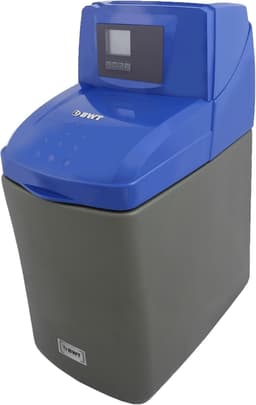
BWT BWT WS355

Rank 3

BWT BWT WS355
8.9/10about £599
On this page

Check the hardness figure before the basket

Find your water company’s current result for your postcode, in milligrams per litre of calcium carbonate (mg/l CaCO3). The Drinking Water Inspectorate describes water below 100 mg/l as soft to moderately soft, 100–200 mg/l as slightly hard, 200–300 mg/l as moderately hard, and above 300 mg/l as hard to very hard. Supplier maps sometimes use different labels, so compare the number rather than a colour or the word hard. There is no UK law that every home above a shop’s cut-off must have a softener. At 210 mg/l, for example, the decision depends on whether scale is shortening shower heads, coating a hot-water cylinder, or leaving marks you can clean. Use a recent supplier result, not an old national map. Then ask what the appliance actually changes.

Choose a salt softener or a conditioner

An ion-exchange softener removes calcium and magnesium and replaces them with sodium. In this set the AquaHouse, BWT and iSpring listings are salt units. They need regeneration salt, a cold-water connection and a suitable waste route. That is the type when you want the minerals removed, not a scale-conditioning claim. Eddy and Water-King wrap a pipe. They use no resin and no brine drain. The Inspectorate says magnetic and similar physical conditioners do not soften, because the chemical composition stays the same. Eddy’s listing says hardness is unchanged. A conditioner can still be a rational trial if you cannot install drainage, want no sodium exchange, and accept that a hardness test will still read hard. It is not a cheaper equivalent of ion exchange. That split is the salt water softener vs electronic descaler page.
iSpring iSpring WCS15KG

Testsieger

iSpring iSpring WCS15KG
6.3/10about £253.99

Measure the cupboard and budget for installation

Measure height, width and depth at the narrowest points, then leave room to open the lid, add salt and reach the bypass. A nominal cabinet size is not the space an installer needs. The AquaHouse 9 litre listing is about 583 mm high, the BWT WS355 about 602 mm, and the larger AquaHouse about 1,047 mm. A shelf, plinth or pipe across the rear can rule out a unit that looks fine on paper. Treat conflicting dimensions as a stop. The iSpring extract disagrees with itself, and the 21 litre AquaHouse listing has a part-number conflict. Ask for a current drawing of the exact model. Do not infer cabinet size from resin litres. The shelf price is not the installed price: those two AquaHouse listings were £399.99 and £649.99, and salt, extra valves and labour sit outside the figures. A 9 litre bed may suit a smaller household. A 21 litre bed needs much more height. Compare the models on the best water softener UK page, then confirm sizing against your hardness and water use.

Check fittings evidence and know when to stop

WRAS approval concerns fittings and materials. It does not mean one approved unit removes more scale than another. The AquaHouse 9 litre listing prints number 260502718. The BWT extract claims WRAS and prints no number. Check both against the current directory and the exact model. A missing line on the iSpring extract is not proof of failure. It is evidence you still need before connection. Plan an untreated drinking outlet at the kitchen sink, because ion exchange raises sodium. If the pipe layout cannot keep that outlet, pause and ask a qualified plumber to design it. Stop before you order if the seller cannot settle the model, the dimensions or the fittings line, if there is no compliant drain and overflow, or if you cannot reach the unit to add salt. A promise of simple fitting cannot see your rising main. Hand the practical checks to an installer with the how to install a water softener page.

Common questions

What hardness means I should consider a water softener?
There is no mandatory UK threshold. The Drinking Water Inspectorate calls 200–300 mg/l CaCO3 moderately hard and more than 300 mg/l hard to very hard. Consider an ion-exchange unit when scale is causing a real problem and you want the minerals removed. Use your supplier’s current postcode result, not a retailer’s universal cut-off.
Is an electronic descaler a type of salt-free softener?
No. An electronic descaler may claim to alter how scale forms, but it does not remove calcium and magnesium, so the water stays chemically hard. It can suit a home without space for salt or a drain only if you accept that limit and can judge the outcome with a defined home trial.
Does WRAS approval mean better scale removal?
No. WRAS approval relates to water-fittings compliance for the named product or material, not a comparison of softening performance. Check the approval number and the model in the directory. Judge scale removal by treatment chemistry, capacity and correct commissioning, not by the logo as a performance badge.
Is the Amazon shelf price the total cost?
Usually not. Allow for salt, valves, adaptors, waste fittings, a possible separate drinking tap, installation and servicing. Even where a box includes a bypass and a drain hose, your plumber may need different fittings, or a second waste route, before the installation is compliant and serviceable.
Can I use softened water for infant formula?
No. NHS guidance says not to use artificially softened water to prepare infant formula, because it may contain too much sodium. Keep a suitable untreated cold-water outlet, normally at the kitchen sink, and confirm the final pipe arrangement with your installer.

Related pages

Sources

Public UK sources from the digest of 16 October 2026, and amazon.co.uk extracts dated 15 October 2026.

  1. Drinking Water Inspectorate: domestic water filters and softeners (retrieved 16 October 2026)
  2. Drinking Water Inspectorate: water hardness (retrieved 16 October 2026)
  3. Drinking Water Inspectorate: hardness map (retrieved 16 October 2026)
  4. Drinking Water Inspectorate: drinking water standards (retrieved 16 October 2026)
  5. NHS: making up baby formula (retrieved 16 October 2026)
  6. DWQR Scotland: water conditioning (retrieved 16 October 2026)
  7. WRAS approvals directory, section 2450 (retrieved 16 October 2026)
  8. Which?: how to buy the best water softener (retrieved 16 October 2026)