Independent comparisons. We may earn from shop links. More info

Under-sink water heater for one basin

Updated: 17.10.2026

You want warm water at a garage sink or cloakroom basin without a long pipe run. An under-sink water heater can solve that one outlet, but UK results mix small storage cylinders with tankless units that heat only while water flows. The [Thermoflow tankless water heater comparison](/hub/hot-water/thermoflow-tankless-water-heater) covers the instantaneous models in this set, and none is a Thermoflow. This page stays with one basin: a 3 kW or 5.5 kW box may give a useful hand wash and still disappoint at a shower or a fully opened kitchen tap. A qualifying purchase can earn a commission at no extra cost to you.

You want warm water at a garage sink or cloakroom basin without a long pipe run.

Our top picks

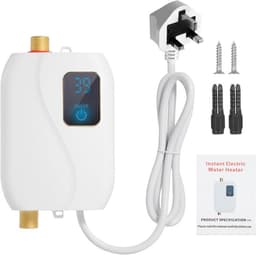
Mulcort Mulcort 3 kW LF-001

Preis-Tipp

Mulcort Mulcort 3 kW LF-001
7.6/10about £46.99
Briwellna Briwellna 5.5 kW

Alternative

Briwellna Briwellna 5.5 kW
6.3/10about £108.99
On this page

One sink, not a shower

Name the outlet first. A cloakroom hand wash needs less flow than a shower, and greasy pans need a hotter supply. The word sink on a listing does not make those the same load. The 3 kW Mulcort LF-001 costs £46.99 in the extract. UK reviewers describe acceptable use at a vanity or garage hand-wash, and say hotter water needs a trickle and dishes may still need a kettle. It is a one-basin appliance, not a hidden shower heater. For a shower or a flat, move to the 10–14 kW class in the instantaneous water heater buying guide. A cupboard does not raise the output.

Why it turns lukewarm when you open the tap

An instantaneous heater adds heat as water passes through. A rule of thumb is that about 70 watts raises one litre per minute by 1°C. It is not a laboratory measurement for these ASINs. At 2 litres per minute, a 3 kW element adds roughly 21°C. From an 8°C winter inlet that is about 29°C before pipe losses: warm, not properly hot. At 1 litre per minute the theoretical rise roughly doubles, so a printed 55°C and a lukewarm tap can both be true. Mount the unit near the outlet where the manual permits. More pressure can push more water through and lower the temperature.

The storage heaters sharing the same search

Many UK results for an under-sink water heater are small vented cylinders. A Hyco Handyflow example stores 5 litres on 2 kW. A Heatrae Sadia Streamline example stores 10 litres on 3 kW. They heat a fixed volume first, so the first draw can be stronger before the store runs out. Some of those models use an open-outlet mixer, where the hot outlet is also the vent. Swapping in an ordinary mixer can create unsafe pressure. Heatrae limits the unit to the maker’s vented taps, and Hyco is sold on the same principle. That rule belongs to those storage products. Do not copy it onto a tankless Mulcort, Briwellna or laloohome, and do not assume a small cylinder takes a standard tap because the thumbnail looks similar. Check whether the product stores water, then follow that manual.

Which listing fits a basin

For a simple hand-wash, the Mulcort LF-001 is the best value option in this set. Buy it only after confirming the connection and accepting that hot water may mean a slow stream. The Briwellna may suit one metering faucet where 5.5 kW and professional wiring are already planned. Its 40°C ceiling is clear, and the 3.4-star line blocks a broad recommendation. At £108.99 it costs more than twice the Mulcort before the circuit. Delousiber and laloohome sit around 5.5–6 kW at about £45–£47 and are not plug-in upgrades. The laloohome disagrees with itself on output and has no review line. UK reviewers report a 13 A-style plug on the 6 kW Delousiber. The UK installation guide is why that conflict stops the job. The best listings by job is the shortlist once the brief grows past one basin.

Common questions

Will a 3 kW under-sink heater wash dishes in winter?
It may take the chill off the water, but UK reviews of the Mulcort LF-001 say proper heat requires a restricted flow and that a kettle may still be needed for dishes. Cold winter inlet water increases the required temperature rise. A small storage heater or higher-output circuit may suit that job better.
Can I use a 3 kW model for a shower?
No product evidence here supports a normal shower from 3 kW. At 2 litres per minute, the rule of thumb gives only about a 21°C rise, and reducing flow enough to become hot would make the shower impractical. A bundled shower head does not alter that limit.
Is an under-sink heater always tankless?
No. UK results include instantaneous heaters and small 5- or 10-litre storage cylinders. A tankless unit heats continuously at a limited flow. A cylinder stores heat and delivers a stronger short draw before recovery. Check the product type and manual rather than relying on the search label.
Do I need a special open-outlet tap?
Only when the exact heater design requires one. Certain vented storage cylinders use the outlet as a vent and must retain their specified mixer. Do not transfer that rule to a tankless product, and do not fit a standard mixer to a vented cylinder unless its manufacturer explicitly permits it.
Can a UK plug run a 5.5 or 6 kW heater?
Not on a normal 13 A socket. A 6 kW load is roughly 26 A at 230 V. The Briwellna names a 25 A breaker, while other 6 kW listings call for dedicated high-current supplies. A fitted 13 A-style plug on such a heater is a warning that needs professional investigation.
Why does the listing say 55°C when the tap feels warm?
The printed figure may be a maximum setting achieved only at low flow and favourable inlet temperature. Opening the tap sends more water through the same element, reducing the temperature rise. Look for performance stated in litres per minute at a defined inlet and outlet temperature.

Related pages

Sources

Public UK sources used with the amazon.co.uk listings; last checked on 16 October 2026. Prices are the extract shelf figures, not a live check.

  1. Approved Document G (2024 amendments) (retrieved 16 October 2026)
  2. Approved Document G FAQ (retrieved 16 October 2026)
  3. GOV.UK, use a competent person scheme (retrieved 16 October 2026)
  4. IET Part P FAQ (retrieved 16 October 2026)
  5. Gas Safety (Installation and Use) Regulations 1998, regulation 30 (retrieved 16 October 2026)
  6. HSE on the Gas Safe Register (retrieved 16 October 2026)
  7. HSE legionella, hot and cold water (retrieved 16 October 2026)
  8. Water Supply (Water Fittings) Regulations 1999, Schedule 2 (retrieved 16 October 2026)