Independent comparisons. We may earn from shop links. More info

How to install a tankless water heater in the UK

Updated: 17.10.2026

You have the heater on the floor, the pipework nearby and perhaps a plug already attached. Before you install a tankless water heater in the UK, stop and read the rating plate: a 3 kW basin appliance, a 12 kW hard-wired heater and an LPG burner require different people, supplies and approvals. The [Thermoflow tankless water heater comparison](/hub/hot-water/thermoflow-tankless-water-heater) includes all three types, although no retained product is made by Thermoflow. This guide explains the safe order of work and the point at which DIY ends. It does not replace the exact model instructions, a circuit design or a Gas Safe engineer’s assessment. A qualifying purchase can earn a commission at no extra cost to you.

You have the heater on the floor, the pipework nearby and perhaps a plug already attached.

Our top picks

CAMPLUX CAMPLUX BW528B

Alternative

CAMPLUX CAMPLUX BW528B
8.4/10about £379.99
Mulcort Mulcort 3 kW LF-001

Preis-Tipp

Mulcort Mulcort 3 kW LF-001
7.6/10about £46.99
On this page

Read the watts before you look at the plug

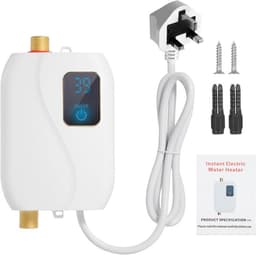
A normal UK socket is protected around a 13 A load, roughly 3 kW at 230 V. A small Mulcort can plausibly claim a UK plug, and you still check the socket and circuit. A plug that fits is not a complete installation test. At 5.5–6 kW the demand is about 24–26 A. The Briwellna listing names a dedicated 25 A double-pole breaker. The Delousiber listing says its 6 kW output generally needs suitable cable and fuses of at least 40 A, yet UK reviewers describe a 13 A-style plug on the received unit. Isolate it and ask a qualified electrician to verify the product, rating and connection. WINTEMP asks for a 50 A double-pole breaker, SIVUATEK names 60 A, and the Stiebel uses a cable prepared for the connection. Those figures do not choose the UK cable. Choose the class in the instantaneous water heater buying guide, then give the manual and rating plate to the electrician.

A new circuit and who signs it off

A high-output instantaneous heater commonly needs a new circuit from the consumer unit, isolation and the protective measures required by BS 7671. The electrician must also check whether the incoming supply and consumer unit have the capacity. A spare way in the board does not mean the property can accept another 50 A or 60 A demand. In England and Wales, adding a new circuit is notifiable under Part P. The usual route is an installer on a competent-person scheme, who can self-certify and provide the certificate. Other routes are third-party certification or a building-control application before work starts. Do not fit the circuit and assume the paperwork can follow.

Mount, connect water, fill and then energise

The commissioning sequence is water before power. Open the supply and the hot outlet until the flow is steady and free of air, then check every joint and the casing for leaks. ZIP and Triton instructions for their own instantaneous products both require filling and purging before energising, so the element is not run dry. Your model’s exact sequence remains controlling. Only then should the authorised person energise it and follow the first-use checks. If the heater trips, smells hot, leaks or behaves erratically, isolate water and power rather than resetting it repeatedly. The under-sink water heater guide explains open-outlet taps on some storage heaters. Do not copy those tap rules onto a tankless unit unless its manual says so.

Gas and LPG are not a plumbing extra

The GEESEN and COAKUE are propane RV heaters. The CAMPLUX is an outdoor butane or propane unit. They are not electrical heaters that happen to use a bottle. Combustion air, flue routing, gas pressure, location and carbon-monoxide risk are part of the installation. Gas work within the regulated scope must be done by a Gas Safe registered engineer qualified for the appliance and fuel, across the UK including Northern Ireland. Do not ask an engineer to sign off pipework or a flue fitted by an unregistered person. The electric or gas tankless water heater comparison separates portable and fixed LPG without cylinder-connection instructions. An outdoor appliance stays outdoors. Confirm the model, rating plate, manual, outlet and location. Have the electrical or gas installation designed by the qualified person, complete the water connections with energy isolated, fill and purge, then inspect for leaks. Commission only under the model instructions, and keep the certificates.

Common questions

Can I use the plug supplied with the heater?
Only if the rating, instructions and UK circuit all support it. A 3 kW appliance may be within the normal 13 A class, subject to the manufacturer’s requirements. A reported 13 A-style plug on a 6 kW heater is a conflict, not approval. Isolate the unit and consult an electrician.
Do I need a new circuit from the consumer unit?
Usually, if the heater asks for 25 A, 40 A, 50 A or 60 A. The electrician must assess total supply capacity as well as cable and protective devices. Even a free way in the consumer unit does not prove that a high-current heater can be added safely.
Is a new circuit notifiable?
In England and Wales, adding a new circuit is notifiable under Part P. A competent-person scheme member can normally self-certify and issue the paperwork. Scotland and Northern Ireland use different building-control frameworks, so check the route that applies where the property is located before work begins.
What happens if I switch the heater on dry?
The element can overheat or fail because water is not carrying heat away. Fill the unit and purge air through the outlet before power is applied, following the exact manual. If it has already been energised dry, isolate it and have it checked rather than assuming a reset has cured any damage.
Can a plumber fit the gas side and ask an engineer to approve it?
Not as a workaround for regulated gas work. The Gas Safe engineer must be qualified for the appliance and fuel and responsible for work within scope. Engage that person before installation so the location, flue and pipework are designed correctly from the start.

Related pages

Sources

Public UK sources used with the amazon.co.uk listings; last checked on 16 October 2026. Prices are the extract shelf figures, not a live check.

  1. Approved Document G (2024 amendments) (retrieved 16 October 2026)
  2. Approved Document G FAQ (retrieved 16 October 2026)
  3. GOV.UK, use a competent person scheme (retrieved 16 October 2026)
  4. IET Part P FAQ (retrieved 16 October 2026)
  5. Gas Safety (Installation and Use) Regulations 1998, regulation 30 (retrieved 16 October 2026)
  6. HSE on the Gas Safe Register (retrieved 16 October 2026)
  7. HSE legionella, hot and cold water (retrieved 16 October 2026)
  8. Water Supply (Water Fittings) Regulations 1999, Schedule 2 (retrieved 16 October 2026)