Part P electric shower: when work is notifiable
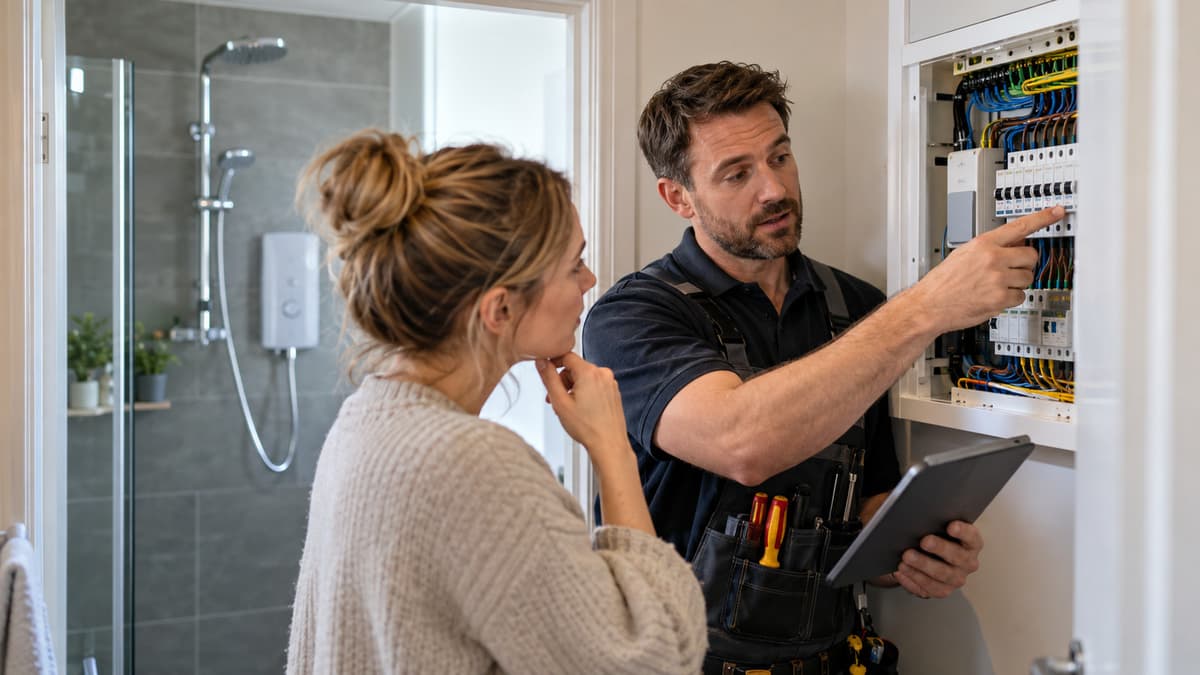
Part P electric shower rules: when a like-for-like swap differs from a new circuit, and how England, Wales, Scotland and Northern Ireland treat the work.
On this page
- 1.In short
- 2.What Part P actually covers in England
- 3.When a like-for-like shower swap is different
- 4.When a new circuit or larger cable changes the job
- 5.Why the bathroom special location matters
- 6.The rules in Wales, Scotland and Northern Ireland
- 7.What a safe electric shower circuit needs
- 8.How to plan the work without crossing the line

You take an old 8.5 kW shower off the wall and discover that the replacement you want is 10.5 kW. What looked like a quick appliance swap may now involve the cable, protective device and consumer unit, and that is where Part P electric shower advice often becomes misleading. In England, an unchanged like-for-like replacement and a new shower circuit are not the same job. Elsewhere in the UK, even the regulatory system is different.
In short
A like-for-like electric shower replacement on an unchanged circuit is generally treated differently from installing a new circuit in England. A new circuit is notifiable, while any work that alters wiring in the bathroom special location needs careful classification. In every case, non-notifiable does not mean untested, and it does not make safety standards optional.
What Part P actually covers in England
Part P is part of the Building Regulations in England and deals with electrical safety in dwellings. It requires reasonable provision to protect people operating, maintaining or altering an electrical installation from fire or injury. It is not a licence attached to a shower, and it does not say that every electrical task must be reported to the council.
Under Approved Document P, installing a new circuit is notifiable, as is replacing a consumer unit. Additions or alterations to existing circuits in a bathroom special location are also notifiable, with distinctions for replacement, repair and maintenance.
People often use Part P for three questions. Must the work meet electrical safety requirements? Yes. Must it be notified to building control? That depends on the work. Who should carry it out and test it? For a high-current shower circuit, an electrician who can assess the complete circuit.
A contractor on an authorised competent person scheme can usually notify qualifying work and issue the paperwork. If they cannot self-certify, agree the building-control route before work starts. Notifying afterwards is not a substitute.
When a like-for-like shower swap is different
In England, replacing a failed electric shower with a genuinely equivalent unit on the same circuit is generally replacement or maintenance, not a new circuit. The new unit should suit the existing supply, water arrangement and manufacturer's requirements without moving or extending fixed wiring.
Matching the kilowatt rating is not enough. The electrician still checks the supply cable and terminations, the circuit protective conductor, isolation, the protective device and RCD protection. Heat damage at a terminal, or an outdated protective arrangement, can turn a nominal swap into remedial work.
Moving the unit may mean extending cable inside the special location. A different connection position can end a simple exchange even when both labels show 8.5 kW. Once the fixed installation changes, classify the job by what is actually altered. Non-notifiable work must still meet Part P and the relevant edition of BS 7671, be inspected and tested, and come with the appropriate electrical certificate.
When a new circuit or larger cable changes the job
A new electric shower circuit is notifiable in England. That covers the first electric shower in a bathroom, and an upgrade where the old circuit cannot carry the new design current. A cable run back to the consumer unit is not an appliance exchange.
At a nominal 230 V, an 8.5 kW shower draws roughly 37 A and a 10.5 kW model roughly 46 A, before design decisions and supply tolerances. Those figures show why a more powerful shower can expose an existing circuit. They are not a cable-selection recipe. Capacity also depends on conductor size, length, route, installation method, thermal insulation, grouping and ambient conditions, plus the protective device, voltage drop, fault protection and the consumer unit. A cable in free air does not match one buried in insulation.
Do not buy an 11 kW model on the assumption that a larger breaker will do. A breaker protects the circuit. Raising its rating without proving the cable can carry the load removes protection. Start with the electric shower cable and kW guide, then have the route surveyed. The survey may also show that the consumer unit, earthing, bonding or incoming supply constrains the proposal. Choose the shower after that assessment.
Why the bathroom special location matters
Approved Document P defines a bathroom special location from the bath or shower, because wet skin and contact with earth raise the consequence of a fault. For a bath or shower tray, the boundary extends 0.6 m horizontally and 2.25 m vertically from finished floor level. Where a fixed shower head is higher, the upper boundary follows that height. For a shower without a basin, the horizontal boundary is 1.2 m from the centre of the fixed water outlet.
Those dimensions decide whether an alteration to an existing circuit is inside the special location for notification. They are not a DIY safe zone just outside a line. The bathroom zones guide covers where equipment may sit. BS 7671 and the manufacturer's instructions still govern the design. A move of 200 mm can matter if it extends a cable or shifts an accessory.
The rules in Wales, Scotland and Northern Ireland
Part P electric shower advice cannot be copied across the UK. Building regulations are devolved. The electrical principles may still draw on BS 7671, but the approval route depends on where the property is.
Wales has its own Building Regulations administration and Approved Document P. Confirm the Welsh notification position with the electrician's scheme or local authority building control before a new circuit or bathroom alteration.
Scotland does not use the English Part P competent-person system. Electrical safety sits in the Scottish building standards, including standard 4.5, and the work may need a building warrant. The phrase not notifiable under Part P does not answer the question in Glasgow or Aberdeen. Ask the local council, and use a suitably qualified electrician.
Northern Ireland has its own building regulations. Confirm the approval route with local building control before a new circuit, particularly in a bathroom conversion. If you are comparing outputs first, the 11 kW electric shower comparison is product research, not proof that the property can accept the load.
What a safe electric shower circuit needs
An electric shower is normally on its own dedicated circuit. Electrical Safety First advises a registered electrician for bathroom work and highlights RCD protection. An RCD can disconnect on certain leakage currents. It does not make up for an undersized cable, a poor termination or missing fault protection.
The assessment should cover rated power, supply characteristics, cable route, protective device, RCD, isolation and earthing. Testing should measure values rather than infer them from the cable's age or a neat consumer-unit label. Isolation must suit the load and the bathroom. Repeated overheating, buzzing, a hot switch, nuisance tripping or discolouration means you should stop using the shower and arrange an inspection.
The unit also needs the pressure and flow its manufacturer specifies, with the cold supply arranged as instructed. Electrical power cannot correct a weak incoming supply. In winter the same shower may need a lower flow for a comfortable temperature. The electric shower water pressure guide explains that limit.
How to plan the work without crossing the line
Photograph the rating label, consumer-unit schedule and accessible isolator without removing covers, and note whether the new unit matches the power and cable entry. That helps the electrician. It does not replace a site visit.
Have the circuit assessed before buying a higher-output shower. The quote should say whether the job is an unchanged replacement, an alteration or a new circuit, whether notification is included, who will notify building control if that is required, and which certificate you will receive.
Check registration rather than accepting Part P qualified as a full description. In England and Wales, confirm the contractor can self-certify the proposed work. In Scotland or Northern Ireland, ask which local route applies. Keep the electrical certificate, any building-regulations certificate, the invoice and the instructions. You can compare products yourself. Circuit design, termination and testing belong with a competent electrician.
Common questions
Can I replace an electric shower myself?
Is a like-for-like electric shower replacement notifiable in England?
Is a new electric shower circuit notifiable?
Do I need a larger cable for a more powerful shower?
Does Part P apply to electric showers in Scotland?
What rules apply in Northern Ireland?
Does non-notifiable mean no certificate is needed?

Peter F. is the editor for DIY & tools at productscompared.co.uk. Comparisons in this category are checked against amazon.co.uk listings, review evidence and public UK sources.
Related articles

Bathroom zones for an electric shower: UK rules
Wet-area layout decides where equipment may go, and a high-powered shower still needs its own circuit.

When to replace an electric shower: warning signs
A leak, a burning smell or repeated tripping matters more than an estimated average lifespan.

Electric shower water pressure: what you need
Kilowatts heat the water. Pressure and flow come from the supply, not from the shower rating.