Independent comparisons. We may earn from shop links. More info

Russell lupin vs annual lupin: height and the year

Updated: 21 October 2026

Two packets both say lupin, at about the same price. Russell lupin versus annual lupin is a choice of height and of which summer you will wait for. Russell seed is a tall perennial that, where a year is stated, flowers the year after sowing. Hartwegii Avalune is a short hardy annual, and UK shops do not agree on about 12 weeks or year two. The [lupine seeds comparison](/hub/herb-seeds/lupine-seeds) lists every packet in this set. Prices are from 19 October 2026. Peter F. compared the listings with public UK sources. The plants were not trialled in a bed. A qualifying purchase can earn us a commission at no extra cost to you.

Two packets both say lupin, at about the same price. Russell lupin versus annual lupin is a choice of height and of which summer you will wait for.

Our top picks

On this page

What Russell seed is for

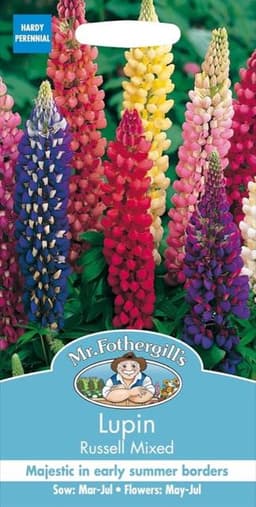
Russell lupins are border perennials. The RHS files the group as Lupinus × regalis, for full sun or light shade and well-drained soil, at about 90–120 cm, with slugs and lupin aphid as the pests that show up. Suttons describes its mix at about 90 cm, flowering the year after a March to June sowing. A Lupinus polyphyllus Russell title is that garden strain, not wild-collected seed. Nika states 100 cm and no flowering year. Mr Fothergill's mixed packet says the year after sowing, and prints 120 cm in the bullets and 60 cm in the specification. Keep both heights.

What Avalune seed is for

Avalune is Lupinus hartwegii, a hardy annual, dwarf and bushy. Thompson & Morgan puts it at about 40 cm and about 12 weeks, and prints harmful if eaten. Suttons calls it about 30–40 cm and, on the page captured here, also places flowers in July to September of year 2. Do not average those into one date. It is not Gallery, the dwarf perennial the RHS describes at about 38–45 cm, which is not in this set. If you need flowers in the sowing year, do not buy the perennial and hope. If you need a plant that comes back, do not buy only the annual.

The listings at the same price

Two rows both cost about £3.59 and both say 200 seeds. Price does not pick the plant. Damavandpro's Avalune is the annual: no centimetres, full sun, a quarter of an inch deep, 4.0 from 58 reviews. One review says the plants were all purple, and the unit count says 1.0 against 200. Damavand Pro's Russell mix is the perennial at the same money: 4.2 from 30, May to July in year two, and 60–100 cm against 100 cm in the specification. Mr Fothergill's mix at about £2.50 is also Russell, with 274 reviews and a 120 cm versus 60 cm clash.

Plants this page is not about

Tree lupin, Lupinus arboreus, is not in these packets. The 20-seed packet at about £8.99 is Lupinus angustifolius, 90 cm, not sweet and not food grade. The wider sort is on how to choose lupin seeds. BBC Gardeners' World says seed-grown lupins do not come true. The RHS says many do. L. polyphyllus is a neophyte on UK roadsides and shingle, and the Schedule 9 lists checked here do not name Lupinus. Do not sow spare seed on a verge.

Common questions

Which one flowers this summer?
Choose the annual if you need a chance of flowers in the sowing year, and read the clash before you promise a date. Thompson & Morgan says Avalune can flower in about 12 weeks. Suttons' Avalune page also carries a year-2 line. Russell listings that state a year in this set say the year after sowing, or May to July in the second year. A perennial bought for this August is the wrong packet.
How tall is Russell compared with Avalune?
The RHS puts Russell hybrids at about 90–120 cm. Merchant Avalune copy is about 30–40 cm. In this set the Avalune listing gives no centimetres, only dwarf and bushy. Russell listings that state a height say 100 cm, 60–100 cm, or both 120 cm and 60 cm on the same page. Allow the tall end for Russell unless the listing you bought is the one that only says 60 cm in a specification, and even then keep the bullet that says 120 cm.
Will Avalune come back next year?
Treat it as an annual. The titles and the merchant pages call Hartwegii Avalune a hardy annual, not a perennial clump. It may leave seed, and that is not the same as a Russell crown that returns. If you want the plant next year without resowing, buy Russell and accept the wait for the first spikes. Resowing Avalune each spring is the honest version of the annual.
Is polyphyllus on a packet the same as Russell?
Often the seller means the Russell garden strain and has printed Lupinus polyphyllus as the species. The RHS names Russell hybrids Lupinus × regalis. Do not read the Latin line as proof of wild species seed, and do not ignore a Russell word that sits beside it. Check the life cycle and the flowering year. If both are missing, the listing has not told you which plant you will get.
Why does Suttons seem to say year 2 for an annual?
Because the Avalune page captured for this comparison calls the plant a hardy annual and also places flowers in July to September of year 2. Thompson & Morgan's page says about 12 weeks. Both cannot be turned into one calendar date. Sow Avalune as an annual, keep the plants that appear, and do not treat a Russell perennial as a failure if you bought the annual by mistake.
Where does the 20-seed blue packet fit?
It does not fit this choice. Buy4seeds at about £8.99 is Lupinus angustifolius, 20 seeds, an annual listed at 90 cm, with one review that does not describe flowers. It is not Avalune and it is not Russell. It is also not food. Park that packet on the buying guide, then come back to the about £3.59 pair when you are choosing between a short annual and a second-year spike.

Related pages

Sources

Public UK sources named below. amazon.co.uk prices, stars and review counts on these seven listings were read on 19 October 2026. Page updated 21 October 2026.

  1. RHS lupin growing guide (retrieved 19 October 2026)
  2. RHS Russell Group (retrieved 19 October 2026)
  3. RHS harvested-seed germination requirements (retrieved 19 October 2026)
  4. RHS lupin aphid (retrieved 19 October 2026)
  5. Seed Marketing Regulations 2011, regulation 4 (retrieved 19 October 2026)
  6. Wildlife and Countryside Act 1981, Schedule 9 (retrieved 19 October 2026)
  7. GOV.UK food allergen information for businesses (retrieved 19 October 2026)
  8. The Kennel Club, poisons in the garden (retrieved 19 October 2026)