Independent comparisons. We may earn from shop links. More info

How to sow lupin seeds: nick the coat, then cover 5 mm

Updated: 21 October 2026

Nick the seed or not, how deep to cover it, and why nothing may show: that is the question once the packet is on the table. How to sow lupin seeds comes down to a hard coat, about 5 mm of cover, and compost that is moist rather than wet. Russell seed sown in spring is for next year's spikes. The [lupine seeds comparison](/hub/herb-seeds/lupine-seeds) is the product table if you have not chosen yet. Peter F. used RHS guidance and the sowing lines from 19 October 2026, not a germination trial. A qualifying purchase can earn us a commission at no extra cost to you.

Nick the seed or not, how deep to cover it, and why nothing may show: that is the question once the packet is on the table.

Our top picks

On this page

Prepare the seed

The coat is hard, so seed can sit unchanged in damp compost. The RHS growing guide says nick it and soak for about 24 hours, with seedlings in about 10–14 days at roughly 10–15°C for border lupins. Suttons suggests about 15°C, about 6.5 mm and 15–60 days. Use one of those routines. The RHS says seed may cause severe discomfort if eaten, so wear gloves and sow only seed that has swollen.

Depth and warmth

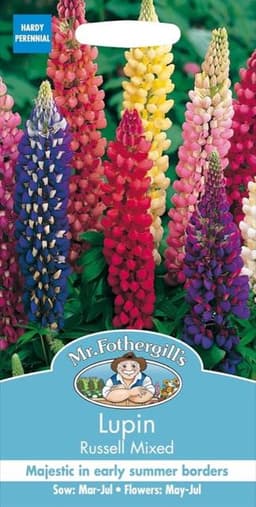
Cover about 5 mm, the RHS table. Suttons is about 6.5 mm. Premier Seeds Direct prints about 4 mm. The Hartwegii listing in this set says a quarter of an inch. Mr Fothergill's blue and purple bullets print 15 cm, indoors from March to June or outdoors from April to July. Do not follow that bullet. Border temperatures on the RHS pages sit around 10–18°C. Buy4seeds prints 18–20°C for Lupinus angustifolius. Avalune merchant copy is about 18–25°C. Keep the compost moist, not wet.

Modules, not a tangled tray

Sow one seed, or a pair thinned to one, in modules. The tap root resents a shared tray, which is why the RHS prefers individual pots. BBC Gardeners' World suggests compost plus perlite. If the pot is still heavy and glistening after two days, you have overwatered, and a rotten seed collapses. Plant out once roots fill the module and hard frost has passed, into sun or light shade and soil that drains. Do not tear a coiled root in midsummer. The wait is on Russell lupins or annual lupins.

What failure means

Nothing at two weeks is not a bad packet. The RHS table allows up to 90 days. A 15 cm sowing, or a pot left in water, needs a fresh sowing at 5 mm. If the chip, the soak and the shallow cover were followed and the whole packet is still unchanged past those ranges, the Consumer Rights Act 2015 is the route for quality and for description. Mr Fothergill's mixed packet says the year after sowing. Damavand Pro says May to July in year two. BBC Gardeners' World says seed does not come true. The RHS says many lupins do. Slugs are not cured by sowing deeper.

Common questions

Do I nick or only soak?
The RHS growing guide uses both: nick the coat, then soak for about 24 hours. The germination table allows a hot soak of one to three days or a chip. Suttons says an overnight soak may help. Nicking and soaking together matches the growing guide. Soaking alone is the lighter version some merchants print. Do not skip both and then blame the packet at day four.
How deep is deep enough?
About 5 mm, with Suttons near 6.5 mm and a quarter of an inch on the Avalune listing in this set. That is a shallow cover. The 15 cm depth on the blue and purple Mr Fothergill's bullets is the outlier. Ignore that bullet even if you buy the packet. A seed pushed to the bottom of a deep pot is not extra safe. It is buried.
What temperature should I use?
Use the range for the plant you bought. RHS border figures sit around 10–15°C on the growing guide and 13–18°C on the germination table. Suttons suggests about 15°C for Russell mix. Avalune merchant copy runs warmer, about 18–25°C. There is no single temperature that covers every listing in this set.
Why do some guides say 14 days and others 90?
They are describing different ends of the same hard seed. After a nick and a soak, the RHS growing guide talks about 10–14 days. The germination table still allows up to 90 days, and Suttons prints 15–60 days. A fast result is possible. A slow result is also inside the published range. Ninety days of a dry, un-nicked seed in cold wet compost is not the same experiment.
Will Russell seed flower this summer?
Do not count on it. Suttons says a Russell mix flowers the following year. Two amazon.co.uk Russell listings in this set say the same thing in their own words: the year after sowing, or May to July in the second year. You should see leaves if germination worked. Spikes are the next season. An annual Hartwegii packet is the one sold for a shorter wait, and even then UK shops do not agree the exact summer.
Should I sow in a tray or in modules?
Use modules or individual pots. The tap root dislikes being torn out of a shared tray. One seed, or two thinned to one, in moist compost with a little perlite, is the practical version of the RHS advice. A windowsill tray of fifty seedlings looks efficient until you try to separate them. You will lose more plants at that moment than you saved in compost.
Are the seedlings safe for dogs to chew?
No. Treat seedlings the way you treat the seed. The RHS says the plant is poisonous, Suttons prints harmful if eaten, and the Kennel Club lists lupins for dogs. Use gloves when you handle wet seed, and do not leave modules where a dog can knock them over. If a pet chews lupin and seems unwell, contact a vet. This sowing guide is not a veterinary dose.

Related pages

Sources

Public UK sources named below. amazon.co.uk prices, stars and review counts on these seven listings were read on 19 October 2026. Page updated 21 October 2026.

  1. RHS lupin growing guide (retrieved 19 October 2026)
  2. RHS Russell Group (retrieved 19 October 2026)
  3. RHS harvested-seed germination requirements (retrieved 19 October 2026)
  4. RHS lupin aphid (retrieved 19 October 2026)
  5. Seed Marketing Regulations 2011, regulation 4 (retrieved 19 October 2026)
  6. Wildlife and Countryside Act 1981, Schedule 9 (retrieved 19 October 2026)
  7. GOV.UK food allergen information for businesses (retrieved 19 October 2026)
  8. The Kennel Club, poisons in the garden (retrieved 19 October 2026)