Independent comparisons. We may earn from shop links. More info

Growing lupins in pots: depth, slugs and the aphid

Updated: 21 October 2026

A wet border, or seedlings gone by morning, is the usual reason to try a pot. Growing lupins in pots works on waterlogged, very alkaline or very acid soil, and it works poorly for a tall Russell spike in a shallow pot. The RHS allows deep containers and still prefers the border for a tap root. The [lupine seeds comparison](/hub/herb-seeds/lupine-seeds) lists the seven packets. Peter F. used the RHS, BBC Gardeners' World, House & Garden and the 19 October 2026 listings, not a pot trial. A qualifying purchase can earn us a commission at no extra cost to you.

A wet border, or seedlings gone by morning, is the usual reason to try a pot. Growing lupins in pots works on waterlogged, very alkaline or very acid soil, and it works poorly for a tall Russell spike in a shallow pot.

Our top picks

On this page

Border first, pot when the soil is wrong

BBC Gardeners' World prefers the border because the tap root wants to go down. The RHS links poor flowering to shade, an oversized pot, and a root-bound pot. House & Garden puts a container first on very alkaline, very acid, or waterlogged ground. Winter wet is the named failure. Russell hybrids at about 90–120 cm still belong in a border that drains, and a pot will not make a spring sowing flower this summer. If you only have paving, use a deep pot and a short plant. Height and year are on Russell lupins or annual lupins.

A pot that is deep and not huge

Use at least 35 cm of depth, the BBC Gardeners' World figure, without an oversized tub, and pot feet so winter rain does not sit underneath. The RHS describes loam-based compost with grit for a plant that stays in the pot, moist through the season and not sodden, and a move into a slightly larger pot rather than a tub. A tomato feed is the House & Garden note if growth in the pot is pale. Avalune, about £3.59 for 200 seeds, is the short plant here: dwarf and bushy, no centimetres, and not labelled for pots. Gallery is not in this set.

Slugs on new shoots

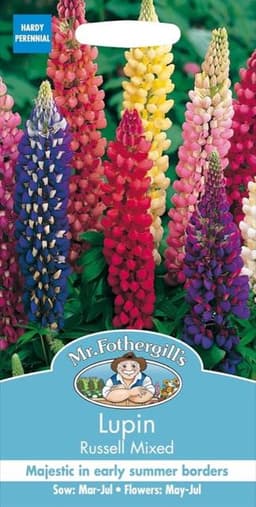
Slugs take soft spring shoots. One UK review on Mr Fothergill's blue and purple Russell, about £3.45 and 4.5 from 62, reports seedlings eaten. That is one account, and the bullets do not answer the pot questions. Grit or copper tape is the BBC Gardeners' World barrier. The RHS preference is non-chemical, and this page sets no pesticide dose. Grit will not restore a shoot that has gone. Follow the label if you later buy a home-garden product. A grey insect on the summer spike is aphid.

Lupin aphid

Macrosiphum albifrons has been in Britain since 1981, from April to September: a grey colony on the spike and the soft tip, and wilting that is not a slug hole. The 2024–2026 RHS trial ended early, with no awards, after water sprays spread anthracnose. Wipe a small colony with gloves, or cut out a covered spike, and check a wet saucer before you blame only the aphid. All parts are poisonous. Call a vet or NHS 111 if a pet or a child has eaten lupin and is unwell.

Common questions

Can lupins live in a pot at all?
Yes, when the pot is deep and the compost drains. The RHS allows deep containers, and House & Garden treats a pot as the better site on waterlogged, very alkaline or very acid soil. BBC Gardeners' World still prefers the border for the tap root. A container will not make a Russell of about 90–120 cm behave like a bedding annual, and it does not promise flowers in the summer you sow.
How deep should the pot be?
BBC Gardeners' World says at least 35 cm deep. House & Garden wants that depth without an oversized tub, plus pot feet so winter rain does not sit under the base. The RHS links poor flowering to overpotting and to a root-bound pot, and it says to move the plant into a slightly larger pot rather than a much bigger one. A wide, shallow bowl will not suit the tap root even if it looks generous on the patio.
What compost should I use?
For a plant that stays in the pot, the RHS describes loam-based compost with grit, and BBC Gardeners' World points to soil-based compost. The grit is for drainage, not a feed. Keep the mix moist through the season and do not leave it sodden, because winter wet is the risk the RHS names. Out in the border you match the soil you have, so this mix is a container recipe.
Why did the seedlings vanish overnight?
Slugs and snails take soft new shoots. That is what the RHS describes, and what a UK review on the Mr Fothergill's blue and purple Russell packet reports. The damage is often finished before daylight. Grit or copper tape can protect what is left. It will not bring back a shoot that has already been eaten. If nothing germinated, the sowing depth is a separate fault.
What is the grey insect on the spike?
That is likely lupin aphid, Macrosiphum albifrons, in Britain since 1981 and active from April to September. It clusters on the spike and the soft tip and can wilt the plant. It is not a slug, so another dose of pellets will not answer it. Wipe a small colony off with gloves on, or cut out a spike that is covered, rather than blasting the plant with water.
Should I spray aphids off with water?
Not as a hard blast. The RHS lupin trial planned for 2024–2026 ended early and made no awards after water sprays spread anthracnose. Wipe the insects or remove a badly covered spike, and check that the pot is not standing in water, because wet compost wilts a lupin for a different reason. This page does not set a pesticide dose. If you use a product for home gardens, follow its label.

Related pages

Sources

Public UK sources named below. amazon.co.uk prices, stars and review counts on these seven listings were read on 19 October 2026. Page updated 21 October 2026.

  1. RHS lupin growing guide (retrieved 19 October 2026)
  2. RHS Russell Group (retrieved 19 October 2026)
  3. RHS harvested-seed germination requirements (retrieved 19 October 2026)
  4. RHS lupin aphid (retrieved 19 October 2026)
  5. Seed Marketing Regulations 2011, regulation 4 (retrieved 19 October 2026)
  6. Wildlife and Countryside Act 1981, Schedule 9 (retrieved 19 October 2026)
  7. GOV.UK food allergen information for businesses (retrieved 19 October 2026)
  8. The Kennel Club, poisons in the garden (retrieved 19 October 2026)