Independent comparisons. We may earn from shop links. More info

How to fit privacy strips on one straight fence bay

Updated: October 2026

You have one bay of mesh and a roll of tape, and the listing says both no tools and clips in the box. How to fit privacy strips, for this job, means weaving that one bay and stopping if the clip does not grip or the posts already move. The five rolls are on the [privacy strips comparison](/hub/hedges-and-privacy-screens/privacy-strips). This page is from the Products Compared editorial team. The steps below follow the fitting lines on these amazon.co.uk listings and the install notes UK fence suppliers publish for their own tape. We did not fit a test fence. A qualifying purchase can earn a commission at no extra cost to you.

You have one bay of mesh and a roll of tape, and the listing says both no tools and clips in the box.

Our top picks

SONGMICS SONGMICS GPJ035H 35 m x 19 cm

Best overall

SONGMICS SONGMICS GPJ035H 35 m x 19 cm
10.0/10about £21.60
VOUNOT VOUNOT black 75 m x 4.7 cm

Alternative

VOUNOT VOUNOT black 75 m x 4.7 cm
9.6/10about £29.99
VOUNOT VOUNOT green 75 m x 4.7 cm

Preis-Tipp

VOUNOT VOUNOT green 75 m x 4.7 cm
9.4/10about £15.47
On this page

Set up one bay

Work on a single panel between two posts, not the whole boundary. Measure that panel from the upright you will start on to the upright you will finish on, and measure the opening the strip has to sit in. If that opening is about 20 cm, you should already be holding the 19 cm roll. If it is much tighter, the 4.7 cm roll is the one in your hand. A mismatch here is a buying problem, and weaving will not stretch 4.7 cm tape across a twin-wire gap. Cut with scissors or a knife on a straight line, and keep an offcut rather than trimming flush before the strip is in the mesh. QUEST, for their own 19 cm tape, tell you to add about 1.5 per cent, which they describe as about 3 cm on a 250 cm panel. That allowance is theirs, so treat a few centimetres extra as a rule of thumb for these rolls, not as a measured result for SONGMICS or VOUNOT. If the posts rock while you pull, stop before you weave. A moving post is not fixed by tape.

Weave through the mesh

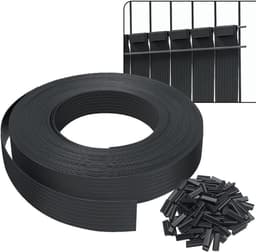
Pass the strip in and out of the mesh so it stays in the opening, one gap at a time. On twin-wire, that is a wave along the horizontal gap, the pattern First Fence show for their strips. Start at one end, keep the strip flat, and do not twist it so the face flips halfway along the bay. The idea is the same for a 19 cm band and a 4.7 cm band. The opening still has to match the width you bought, or the strip either rattles in a wide gap or will not enter a tight one. The SONGMICS bullets say you weave through the fence and fix the ends with the 25 clips, and they say no tools. The technical table on the same page says assembly is required. Both lines are on the listing, so no tools means no drill in the bullets, not that the table is blank. The VOUNOT table says assembly is not required, and the bullets still tell you to weave and clip. You do not need a socket set for a straight bay. You do need a straight cut and enough length to finish the end without stretching the strip until it necks.

Finish the ends with the clips in the box

Seat a clip on a straight cut, starting at the bottom of the upright and pushing it on so it closes over the wire and the end of the strip. First Fence describe that motion for their own 190 mm by 15 mm clips on wire of about 5 mm or 6 mm, and they suggest clips at the start and end of a run rather than on every bay of their roll. Those clips are not the clips in a VOUNOT or SONGMICS box. If your box clip is shorter, thinner or aimed at a different wire, it will not copy that 5–6 mm fit. UK reviews on the VOUNOT files are the warning. Buyers returned clips that only suited a thin gate or a tiny metal frame, and the separate black 75 m file has a UK review that limits the clips to the thinnest wire. French reviews in that smaller file say clips snap as they close. A clip that only grips a thin gate is a return, not a tighter squeeze onto 6 mm bar. SONGMICS gives you 25 clips on 35 m. Stand back and look along the bay. The strip should still be on the wire after you let go.

Stop before you fill a weak or windy run

A finished bay that stays put is the moment to decide whether the next bay is the same mesh. It is not the moment to cover an open, coastal or roadside run from a 300 m roll. Covered mesh catches more wind than open mesh. Fenceonline say so for braided tape, and they will not guarantee tape you add after they have installed a fence. If the posts move, the mesh needs replacing, or you would be raising the fence, that is a fencer's job or a planning question. Listed curtilage, an Article 4 direction, or a planning condition can remove the usual height limits. Those limits are on privacy strips, wind and fence height. Do not invent a post depth and do not keep weaving while a post rocks. The VOUNOT listings claim a hose or a pressure washer. The SONGMICS page does not state a cleaning method, so we do not invent one. One bay that holds, with ends you can see, is the whole job this page is for.

Common questions

Do you need tools to fit privacy strips?
The SONGMICS bullets say no tools, and the technical table says assembly is required. The VOUNOT table says assembly is not required, and the bullets still say weave and clip. For one straight bay you need a way to cut the strip and the clips in the box if they fit the wire. You do not need a drill unless the fence itself needs work.
How do you weave one band through a panel?
Pass the strip in and out so it stays in a single opening, working from one upright to the next without twisting the face. Do one gap, then the next, rather than trying to dress the whole panel at once. The weave is the same idea on a wide strip and a narrow strip. The opening still has to match the width.
Where do the clips go?
On the straight-cut ends, pushed on from the bottom of the upright so the clip holds strip and wire together. Suppliers who sell their own end clips often use them at the start and end of a run, not on every wire. The clips in these Amazon boxes are the ones you test. If they do not close on your wire, they do not belong further along the fence.
How much extra length should you cut?
Keep an offcut. QUEST add about 1.5 per cent on their own tape, about 3 cm on a 250 cm panel. That is a rule of thumb for these rolls, not a measured allowance for a named ASIN. Cut after the strip is offered to the bay. A piece that is slightly long can be trimmed. A piece that is short cannot be stretched back to width.
Can you fit a corner?
A corner is two bays, not one continuous wave around the post. Finish the first bay on its upright, cut, and start the next bay on the return. Pulling one strip around the corner leaves a gap at the post and loads the clip. If the corner post is the one that moves, stop and treat the post before any more tape.
What if the clips are too small?
Stop on that bay. UK reviews describe VOUNOT clips that only fitted a thin gate or the thinnest wire, and some were returned. Snapping a clip shut on the wrong wire wastes the rest of the pack. A 190 mm clip sold for 5 mm or 6 mm wire is a different product. It is not a fix hidden in these boxes.
When should you stop and call a fencer?
Stop if the posts move, the mesh is bent or needs replacing, or you would raise the fence to get the cover you want. Listed boundaries, Article 4 directions and planning conditions are not solved with a longer roll. Wind on a fully taped run is the same stop, and it is set out on the wind and rules page.

Related pages

Sources

Public UK sources named below. amazon.co.uk prices, stars and review counts are from the five listings in this comparison, recorded on 19 October 2026. Page updated October 2026.

  1. Planning Portal, fences, gates and garden walls (retrieved 21 October 2026)
  2. England GPDO 2015, Class A gates, fences, walls (retrieved 21 October 2026)
  3. GOV.WALES, planning permission for fences, gates and garden walls (retrieved 21 October 2026)
  4. Scotland Circular 1/2024, Class 3E (retrieved 21 October 2026)
  5. Northern Ireland GPDO 2015, Part 3 (retrieved 21 October 2026)
  6. GOV.UK, high hedges: complaining to the council (retrieved 21 October 2026)
  7. High Hedges (Scotland) Act 2013 (retrieved 21 October 2026)
  8. Citizens Advice, disagreeing about a wall or fence (retrieved 21 October 2026)
  9. Fenceonline, braided tapes (retrieved 21 October 2026)